Oklahoma Social Studies WG.C.2.3
The Standard
- WG.C.2
- Analyze how the human population is organized geographically in order to understand how change affects human systems.
Explain the push and pull theory of migration and its impact on human capital and demographic transitions, including the consequences of major voluntary and involuntary migrations.
Oklahoma Academic Standards for Social Studies (2026) · WG.C.2
Teacher's field guide
What This Standard Means
What Students Need to Do
- Students explain why people leave one place and choose another, including when they are forced to move. They trace how migration changes the skills and age mix in both places, and how that can affect future birth and death rates.
What Mastery Looks Like
- Given a job migration and a refugee flight, a student identifies the push and pull factors and tells which move was forced. They explain what each place gains or loses in workers, skills, and age groups.
Common Misconceptions
- Students may call every move a free choice, even when people flee war. They may count only the destination's gains and miss the origin's loss of trained workers or change in age mix.
How to Assess It
- Exit ticket: A town loses 200 working-age nurses to higher-paying jobs abroad. Name the pull factor, then predict one change in the town's skills and one possible effect on future births.
Lesson moves
Ways to Teach It
Use colored counters for nurses, children, and older adults to model departures and arrivals; recount each place's age groups and skilled workers.
Ask: How would a nurse leaving for better pay differ from a family fleeing war? Write who chose to move and what each place loses.
Give pairs migration cards showing jobs, war, or family ties; have them sort push factors, pull factors, and forced moves, then defend one choice.
Compare local job ads with census age data; ask students which jobs might attract migrants and how arrivals could change the area's age mix.
Free download
Printable WG.C.2.3 Worksheet
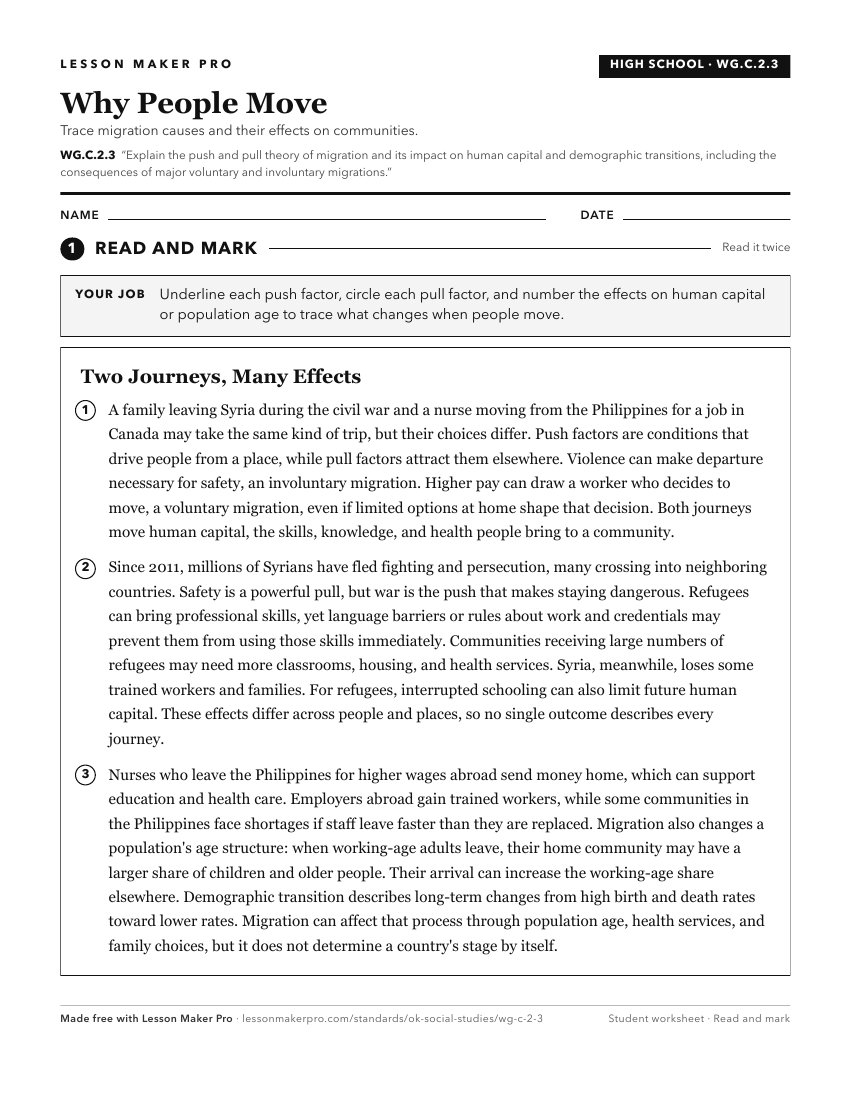
A ready-to-print activity worksheet aligned to WG.C.2.3, with an answer key for the teacher on its own page. No account needed.
PDF, US Letter, prints cleanly in black and white.
Download the worksheetKeep exploring
Related Standards
- 7.C.3.5.A
Examine the role of pull factors (e.g., economic opportunity, education, family) and the role of push factors (e.g., political unrest, religious persecution, wa...
- 6.C.3.4.B
Identify and provide examples of pull factors of migration (e.g., economic opportunity, religious freedom, family ties, education).
- 4.C.2.3.C
Examine motives for human migration by identifying basic push and pull factors (e.g., pull factors: economic opportunity, religious freedom, education; push fac...
- 6.C.3.4.A
Define push factors of migration (e.g., instability, conflict, natural disasters) using historic or contemporary examples (e.g., European colonization, politica...
Turn this exact standard into a lesson
Grade, subject, topic, and the complete standard are prefilled. Create one free, no account needed.
Also for this standard:Make a WorksheetMake a QuizMake a Sub Lesson