Oklahoma Social Studies 7.C.3.5.A
The Standard
- 7.C.3
- Identify the distribution and demographic patterns of human populations of the Eastern Hemisphere.
- 7.C.3.5
- Describe the reasons for emigration and immigration.
Examine the role of pull factors (e.g., economic opportunity, education, family) and the role of push factors (e.g., political unrest, religious persecution, war, famine, natural disasters) which motivate both emigration and immigration, differentiating between involuntary and voluntary migration.
Oklahoma Academic Standards for Social Studies (2026) · 7.C.3.5
Teacher's field guide
What This Standard Means
What Students Need to Do
- Students explain why people leave one place and choose another. They identify reasons to leave and reasons to arrive, then distinguish leaving a country from entering one and chosen moves from forced moves.
What Mastery Looks Like
- Given a migration story, a student points to a push factor and a pull factor in the details. They describe the move as emigration from one country and immigration to another, then explain whether the person had a safe choice to stay.
Common Misconceptions
- Students may call every reason for moving a pull factor, even when war or crop failure drove people away. They may think emigration and immigration are different trips, or assume that moving for work always means someone had a free choice.
How to Assess It
- Exit ticket: A family leaves Country A after armed attacks and joins relatives in Country B, where jobs are available. Name one push factor and two pull factors, identify where they emigrated and immigrated, and explain whether leaving was voluntary.
Lesson moves
Ways to Teach It
Give pairs two blank country maps and four migration story cards; have them draw routes and mark each cause as push or pull.
Ask students to write why a family fleeing armed attacks might have less choice than a family moving for a new job.
Play four corners: read a short migration statement, then have students choose push, pull, emigration, or immigration and explain their choice.
On a Dust Bowl migration map, trace a move from Oklahoma to California and label dust storms and farm jobs along the route.
Free download
Printable 7.C.3.5.A Worksheet
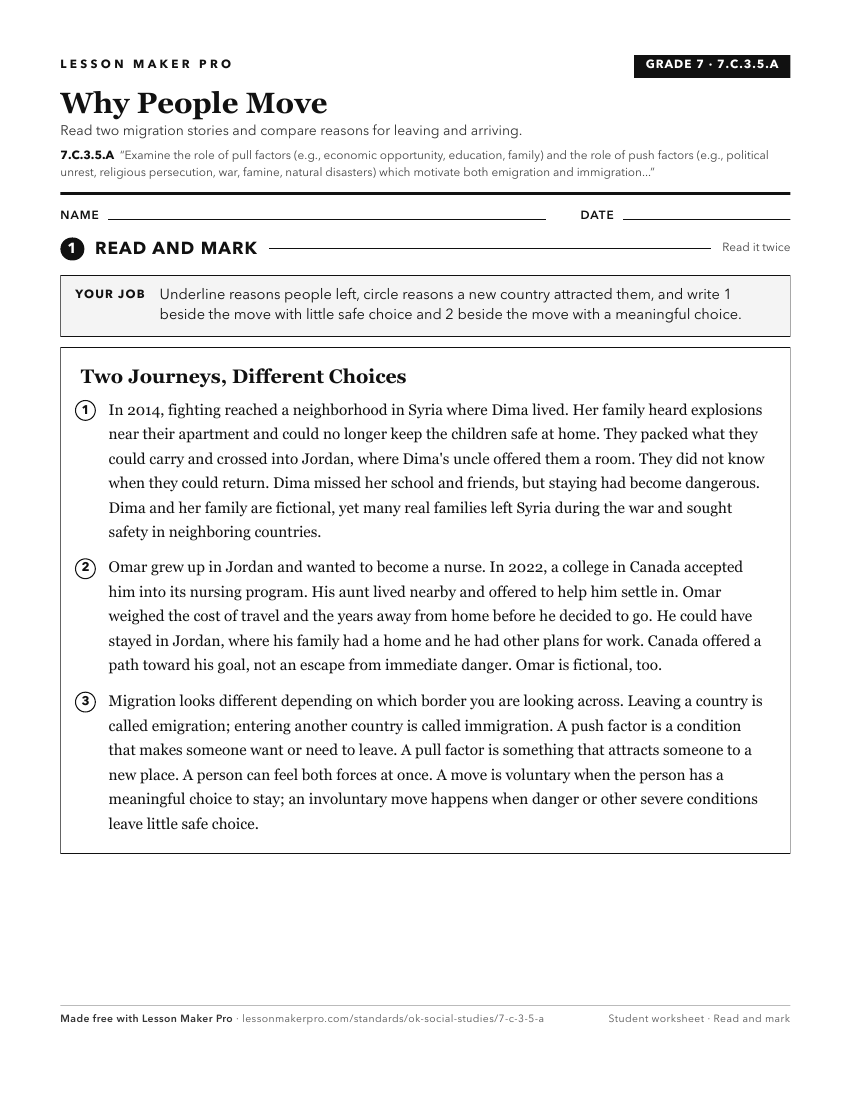
A ready-to-print activity worksheet aligned to 7.C.3.5.A, with an answer key for the teacher on its own page. No account needed.
PDF, US Letter, prints cleanly in black and white.
Download the worksheetKeep exploring
Related Standards
- 6.C.3.4.B
Identify and provide examples of pull factors of migration (e.g., economic opportunity, religious freedom, family ties, education).
- 4.C.2.3.C
Examine motives for human migration by identifying basic push and pull factors (e.g., pull factors: economic opportunity, religious freedom, education; push fac...
- 6.C.3.4.A
Define push factors of migration (e.g., instability, conflict, natural disasters) using historic or contemporary examples (e.g., European colonization, politica...
- WG.C.2.3
Explain the push and pull theory of migration and its impact on human capital and demographic transitions, including the consequences of major voluntary and inv...
Turn this exact standard into a lesson
Grade, subject, topic, and the complete standard are prefilled. Create one free, no account needed.
Also for this standard:Make a WorksheetMake a QuizMake a Sub Lesson