Oklahoma Social Studies USG.C.7.2
Standard Cluster
- USG.C.7
- Analyze the processes and implementation of public policy in the United States of America.
Evaluate the role of the national government in formulating and carrying out foreign policy. Explain different philosophies nations pursue to protect their self-interests abroad, such as isolationism and internationalism. Explain why and how the United States of America pursues its national interest and to what extent the pursuit of national interest harmonizes with the pursuit of American ideals. Identify and explain powers that the Constitution of the United States of America gives to the President and Congress to conduct foreign affairs. Describe the tools used to carry out United States of America’s foreign policy, including diplomacy, economic aid, military aid, humanitarian aid, treaties, sanctions, and military intervention. Explain the government’s role regarding national defense, trade, and humanitarian efforts by examining contemporary commitments to international organizations and alliances.
Oklahoma Academic Standards for Social Studies (2026) · USG.C.7
Cluster contents
Standards in This Cluster
USG.C.7.2 is a cluster heading. These are the individual standards under it.
- USG.C.7.2.A
Explain different philosophies nations pursue to protect their self-interests abroad, such as isolationism and internationalism.
- USG.C.7.2.B
Explain why and how the United States of America pursues its national interest and to what extent the pursuit of national interest harmonizes with the pursuit o...
- USG.C.7.2.C
Identify and explain powers that the Constitution of the United States of America gives to the President and Congress to conduct foreign affairs.
- USG.C.7.2.D
Describe the tools used to carry out United States of America’s foreign policy, including diplomacy, economic aid, military aid, humanitarian aid, treaties, san...
- USG.C.7.2.E
Explain the government’s role regarding national defense, trade, and humanitarian efforts by examining contemporary commitments to international organizations a...
Teacher's field guide
What This Cluster Means
What Students Need to Do
- Students compare staying out of overseas conflicts with working through alliances and international groups. They explain why the United States uses diplomacy, aid, sanctions, treaties, or force, and what the president and Congress can do.
What Mastery Looks Like
- Given a foreign crisis, a student chooses a response and explains how it serves a security, trade, or humanitarian goal. They identify the powers involved and weigh a national interest against an American ideal.
Common Misconceptions
- Students may think the president can declare war or make a treaty without Senate approval. They may assume foreign aid is purely charitable, or that avoiding military conflict means ending trade and diplomacy.
How to Assess It
- An ally faces an attack, and civilians flee. Ask students to choose one U.S. response, name a presidential and a congressional power involved, and explain one interest and one ideal it serves.
Lesson moves
Ways to Teach It
Give groups a fictional border crisis, policy tool cards, and president and Congress cards; have them build a response and label who acts.
Ask: Should the U.S. help an ally respond to a blockade or stay out? Require one security interest and one ideal.
Run a power-sort relay with cards for negotiating treaties, approving treaties, declaring war, and regulating foreign trade.
Print a NATO defense statement and a UN humanitarian appeal; pairs identify a U.S. security interest and a humanitarian goal.
Free download
Printable USG.C.7.2 Worksheet
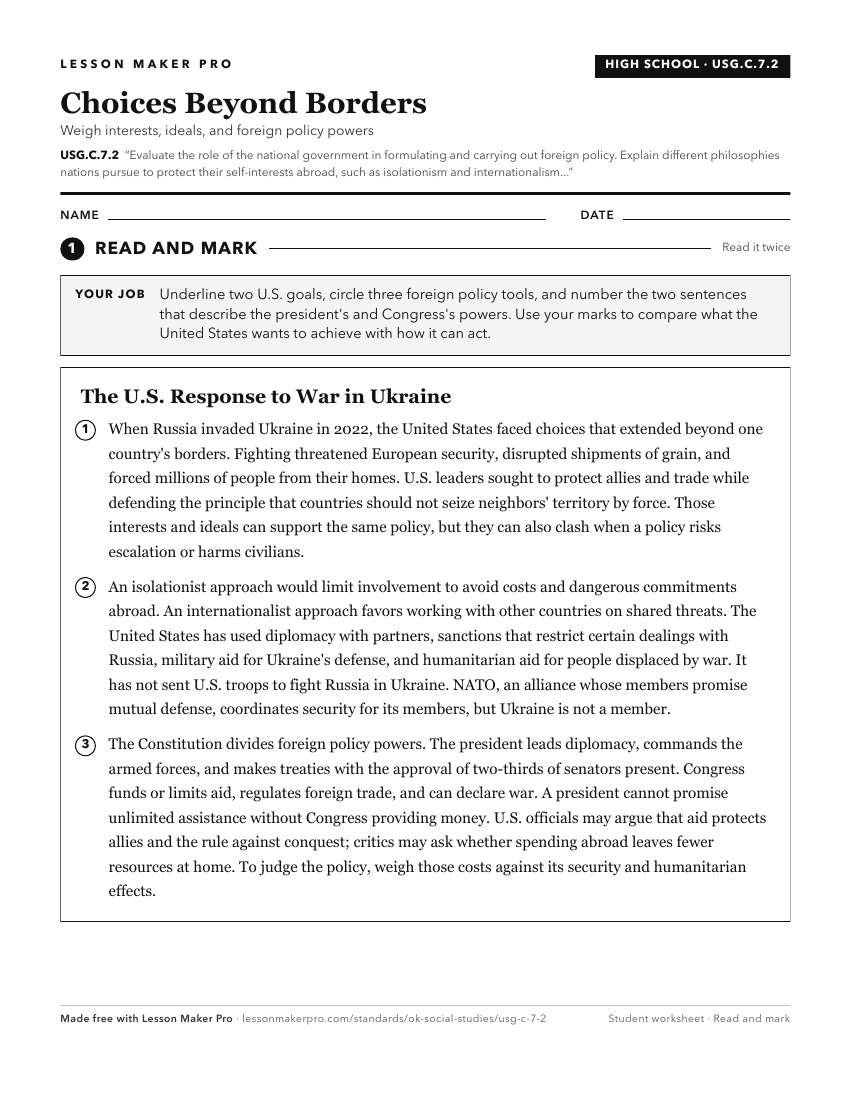
A ready-to-print activity worksheet aligned to USG.C.7.2, with an answer key for the teacher on its own page. No account needed.
PDF, US Letter, prints cleanly in black and white.
Download the worksheetKeep exploring
Related Standards
- USG.C.1.5
Examine the role of government in a nation’s economy.
- 7.C.7.6
Analyze the role of government to finance a nation’s development (e.g., infrastructure, social programs, and education).
- E.C.3.5
Evaluate the role of the government within the economy as it relates to defining, establishing, and enforcing property rights.
Turn this cluster into a lesson
Grade, subject, topic, and the complete cluster are prefilled. Create one free, no account needed.
Also for this cluster:Make a WorksheetMake a QuizMake a Sub Lesson