Oklahoma Social Studies USG.C.6
Standard Cluster
Explain how the Constitution of the United States of America preserves the equal protection of rights and liberties. Evaluate the importance of the rule of law as the principle that all citizens and institutions are to be held accountable to the same laws and consequences. Explain how the Constitution of the United States of America provides majority rule with equal protection for the rights of individuals of the minority. Examine the traditions and historical documents which have contributed to the American concepts of rights and liberties (e.g., English Bill of Rights, Virginia Declaration of Rights, Virginia Statute for Religious Freedom). Analyze the civil rights and civil liberties affirmed and guaranteed by the Bill of Rights. Explain how individual liberties are essential to the functioning of the United States of America constitutional republic society. Examine how liberty and private property have contributed to economic opportunity and prosperity in the United States of America. Identify basic rights, liberties, and protections of due process protected by the Bill of Rights and subsequent constitutional amendments. Explain how the Bill of Rights protects individuals from abuse by the national government and explain the extent that protections have been applied to the states through the “doctrine of selective incorporation” established by the 14th Amendment. Describe the concept of American exceptionalism and examine arguments that the United States of America has played a distinctive role in promoting political liberty, economic development, and innovation. Explain how freedom of expression is an essential element of a constitutional republic by examining historic landmark Supreme Court decisions which have addressed and clarified individual rights under the First Amendment (e.g., Gitlow v. New York, Brandenburg v. Ohio, New York Times v. United States, and Texas v. Johnson). Analyze how the First Amendment protects religious freedom through both the Free Exercise Clause and the Establishment Clause by examining landmark Supreme Court decisions including free exercise cases (e.g., West Virginia v. Barnette, Wisconsin v. Yoder), Establishment Clause cases (e.g., Engel v. Vitale, Lee v. Weisman), and cases addressing the tension between these clauses (e.g., Kennedy v. Bremerton School District). Explain why due process rights are essential for the protection of individual rights and the maintenance of limited government by examining landmark Supreme Court cases which have specified due process rights over time (e.g., Mapp v. Ohio, Gideon v. Wainwright, Miranda v. Arizona, and Furman v. Georgia). Describe how significant issues in American society have been addressed by examining landmark decisions (e.g., Regents of the University of California v. Bakke, McDonald v. City of Chicago, and Dobbs v. Jackson Women's Health).
Oklahoma Academic Standards for Social Studies (2026)
Cluster contents
Standards in This Cluster
USG.C.6 is a cluster heading. These are the individual standards under it.
- USG.C.6.1
Evaluate the importance of the rule of law as the principle that all citizens and institutions are to be held accountable to the same laws and consequences.
- USG.C.6.2
Explain how the Constitution of the United States of America provides majority rule with equal protection for the rights of individuals of the minority.
- USG.C.6.3
Examine the traditions and historical documents which have contributed to the American concepts of rights and liberties (e.g., English Bill of Rights, Virginia ...
- USG.C.6.4
Analyze the civil rights and civil liberties affirmed and guaranteed by the Bill of Rights.
- USG.C.6.4.A
Explain how individual liberties are essential to the functioning of the United States of America constitutional republic society.
- USG.C.6.4.B
Examine how liberty and private property have contributed to economic opportunity and prosperity in the United States of America.
- USG.C.6.4.C
Identify basic rights, liberties, and protections of due process protected by the Bill of Rights and subsequent constitutional amendments.
- USG.C.6.4.D
Explain how the Bill of Rights protects individuals from abuse by the national government and explain the extent that protections have been applied to the state...
- USG.C.6.5
Describe the concept of American exceptionalism and examine arguments that the United States of America has played a distinctive role in promoting political lib...
- USG.C.6.6
Explain how freedom of expression is an essential element of a constitutional republic by examining historic landmark Supreme Court decisions which have address...
- USG.C.6.7
Analyze how the First Amendment protects religious freedom through both the Free Exercise Clause and the Establishment Clause by examining landmark Supreme Cour...
- USG.C.6.8
Explain why due process rights are essential for the protection of individual rights and the maintenance of limited government by examining landmark Supreme Cou...
- USG.C.6.9
Describe how significant issues in American society have been addressed by examining landmark decisions (e.g., Regents of the University of California v. Bakke,...
Teacher's field guide
What This Cluster Means
What Students Need to Do
- Students explain how the Constitution protects individual rights, even when a majority disagrees. They trace those protections from early documents through amendments and court decisions, including rulings that apply rights to states. They use evidence to weigh claims about property, economic opportunity, and America's role in liberty and innovation.
What Mastery Looks Like
- Students can explain why Engel barred school-led prayer and why Gideon required a lawyer for a defendant who could not afford one. They can show how these rulings limit state governments and why a majority vote cannot cancel individual rights.
Common Misconceptions
- Students may think the Bill of Rights restricted state governments from the start, or that every protection now applies to states. They may think a majority vote can override minority rights. They may also confuse a student's private prayer with prayer led by a public school.
How to Assess It
- Exit ticket: A public school leads a required prayer and suspends a student who refuses. Name two protections at issue, explain why a school vote cannot override them, and cite one relevant Supreme Court case.
Lesson moves
Ways to Teach It
Give pairs excerpts from the English Bill of Rights, Virginia Declaration of Rights, and Virginia Statute for Religious Freedom to match with amendments.
Ask students to write four sentences: Does America's record on free speech and innovation support claims of a distinctive role? Cite one example.
Play a case-match round with Gitlow, Engel, Gideon, Mapp, and McDonald cards: students pair each ruling with its amendment and state impact.
Give students a local food truck permit rule; ask how property rights, fair procedures, and equal rules affect a new owner's opportunity.
Free download
Printable USG.C.6 Worksheet
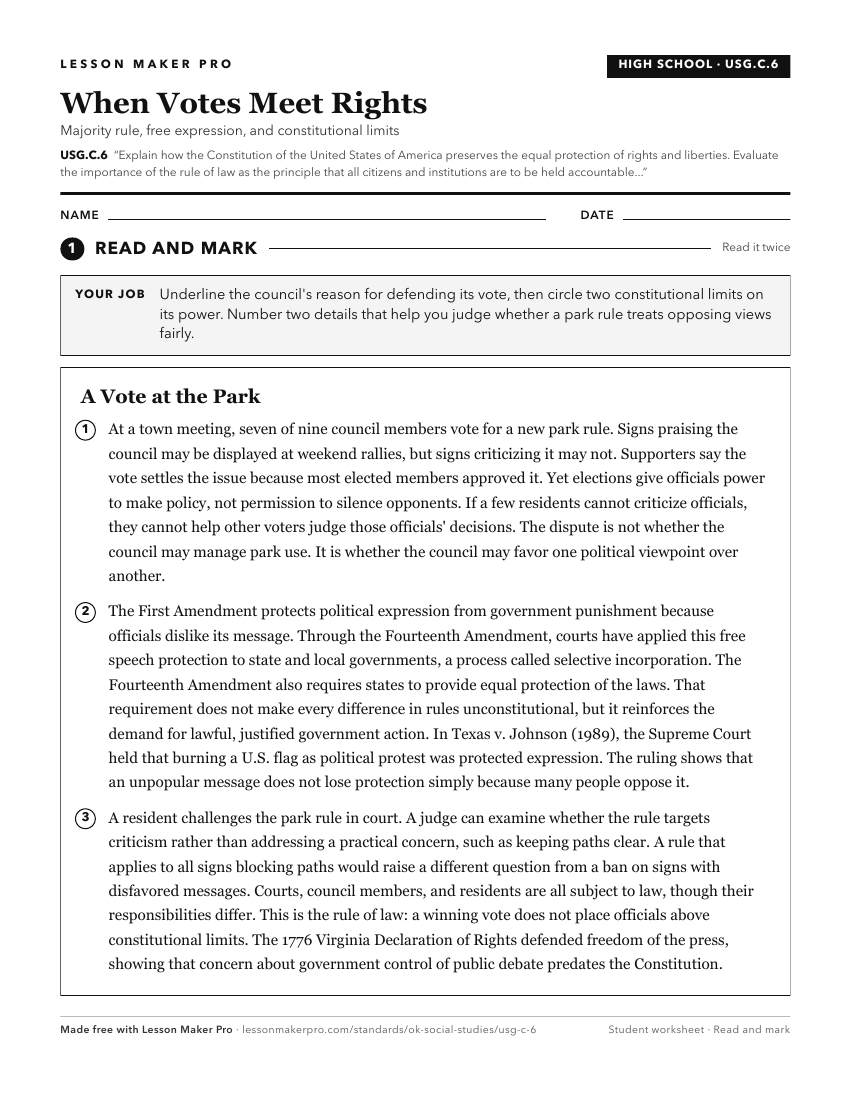
A ready-to-print activity worksheet aligned to USG.C.6, with an answer key for the teacher on its own page. No account needed.
PDF, US Letter, prints cleanly in black and white.
Download the worksheetKeep exploring
Related Standards
- USG.C.3.1.B
Analyze how the Constitution of the United States of America safeguards against authoritarianism by establishing enumerated powers, organizing government, and d...
- 8.C.4.5.E
Describe how the Bill of Rights and the United States of America’s judicial system uphold the rule of law guaranteeing fair and equal application of the law and...
- USG.C.1.3.C
Explain how the Constitution of the United States of America reflects a balance between a concern for the public good and a concern for the protection of indivi...
Turn this cluster into a lesson
Grade, subject, topic, and the complete cluster are prefilled. Create one free, no account needed.
Also for this cluster:Make a WorksheetMake a QuizMake a Sub Lesson