Oklahoma Social Studies TOT.C.9.3
Standard Cluster
Trace the rise of Communist influence in other regions of the world including, Communist leadership (e.g., Che Guevara, Fidel Castro, Mao Zedong, and Kim Il Sung), establishment of the North Korean dictatorship, Cuban Missile Crisis, Chinese Revolution (e.g., one-party dictatorship, collectivization, laogai prisons, Hundred Flowers Campaign, and Anti-Rightist Campaign), China’s genocidal conquest of Tibet, Great Leap Forward, and Cultural Revolution, Deng Xiaoping’s political and economic reforms.
Oklahoma Academic Standards for Social Studies (2026)
Cluster contents
Standards in This Cluster
TOT.C.9.3 is a cluster heading. These are the individual standards under it.
- TOT.C.9.3.A
Communist leadership (e.g., Che Guevara, Fidel Castro, Mao Zedong, and Kim Il Sung)
- TOT.C.9.3.B
establishment of the North Korean dictatorship
- TOT.C.9.3.C
Cuban Missile Crisis
- TOT.C.9.3.D
Chinese Revolution (e.g., one-party dictatorship, collectivization, laogai prisons, Hundred Flowers Campaign, and Anti-Rightist Campaign).
- TOT.C.9.3.E
China’s genocidal conquest of Tibet, Great Leap Forward, and Cultural Revolution
- TOT.C.9.3.F
Deng Xiaoping’s political and economic reforms.
Teacher's field guide
What This Cluster Means
What Students Need to Do
- Students trace how Mao, Castro, Guevara, and Kim Il Sung spread communist influence in China, Cuba, and North Korea. They connect policies and crises to repression, famine, and Cold War danger. They explain how Deng changed China's economy without ending one-party rule.
What Mastery Looks Like
- Students put China's revolution, conquest of Tibet, Great Leap Forward, Cultural Revolution, and Deng's reforms in order and describe their effects. They explain how the Hundred Flowers Campaign was followed by Anti-Rightist arrests and imprisonment in laogai camps. They link Kim's dictatorship to repression and Castro's Soviet alliance to the Cuban Missile Crisis.
Common Misconceptions
- Students may think the Cuban Missile Crisis caused Castro's revolution. Some assume Deng's market reforms ended one-party rule. Others think Mao's invitation to criticize leaders protected critics, missing the Anti-Rightist arrests.
How to Assess It
- Exit ticket: Put North Korea's founding, China's revolution, China's conquest of Tibet, the Cuban Missile Crisis, and Deng's reforms in order. Name one leader and one consequence for two events.
Lesson moves
Ways to Teach It
Give pairs cards naming North Korea's founding, China's revolution, China's conquest of Tibet, Cuba's revolution, the missile crisis, and Deng's reforms; order them.
Have students write three sentences explaining how Mao's call for criticism in the Hundred Flowers Campaign was followed by Anti-Rightist arrests.
Match Mao with the Great Leap Forward, Kim with North Korea's dictatorship, Castro with the missile crisis, Guevara with Cuba's revolution, Deng with market reforms.
Show 1970s commune and 1980s market photos with captions on party rule; have students list two economic changes and one political continuity.
Free download
Printable TOT.C.9.3 Worksheet
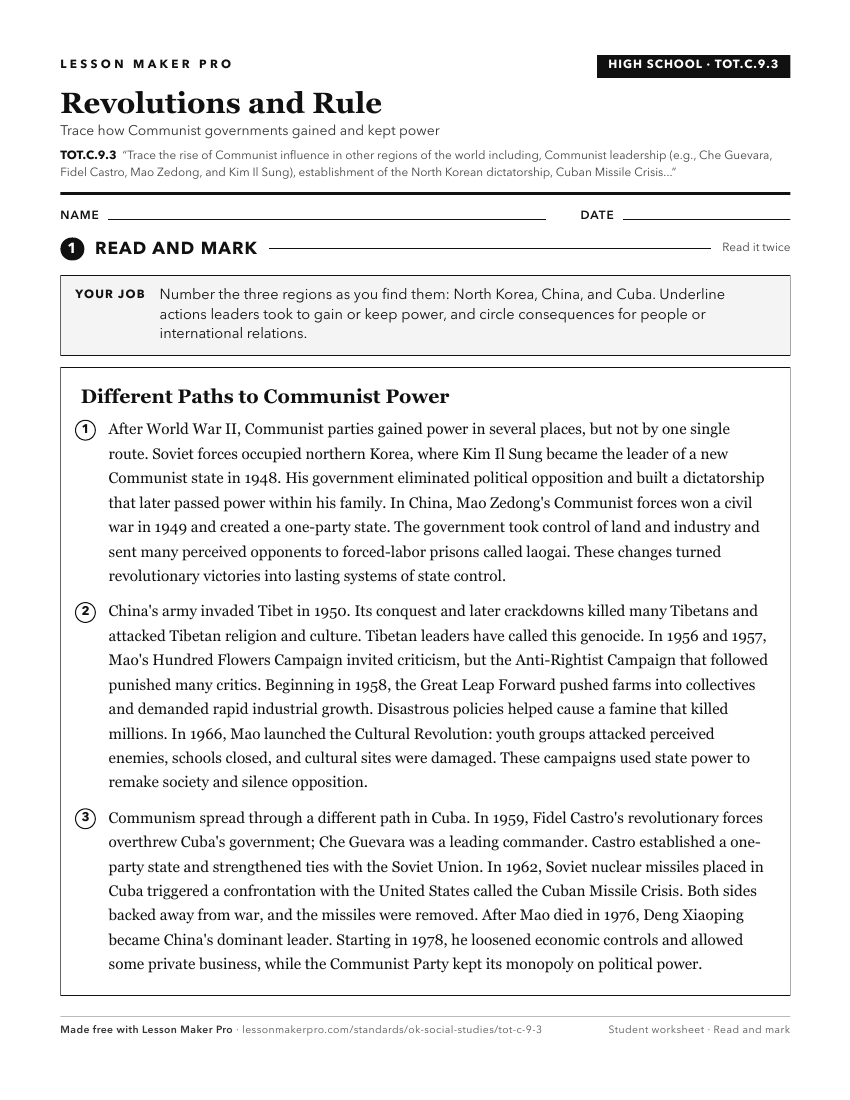
A ready-to-print activity worksheet aligned to TOT.C.9.3, with an answer key for the teacher on its own page. No account needed.
PDF, US Letter, prints cleanly in black and white.
Download the worksheetKeep exploring
Related Standards
- TOT.C.9.5
Examine the development of communism in the United States of America, including Soviet coordination of Western communist party tactics, communist “front” moveme...
- TOT.C.2.1
Identify political responses to Communist and socialist political parties in Europe, including
- TOT.C.9.4
Describe the rise of communism in Vietnam (e.g., successful communist revolt against French colonial rule, Land Reform Terror, Soviet and Chinese support for th...
- TOT.C.9.1
Examine the USSR’s occupation of Eastern Europe after World War II, including Soviet Communization of Eastern Europe, the coup d’etat in Czechoslovakia, chronic...
Turn this cluster into a lesson
Grade, subject, topic, and the complete cluster are prefilled. Create one free, no account needed.
Also for this cluster:Make a WorksheetMake a QuizMake a Sub Lesson