Oklahoma Social Studies TOT.C.10.2
Standard Cluster
Trace the rise of China to peer competitor with the United States of America including. retirement of Deng Xiaoping following the Tiananmen Square massacre, rise of Jiang Zemin and the introduction of the concept of a Socialist Market Economy, rapid growth of the economy, government debt, dependence on exports, Belt and Road Initiative, continuing internal repression (e.g., Christians, Falun Gong, Hong Kong, Tibet, Xinjiang), social credit system to monitor the population, denial of access to schools, travel, banks, and other state institutions, exploitation of Western investment in China and scientific, academic, and industrial espionage.
Oklahoma Academic Standards for Social Studies (2026)
Cluster contents
Standards in This Cluster
TOT.C.10.2 is a cluster heading. These are the individual standards under it.
- TOT.C.10.2.A
retirement of Deng Xiaoping following the Tiananmen Square massacre
- TOT.C.10.2.B
rise of Jiang Zemin and the introduction of the concept of a Socialist Market Economy
- TOT.C.10.2.C
rapid growth of the economy, government debt, dependence on exports, Belt and Road Initiative
- TOT.C.10.2.D
continuing internal repression (e.g., Christians, Falun Gong, Hong Kong, Tibet, Xinjiang)
- TOT.C.10.2.E
social credit system to monitor the population, denial of access to schools, travel, banks, and other state institutions
- TOT.C.10.2.F
exploitation of Western investment in China and scientific, academic, and industrial espionage.
Teacher's field guide
What This Cluster Means
What Students Need to Do
- Students put the Tiananmen crackdown, Deng Xiaoping's retirement, Jiang Zemin's rise, and the 1992 market reforms in order. They explain how exports, Western investment, and Belt and Road projects expanded China's reach, while debt and export dependence created risks. They examine repression, surveillance, and documented cases of scientific and industrial espionage.
What Mastery Looks Like
- Students link market reforms to export growth and explain one risk of relying on exports. They use sources to describe restrictions affecting people in Hong Kong, Tibet, or Xinjiang. They know that travel restrictions exist, but reject the claim that every person has one national social credit score.
Common Misconceptions
- Students may think Deng lost all influence as soon as he retired, though he remained influential. Some assume economic growth ended political repression. Others mistake China's social credit programs for one nationwide score assigned to every person.
How to Assess It
- Exit ticket: Put the 1989 crackdown, the 1992 market reforms, and the 2013 Belt and Road launch in order. Name one growth driver, one economic risk, and one example of state repression.
Lesson moves
Ways to Teach It
Give pairs six dated cards, including Tiananmen, Deng's retirement, Jiang's rise, market reforms, WTO entry, and Belt and Road, to order.
Read a foreign factory investment excerpt and a DOJ espionage case summary. Write two sentences explaining the difference between investment and theft.
Give teams a source sheet and claim cards about Hong Kong, Xinjiang, travel bans, and social credit; sort claims by evidence.
Check the country-of-origin labels on three classroom devices, then compare the findings with a chart of U.S. imports from China.
Free download
Printable TOT.C.10.2 Worksheet
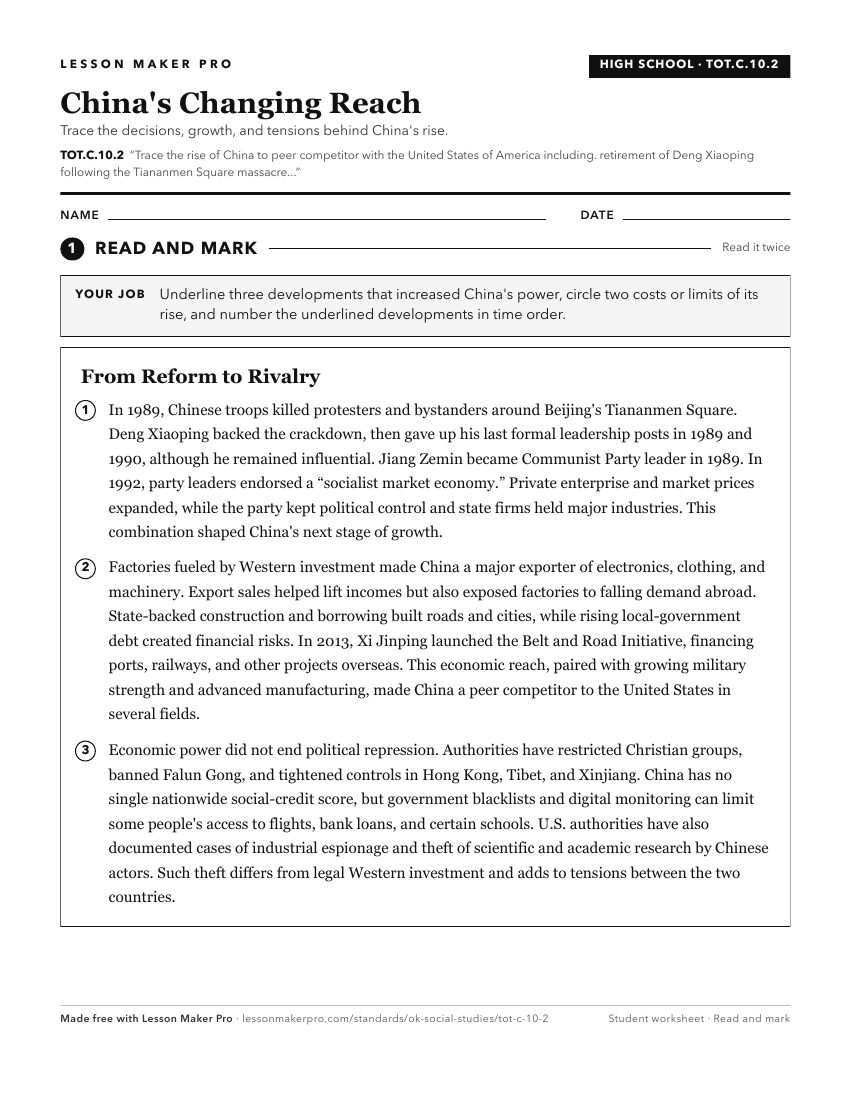
A ready-to-print activity worksheet aligned to TOT.C.10.2, with an answer key for the teacher on its own page. No account needed.
PDF, US Letter, prints cleanly in black and white.
Download the worksheetKeep exploring
Related Standards
- TOT.C.9.3
Trace the rise of communist influence in other regions of the world, including
- USH.C.3.1.A
Explain the rise of the United States of America as a world power amidst debates over the United States of America’s role in world affairs and overseas expansio...
- MWH.C.7.4.B
Describe significant political and economic change in China, including the influence of Sun Yat-Sen and the 1911 Revolution, and examine the consequences of the...
- MWH.C.7.4.D
Explain the significance of pro-democracy movements such as Tiananmen Square and evaluate how economic reforms under Deng Xiaoping contributed to China’s modern...
Turn this cluster into a lesson
Grade, subject, topic, and the complete cluster are prefilled. Create one free, no account needed.
Also for this cluster:Make a WorksheetMake a QuizMake a Sub Lesson