Oklahoma Social Studies TOT.C.1.6
Standard Cluster
Examine the criticisms of the ideas of Karl Marx and Friedrich Engels. Explain how violent revolution tends to undermine the rule of law and may empower those more capable of oppression. Describe how state ownership of means of production, including centralized economic planning, leads to an authoritarian state which restricts individual freedoms.
Oklahoma Academic Standards for Social Studies (2026)
Cluster contents
Standards in This Cluster
TOT.C.1.6 is a cluster heading. These are the individual standards under it.
- TOT.C.1.6.A
Explain how violent revolution tends to undermine the rule of law and may empower those more capable of oppression.
- TOT.C.1.6.B
Describe how state ownership of means of production, including centralized economic planning, leads to an authoritarian state which restricts individual freedom...
Teacher's field guide
What This Cluster Means
What Students Need to Do
- Students explain criticisms of Marx and Engels. They show how violent revolution can weaken courts and help new leaders silence opponents. They explain how state ownership and central planning can give officials control over jobs and other choices.
What Mastery Looks Like
- A student can separate Marx and Engels's goal of ending class exploitation from criticisms of their proposed approach. Using a Soviet example, they can explain how closing courts removed a check on leaders or how state control of jobs limited freedom.
Common Misconceptions
- Students may think Marx and Engels ran the Soviet Union. Some assume a revolution creates fair laws because its leaders promise equality. Others treat any public ownership as dictatorship, without asking who controls decisions and whether people can challenge them.
How to Assess It
- Exit ticket: After a revolution, leaders close independent courts and take over factories, setting production targets and assigning jobs. Name one freedom each decision could threaten and explain how.
Lesson moves
Ways to Teach It
Give groups cards marked armed takeover, closed courts, factory nationalization, state job assignments, and jailed critics; have them build two cause-and-effect chains.
Ask students to write: How might a revolution promising equality give a new leader more power than the rulers it replaced?
In pairs, match policy cards, state job assignments, closed courts, newspaper bans, to freedom cards, work choice, legal appeal, free speech.
Print three local job ads; ask how workers' options change if one government office controls hiring for all three jobs.
Free download
Printable TOT.C.1.6 Worksheet
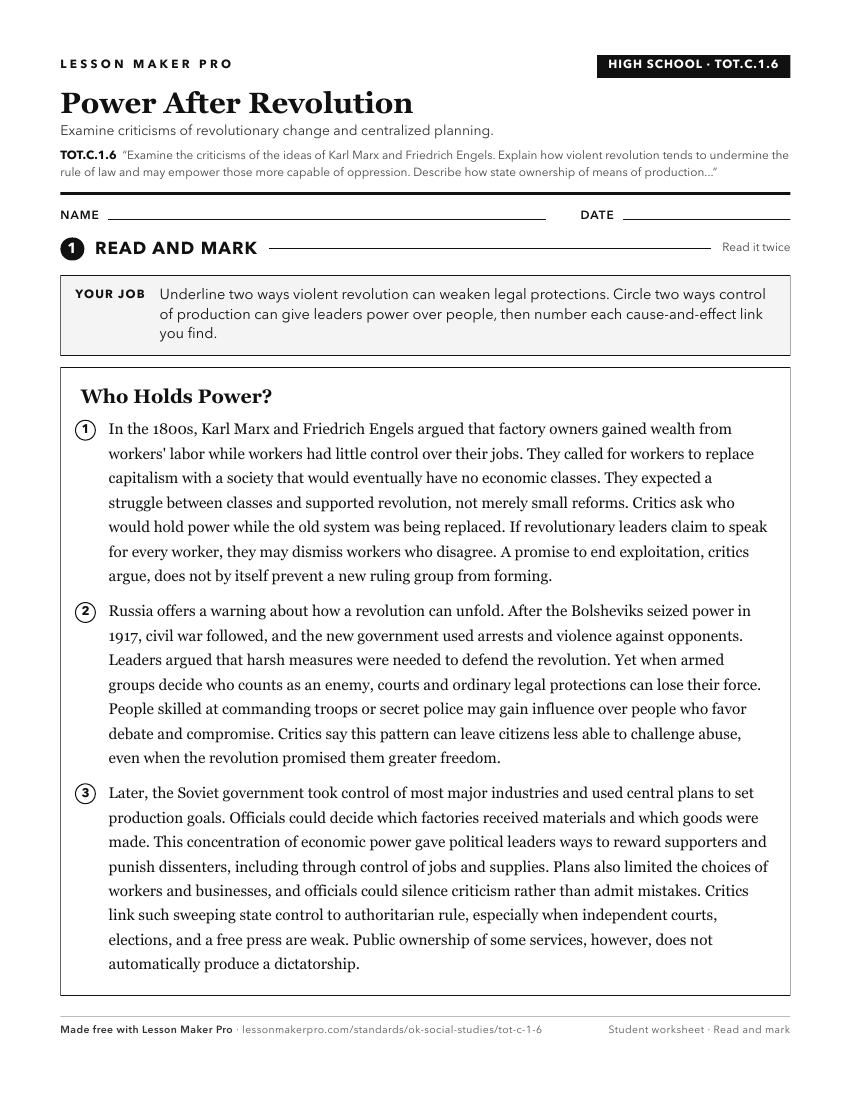
A ready-to-print activity worksheet aligned to TOT.C.1.6, with an answer key for the teacher on its own page. No account needed.
PDF, US Letter, prints cleanly in black and white.
Download the worksheetKeep exploring
Related Standards
- TOT.C.9.6
Examine how Marxism evolved after the West’s intellectual disillusionment with Soviet Communism and evaluate the role of Soviet dissidents, such as Boris Paster...
- MWH.C.5.2.D
Describe the rise of socialism, including the ideas and influence of Robert Owen and Karl Marx, as well as the major ideas of Marx and Engels’ The Communist Man...
- TOT.C.1.2
Explain the socio-economic ideas of Marx and Engels as outlined in their treatise The Communist Manifesto, including the claim known as “dialectical materialism...
- TOT.C.1.3
Examine the claim that private enterprise is exploitative and inequality the fault of capitalism.
Turn this cluster into a lesson
Grade, subject, topic, and the complete cluster are prefilled. Create one free, no account needed.
Also for this cluster:Make a WorksheetMake a QuizMake a Sub Lesson