Oklahoma Social Studies PS.2.4
The Standard
- PS.2
- Investigate the structure, biochemistry, and circuitry of the brain and the nervous system to understand their roles in affecting behavior.
Explain the processes of sensation, including the structures and functions of visual, auditory, kinesthetic/vestibular, and chemical sensory systems.
Oklahoma Academic Standards for Social Studies (2026) · PS.2
Teacher's field guide
What This Standard Means
What Students Need to Do
- Students explain how light, sound, body movement, taste, and smell become nerve signals. They identify the parts that detect each one, including cells in the retina, cochlea, muscles, joints, tongue, and nose.
What Mastery Looks Like
- Given a bell, a spinning chair, a bent arm, and a lemon, students can name the receptors involved and explain what information they send to the brain. They can distinguish body position from balance, and taste from smell.
Common Misconceptions
- Students may think the eyes and ears interpret what they detect, rather than sending signals to the brain. They may confuse joint position with inner ear balance or think taste buds detect food odors.
How to Assess It
- On an exit ticket, list light, a bell, a bent elbow, a spinning chair, lemon juice, and lemon scent. Ask students to name the receptor and its location for each, and state what it detects.
Lesson moves
Ways to Teach It
Have students stand on one foot, then close their eyes; record changes and label input from the eyes, inner ears, and joints.
Ask, “Why does food taste bland when your nose is blocked?” Have students explain using taste buds and smell receptors.
Give pairs cards labeled retina, cochlea, taste buds, smell receptors, joint receptors, and semicircular canals; match each to a stimulus.
Show a gymnast spinning, then ask students to explain dizziness using the semicircular canals and arm position using receptors in muscles and joints.
Free download
Printable PS.2.4 Worksheet
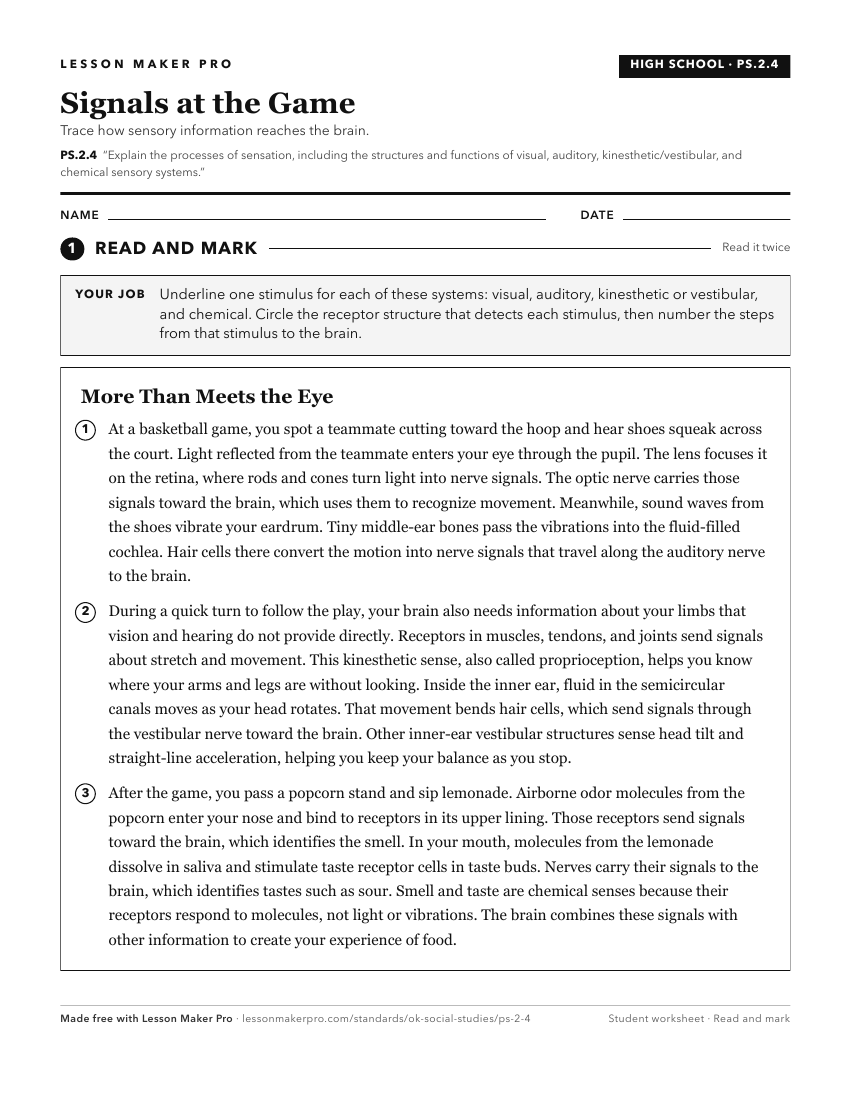
A ready-to-print activity worksheet aligned to PS.2.4, with an answer key for the teacher on its own page. No account needed.
PDF, US Letter, prints cleanly in black and white.
Download the worksheetKeep exploring
Related Standards
- PS.2.2
Identify and describe the structure and function of major brain systems, including the major parts of the brainstem, limbic system and cerebral cortex.
- USG.C.1.4.A
Describe the structures of unitary, federal, and confederal systems, including contemporary examples of the presidential versus parliamentary systems.
- PS.2.1
Identify and describe the major divisions of the nervous system.
- PS.3.2
Describe principles of perception, including personal and environmental interactions.
Turn this exact standard into a lesson
Grade, subject, topic, and the complete standard are prefilled. Create one free, no account needed.
Also for this standard:Make a WorksheetMake a QuizMake a Sub Lesson