Oklahoma Social Studies OKH.P.3.2
Standard Cluster
- OKH.P.3
- Engage in critical, active reading of primary and secondary sources related to social studies concepts.
Apply critical reading and thinking skills to interpret, evaluate, and respond to a variety of complex texts and perspectives. Evaluate the extent to which historical or cultural perspectives affect an author’s stated or implied purpose. Evaluate the author’s point of view, potential bias, and how authors can reach different conclusions regarding the same issue. Actively listen, evaluate, and analyze a speaker’s message, asking questions while engaged in collaborative discussions about social studies topics and texts.
Oklahoma Academic Standards for Social Studies (2026) · OKH.P.3
Cluster contents
Standards in This Cluster
OKH.P.3.2 is a cluster heading. These are the individual standards under it.
- OKH.P.3.2.A
Evaluate the extent to which historical or cultural perspectives affect an author’s stated or implied purpose.
- OKH.P.3.2.B
Evaluate the author’s point of view, potential bias, and how authors can reach different conclusions regarding the same issue.
- OKH.P.3.2.C
Actively listen, evaluate, and analyze a speaker’s message, asking questions while engaged in collaborative discussions about social studies topics and texts.
Teacher's field guide
What This Cluster Means
What Students Need to Do
- Students read different accounts of the same Oklahoma event. They compare claims, evidence, and what each author leaves out. They explain how an author's role and historical setting may shape the account, then listen, ask questions, and respond to classmates.
What Mastery Looks Like
- A student can name each author's claim and purpose, cite a detail from each account, and explain why the authors may reach different conclusions. They ask a partner a follow-up question and use evidence when they respond.
Common Misconceptions
- Students may call an account false simply because its author has a stake in the issue. They may also miss the difference between a reporter writing in 1935 and a farmer recalling the event years later.
How to Assess It
- Give pairs a Black Sunday newspaper excerpt and a farmer interview excerpt. After two minutes of talk, ask each student to write both claims, quote one detail from each source, explain a difference, and note a question they asked.
Lesson moves
Ways to Teach It
Hand pairs printed Black Sunday news and farmer interview excerpts; use two colors to mark claims and clues about purpose.
After a partner explains the farmer interview, ask, 'Which detail supports your reading?' Restate their answer before sharing your view.
Play source match with four Dust Bowl quote cards and four author cards; teams defend each match with a clue from the quote.
Print a city road-closure notice and a news report on the closure; mark each writer's purpose and what each leaves out.
Free download
Printable OKH.P.3.2 Worksheet
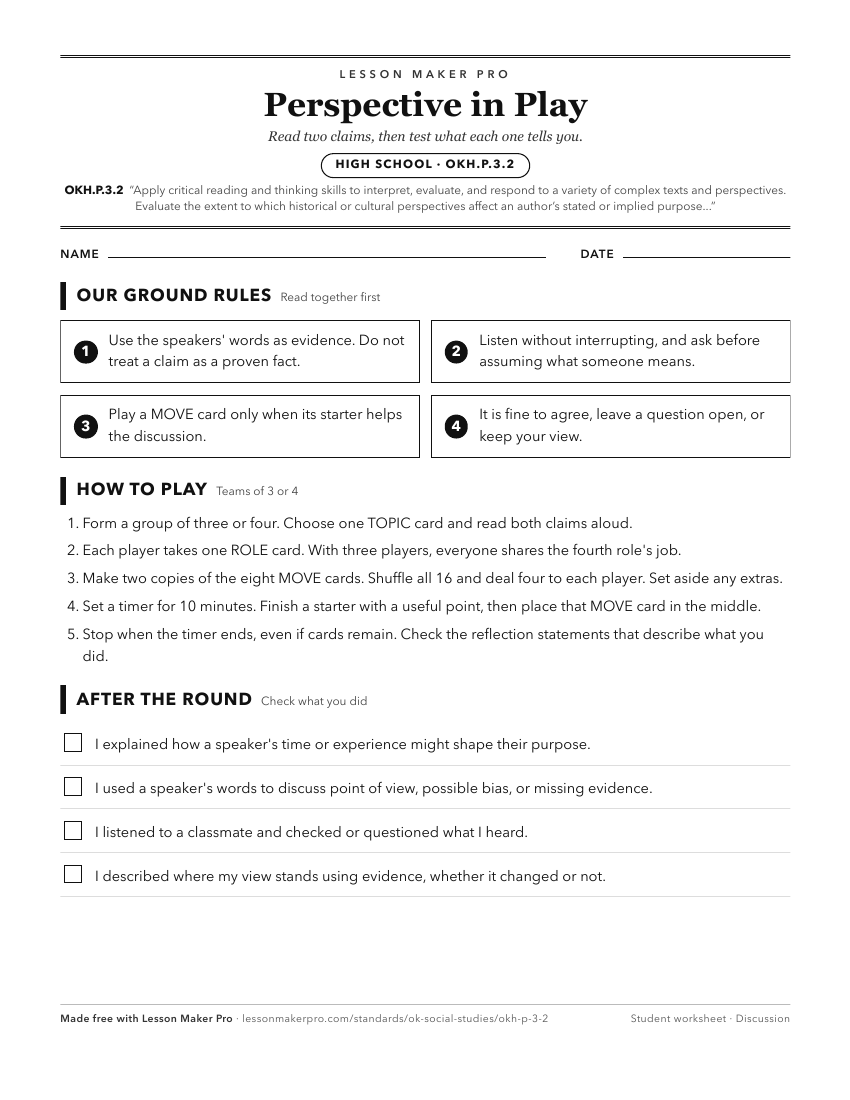
A ready-to-print activity worksheet aligned to OKH.P.3.2, with an answer key for the teacher on its own page. No account needed.
PDF, US Letter, prints cleanly in black and white.
Download the worksheetKeep exploring
Related Standards
- 6.P.3.2
Apply critical reading and thinking skills to interpret, evaluate, and respond to a variety of complex texts and perspectives.
- MWH.P.3.2
Apply critical reading and thinking skills to interpret, evaluate, and respond to a variety of complex texts and perspectives.
- E.P.3.2
Apply critical reading and thinking skills to interpret, evaluate, and respond to a variety of complex texts and perspectives.
- K.P.3.2
Apply critical reading and thinking skills to interpret, evaluate, and respond to a variety of complex texts and perspectives.
Turn this cluster into a lesson
Grade, subject, topic, and the complete cluster are prefilled. Create one free, no account needed.
Also for this cluster:Make a WorksheetMake a QuizMake a Sub Lesson