Oklahoma Social Studies E.C.4
Standard Cluster
Describe the role of economic institutions and government in a market economy. Evaluate the impact of the government's protection of private property rights and enforcement of the rule of law in a market economy. Describe the purpose, costs, and benefits of government funded services. Describe how financial institutions, such as banks and credit unions, allow people to pool their incomes and provide future income through investment in stocks. Explain how commercial banks expand and contract the money supply through lending, repayment of loans, and reserve requirements, and describe how central banking policies influence these processes.
Oklahoma Academic Standards for Social Studies (2026)
Cluster contents
Standards in This Cluster
E.C.4 is a cluster heading. These are the individual standards under it.
- E.C.4.1
Evaluate the impact of the government's protection of private property rights and enforcement of the rule of law in a market economy.
- E.C.4.2
Describe the purpose, costs, and benefits of government funded services.
- E.C.4.3
Describe how financial institutions, such as banks and credit unions, allow people to pool their incomes and provide future income through investment in stocks.
- E.C.4.4
Explain how commercial banks expand and contract the money supply through lending, repayment of loans, and reserve requirements, and describe how central bankin...
Teacher's field guide
What This Cluster Means
What Students Need to Do
- Students explain how property rights and enforced laws shape trade. They weigh the benefits of public services against their tax costs. They explain how banks and credit unions support lending, how stocks may provide income, and how banking rules affect the money supply.
What Mastery Looks Like
- Given a city bus proposal, students identify who pays, who benefits, and why enforceable contracts matter to investors. They distinguish pooled bank deposits from stock purchases, whose returns are not guaranteed. On a bank ledger, they show that a new loan adds deposit money and repayment removes it.
Common Misconceptions
- Students may think property rights protect only landowners or that public services are free when users pay no fee. They may confuse deposits with stocks and assume stock returns are guaranteed. They may think loan repayment adds money to circulation or that the central bank sets every loan rate.
How to Assess It
- Exit ticket: A bank makes a $100 loan, then receives $100 in repayment. State what happens to deposit money at each step, and predict how a higher central bank rate might affect lending.
Lesson moves
Ways to Teach It
Give pairs paper bank ledgers and loan slips; have them record a new loan, its repayment, and a higher reserve requirement.
Ask: Should the city pay for streetlights through taxes? Name two benefits, one cost, and how property laws affect nearby shops.
Have teams match bank, credit union, court, stock investor, and central bank cards to lending, contract enforcement, stock returns, and rate policy.
Show a local credit union rate sheet; students explain how a central bank rate increase might affect its borrowers.
Free download
Printable E.C.4 Worksheet
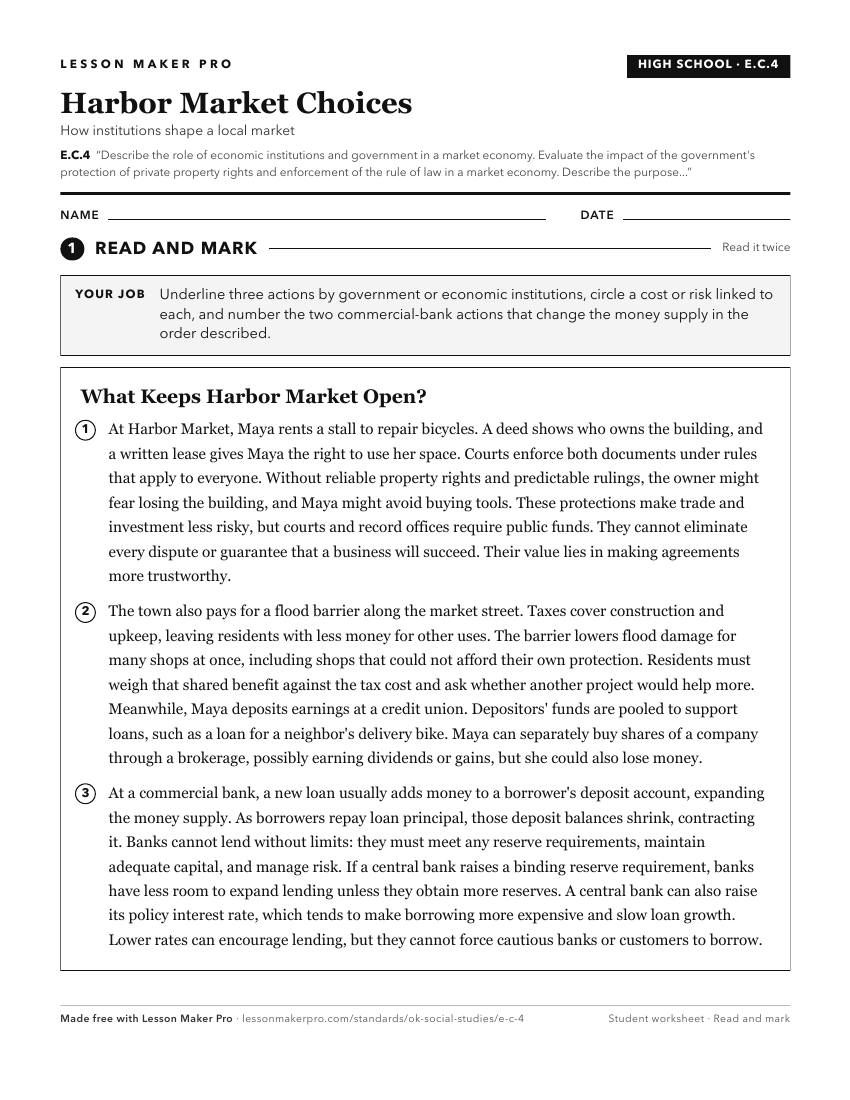
A ready-to-print activity worksheet aligned to E.C.4, with an answer key for the teacher on its own page. No account needed.
PDF, US Letter, prints cleanly in black and white.
Download the worksheetKeep exploring
Related Standards
- USG.C.1.5
Examine the role of government in a nation’s economy.
- 3.C.4.1
Describe the features of a market economic system.
- USG.C.1.5.A
Compare the role of government in a market versus command economic systems.
- E.C.3.5
Evaluate the role of the government within the economy as it relates to defining, establishing, and enforcing property rights.
Turn this cluster into a lesson
Grade, subject, topic, and the complete cluster are prefilled. Create one free, no account needed.
Also for this cluster:Make a WorksheetMake a QuizMake a Sub Lesson