Oklahoma Social Studies E.C.3
Standard Cluster
Explain how prices are set in a market economy and will determine how price provides incentives to buyers and sellers. Analyze how price and non-price factors affect the demand and supply of goods and services available in the marketplace. Explain what causes shortages and surpluses (e.g., government-imposed price floors, price ceilings, and other government regulations) and describe their impact on prices and people’s decisions to buy or sell. Explain ways that firms engage in competition and examine the role of firms in setting prices in a market economy, including administered price theory and the impact of marketing. Compare the basic characteristics of market structures, including monopoly, oligopoly, and competitive markets, and analyze how each influences pricing and output. Evaluate the role of the government within the economy as it relates to defining, establishing, and enforcing property rights. Explain how competition impacts market production and the allocation of goods and services to consumers. Explain how people’s own self-interest, incentives, and disincentives influence market decisions.
Oklahoma Academic Standards for Social Studies (2026)
Cluster contents
Standards in This Cluster
E.C.3 is a cluster heading. These are the individual standards under it.
- E.C.3.1
Analyze how price and non-price factors affect the demand and supply of goods and services available in the marketplace.
- E.C.3.2
Explain what causes shortages and surpluses (e.g., government-imposed price floors, price ceilings, and other government regulations) and describe their impact ...
- E.C.3.3
Explain ways that firms engage in competition and examine the role of firms in setting prices in a market economy, including administered price theory and the i...
- E.C.3.4
Compare the basic characteristics of market structures, including monopoly, oligopoly, and competitive markets, and analyze how each influences pricing and outp...
- E.C.3.5
Evaluate the role of the government within the economy as it relates to defining, establishing, and enforcing property rights.
- E.C.3.6
Explain how competition impacts market production and the allocation of goods and services to consumers.
- E.C.3.7
Explain how people’s own self-interest, incentives, and disincentives influence market decisions.
Teacher's field guide
What This Cluster Means
What Students Need to Do
- Students explain how prices guide buyers and sellers. They show how costs, tastes, and ads change supply or demand, and how price limits can cause shortages or surpluses. They compare how firms set prices in different markets and explain why property rights matter.
What Mastery Looks Like
- Given a change in costs or tastes, students predict what happens to price and quantity. They explain how a price ceiling or floor changes buyers' and sellers' choices. They compare pricing in a monopoly, an oligopoly, and a competitive market, including the limits on a firm's posted price.
Common Misconceptions
- Students often mistake a change in price for a shift in demand. They mix up price ceilings and floors, or assume every low price causes a shortage. Some think a monopoly can charge any price it wants, regardless of what buyers will pay.
How to Assess It
- Exit ticket: Concert tickets normally sell for $80, with every seat sold. A law caps tickets at $40. Predict a shortage or surplus, and name one buyer and one seller response.
Lesson moves
Ways to Teach It
Give five sellers snack cards and five buyers play money; trade twice, capping second-round prices below the first-round average.
Ask: If anyone could copy and sell your T-shirt design, would you spend time making one? Explain how ownership rules affect your choice.
Deal cards showing one water utility, three phone carriers, and 30 tomato growers; teams sort markets and predict pricing power and output.
Compare two grocery flyers for milk; mark each listed price and coupon, then explain how ads might change shopper choices.
Free download
Printable E.C.3 Worksheet
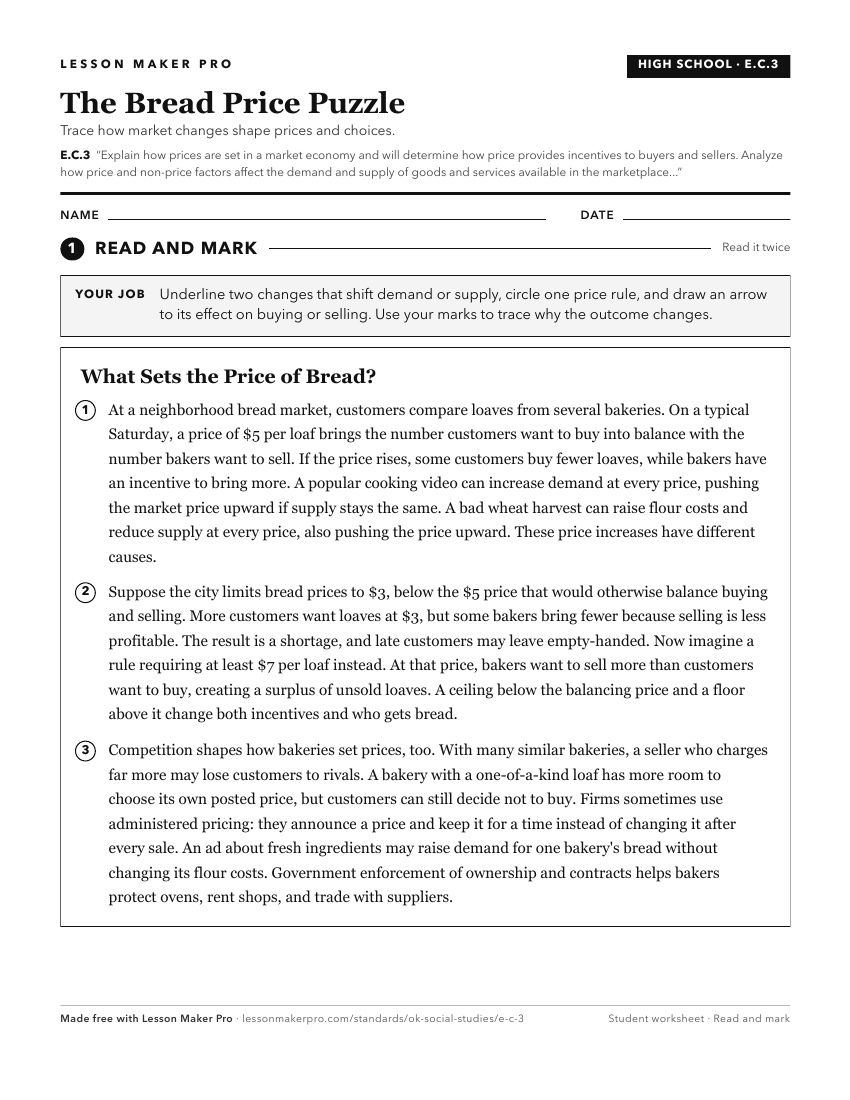
A ready-to-print activity worksheet aligned to E.C.3, with an answer key for the teacher on its own page. No account needed.
PDF, US Letter, prints cleanly in black and white.
Download the worksheetKeep exploring
Related Standards
Turn this cluster into a lesson
Grade, subject, topic, and the complete cluster are prefilled. Create one free, no account needed.
Also for this cluster:Make a WorksheetMake a QuizMake a Sub Lesson