Oklahoma Social Studies E.C.3.4
The Standard
- E.C.3
- Explain how prices are set in a market economy and will determine how price provides incentives to buyers and sellers.
Compare the basic characteristics of market structures, including monopoly, oligopoly, and competitive markets, and analyze how each influences pricing and output.
Oklahoma Academic Standards for Social Studies (2026) · E.C.3
Teacher's field guide
What This Standard Means
What Students Need to Do
- Students identify markets with one seller, a few sellers, or many sellers. They explain how the number of sellers affects price choices and the amount offered for sale.
What Mastery Looks Like
- A student can classify a market from a short scenario and explain the clues. They can predict that a sole seller often charges more and sells less than sellers facing strong competition. They can explain why a few sellers watch each other's prices.
Common Misconceptions
- Students may think a monopoly can charge any price without losing buyers. They may also assume that a market with three sellers works just like one with 30, or that a lower price always means less will be sold.
How to Assess It
- Exit ticket: Three same-sized towns have one, three, or 30 sellers of identical notebooks. Name each market and predict how price and output might differ, with a reason.
Lesson moves
Ways to Teach It
Give groups one, three, or ten paper notebook sellers, plus buyer cards with spending limits; run two sales rounds and record prices and quantities.
Ask students to write: Why might three notebook sellers watch each other's prices, while ten sellers have less room to raise theirs?
Use scenario cards showing seller counts and barriers to entry; teams sort them into market types and defend one price prediction.
Compare a local water provider, cell phone carriers, and farmers' market apple stalls; list sellers and discuss who can raise prices most easily.
Free download
Printable E.C.3.4 Worksheet
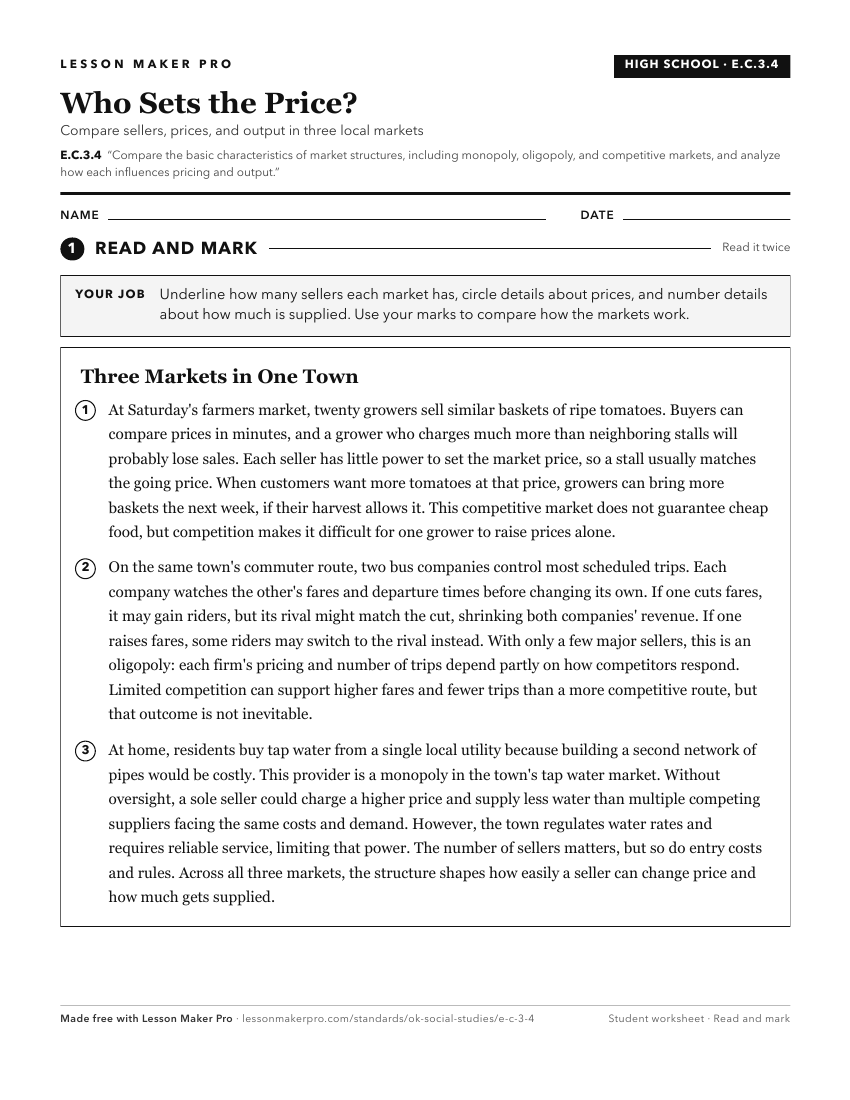
A ready-to-print activity worksheet aligned to E.C.3.4, with an answer key for the teacher on its own page. No account needed.
PDF, US Letter, prints cleanly in black and white.
Download the worksheetKeep exploring
Related Standards
- E.C.8.3
Explain that prices in a market economy act as signals of relative scarcity and help coordinate decisions of producers and consumers, and analyze how attempts t...
- E.C.3.3
Explain ways that firms engage in competition and examine the role of firms in setting prices in a market economy, including administered price theory and the i...
- E.C.2.1
Compare traditional, market (free enterprise), command, and mixed economic systems, and explain how each addresses the three basic economic questions of what to...
- 6.C.6.2.A
Define the characteristics of traditional, market, and command economic systems.
Turn this exact standard into a lesson
Grade, subject, topic, and the complete standard are prefilled. Create one free, no account needed.
Also for this standard:Make a WorksheetMake a QuizMake a Sub Lesson