Oklahoma Social Studies E.C.2
Standard Cluster
Evaluate how societies answer basic economic questions. Compare traditional, market (free enterprise), command, and mixed economic systems, and explain how each addresses the three basic economic questions of what to produce, how to produce, and for who to produce. Describe how comparative and absolute advantage influence specialization and trade in answering the three basic economic questions. Explain how clearly defined and enforced property rights and rule of law support the functioning of market economies. Explain the costs and benefits of government fiduciary policy and regulations including the impact both have on competition.
Oklahoma Academic Standards for Social Studies (2026)
Cluster contents
Standards in This Cluster
E.C.2 is a cluster heading. These are the individual standards under it.
- E.C.2.1
Compare traditional, market (free enterprise), command, and mixed economic systems, and explain how each addresses the three basic economic questions of what to...
- E.C.2.2
Describe how comparative and absolute advantage influence specialization and trade in answering the three basic economic questions.
- E.C.2.3
Explain how clearly defined and enforced property rights and rule of law support the functioning of market economies.
- E.C.2.4
Explain the costs and benefits of government fiduciary policy and regulations including the impact both have on competition.
Teacher's field guide
What This Cluster Means
What Students Need to Do
- Students compare how traditional, market, command, and mixed economies decide what to make, how to make it, and who gets it. They use output and opportunity cost to explain specialization and trade. They explain how property rights, enforced laws, public spending, and regulations affect businesses and competition.
What Mastery Looks Like
- Given a food shortage, a student can explain how each economic system would make and distribute food. With an output table, they can identify who makes more, who gives up less, and what each place should specialize in. They can explain why protected ownership encourages investment and name a cost and benefit of a government rule or spending choice.
Common Misconceptions
- Students may call any economy with taxes a command economy, rather than a mixed economy. They may assign every product to whoever makes the most, without checking opportunity cost. They may assume regulations always help or always hurt competition.
How to Assess It
- Exit ticket: Town A can make 12 loaves or 6 shirts a day. Town B can make 8 loaves or 8 shirts. Ask which town has absolute advantage in bread, which has comparative advantage in shirts, and why.
Lesson moves
Ways to Teach It
Give groups four economic system cards and food, tool, and clothing tokens; have them decide what to make and who gets each item.
Ask students to write: Would you open a bakery if someone could take your oven and contracts were not enforced? Why?
Run an output-table relay where pairs calculate opportunity costs, choose specialties, and trade paper crop cards.
Bring a local business permit fee schedule and city budget excerpt; students identify one benefit and one cost for new competitors.
Free download
Printable E.C.2 Worksheet
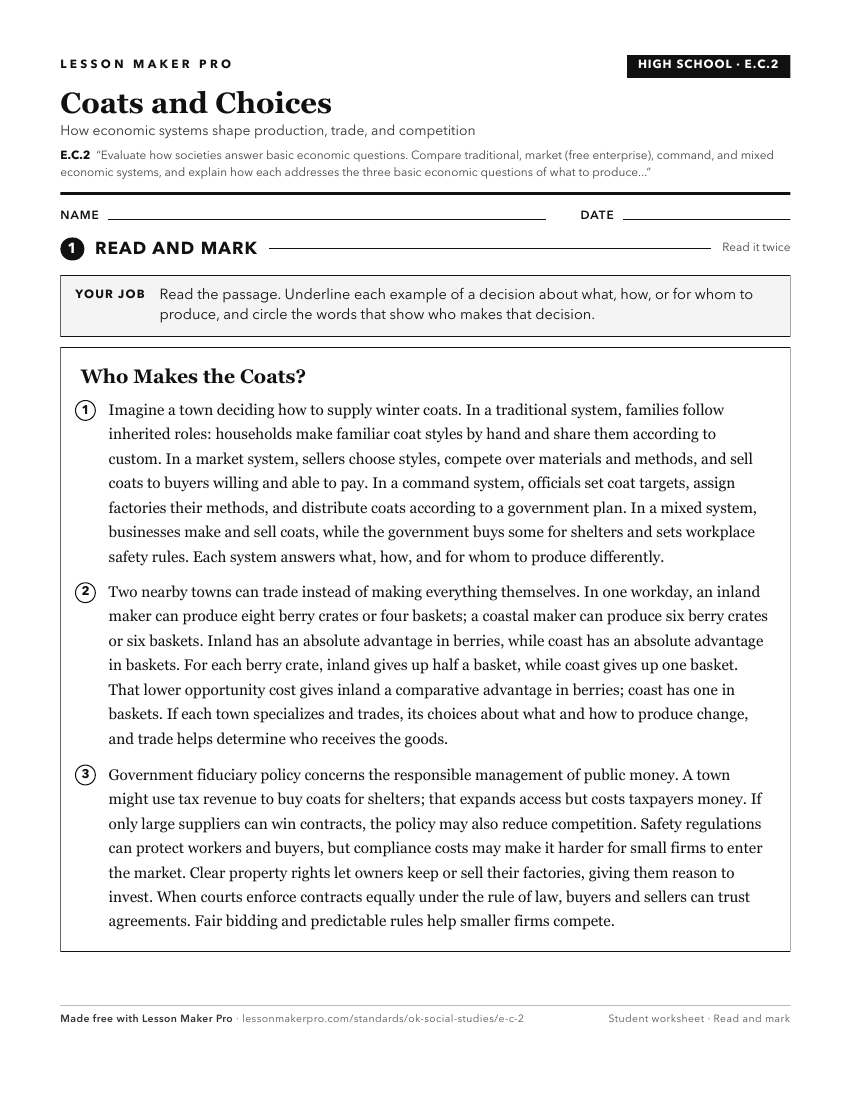
A ready-to-print activity worksheet aligned to E.C.2, with an answer key for the teacher on its own page. No account needed.
PDF, US Letter, prints cleanly in black and white.
Download the worksheetKeep exploring
Related Standards
- 6.C.6.1
Explain how people organize economic systems to address basic economic questions regarding which goods and services will be produced, how they will be distribut...
- 7.C.7
Examine and compare economic systems as means by which governments organize and distribute available resources, services, and goods.
- K.C.4
Identify basic economic concepts.
- 7.C.7.1
Explain how people organize economic systems to address basic economic questions regarding which goods and services will be produced, how they will be distribut...
Turn this cluster into a lesson
Grade, subject, topic, and the complete cluster are prefilled. Create one free, no account needed.
Also for this cluster:Make a WorksheetMake a QuizMake a Sub Lesson