Oklahoma Social Studies E.C.1
Standard Cluster
Develop and apply economic reasoning and decision-making skills. Define and explain basic economic concepts (e.g., scarcity, surplus, opportunity cost, cost/benefit analysis, risk/reward relationship, incentive, and trade-off) and apply them to a variety of economic situations. Determine appropriate courses of economic actions by applying principles such as scarcity, opportunity cost, incentives, productive resources, and voluntary exchange to real world situations. Explain how productive resources (natural, human, capital) are necessary to produce goods and services. Examine how producers and consumers respond to scarcity by making choices involving opportunity costs and tradeoffs. Describe how incentives influence behavior and how individual decisions are shaped by subjective preferences. Explain how voluntary exchange occurs when all parties expect to benefit and how trade contributes to mutual gain and overall well-being.
Oklahoma Academic Standards for Social Studies (2026)
Cluster contents
Standards in This Cluster
E.C.1 is a cluster heading. These are the individual standards under it.
- E.C.1.1
Define and explain basic economic concepts (e.g., scarcity, surplus, opportunity cost, cost/benefit analysis, risk/reward relationship, incentive, and trade-off...
- E.C.1.2
Determine appropriate courses of economic actions by applying principles such as scarcity, opportunity cost, incentives, productive resources, and voluntary exc...
- E.C.1.3
Explain how productive resources (natural, human, capital) are necessary to produce goods and services.
- E.C.1.4
Examine how producers and consumers respond to scarcity by making choices involving opportunity costs and tradeoffs.
- E.C.1.5
Describe how incentives influence behavior and how individual decisions are shaped by subjective preferences.
- E.C.1.6
Explain how voluntary exchange occurs when all parties expect to benefit and how trade contributes to mutual gain and overall well-being.
Teacher's field guide
What This Cluster Means
What Students Need to Do
- Students explain how scarcity, surplus, and opportunity cost shape choices. They weigh costs, benefits, risks, and incentives when deciding what to buy or produce. They identify the resources needed to make goods and explain why people with different preferences might both gain from a trade.
What Mastery Looks Like
- Given a school store with limited stock and money, a student can identify what is scarce or left over and name the next-best choice forgone. They can explain how a price change affects choices, which resources the store needs, and why a buyer and seller both accept a deal.
Common Misconceptions
- Students may list every rejected option as the opportunity cost instead of the next-best choice. They may confuse surplus stock with a shortage. They may assume one person loses in every trade or that everyone values the same item equally.
How to Assess It
- Exit ticket: A school store has 20 notebooks, and 12 students each want one at $5; you are one of them and could buy lunch for $5 instead. If all 12 buy notebooks, how many remain, what do you give up, and why might you and the store both benefit?
Lesson moves
Ways to Teach It
Give groups paper and scissors to make bags; remove scissors halfway through, then identify trees, labor, and tools as productive resources.
Ask, “Would you trade your snack for a pencil before a test?” Have partners explain how each person's needs affect the deal.
Give pairs cards with a buyer's maximum price and seller's minimum price; have them negotiate and record why both agreed.
Show two phone plans with monthly fees, data caps, and overage charges; have students choose one for a set budget and weigh the risk.
Free download
Printable E.C.1 Worksheet
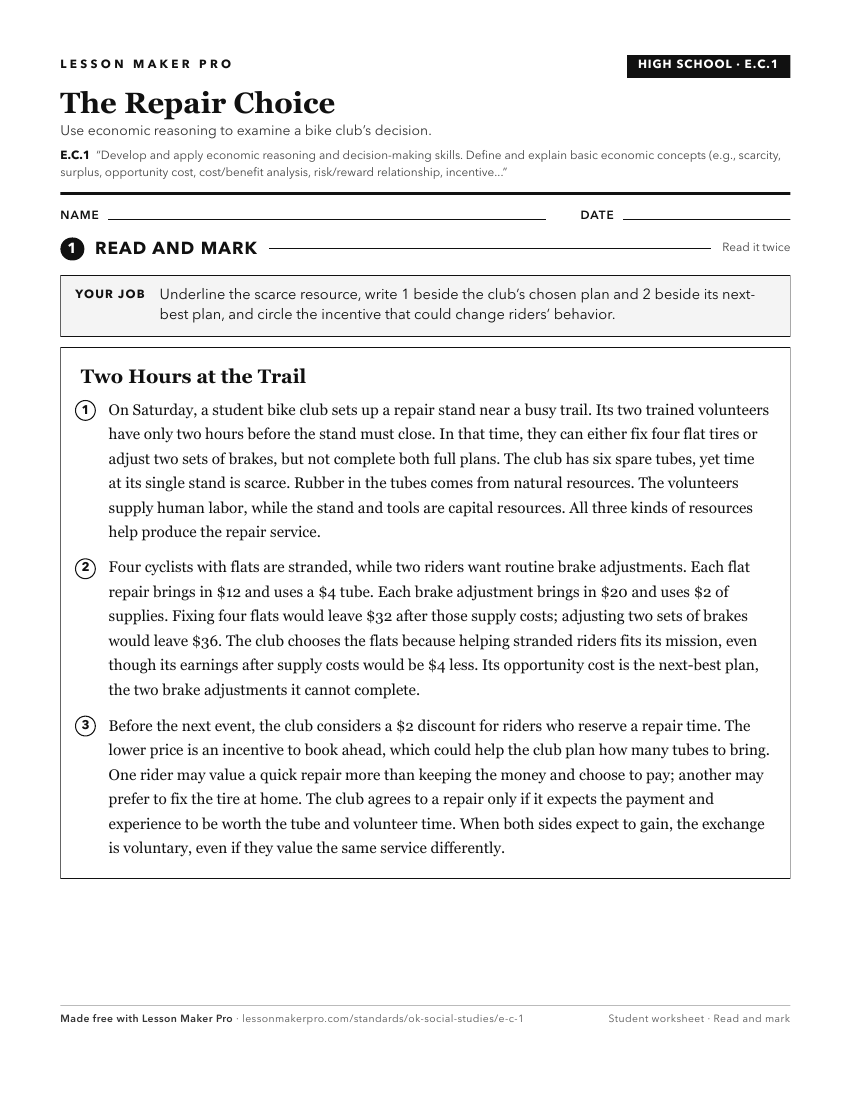
A ready-to-print activity worksheet aligned to E.C.1, with an answer key for the teacher on its own page. No account needed.
PDF, US Letter, prints cleanly in black and white.
Download the worksheetKeep exploring
Related Standards
Turn this cluster into a lesson
Grade, subject, topic, and the complete cluster are prefilled. Create one free, no account needed.
Also for this cluster:Make a WorksheetMake a QuizMake a Sub Lesson