Oklahoma Social Studies E.C.1.4
The Standard
- E.C.1
- Develop and apply economic reasoning and decision-making skills.
Examine how producers and consumers respond to scarcity by making choices involving opportunity costs and tradeoffs.
Oklahoma Academic Standards for Social Studies (2026) · E.C.1
Teacher's field guide
What This Standard Means
What Students Need to Do
- Students decide how to use limited money, time, or supplies as buyers and producers. They explain what each choice gains and gives up. They identify the best alternative not chosen.
What Mastery Looks Like
- Given one oven hour, a student can explain why a bakery makes bread instead of muffins and name the muffins as its opportunity cost. With a fixed lunch budget, the student can explain what buying one meal means giving up.
Common Misconceptions
- Students may call every rejected option the opportunity cost, rather than the best one they passed up. They may think only shoppers face scarcity, or that a choice has no cost when no money changes hands.
How to Assess It
- Exit ticket: A bakery uses its last bag of flour for bread instead of muffins, and you spend your last $8 on lunch instead of a movie ticket. For each choice, name what is gained and the best alternative given up.
Lesson moves
Ways to Teach It
Give pairs 12 paper tokens to buy supplies for a snack stand; have them record what they buy and the best purchase they skip.
Ask: A bakery has one oven hour left. Should it bake bread or muffins? Write what the bakery gains and gives up.
Run three rounds of a $15 lunch-budget game with changing prices; students record each purchase and its next best alternative.
Use a grocery ad to plan a $25 dinner; students explain which food they left out and why.
Free download
Printable E.C.1.4 Worksheet
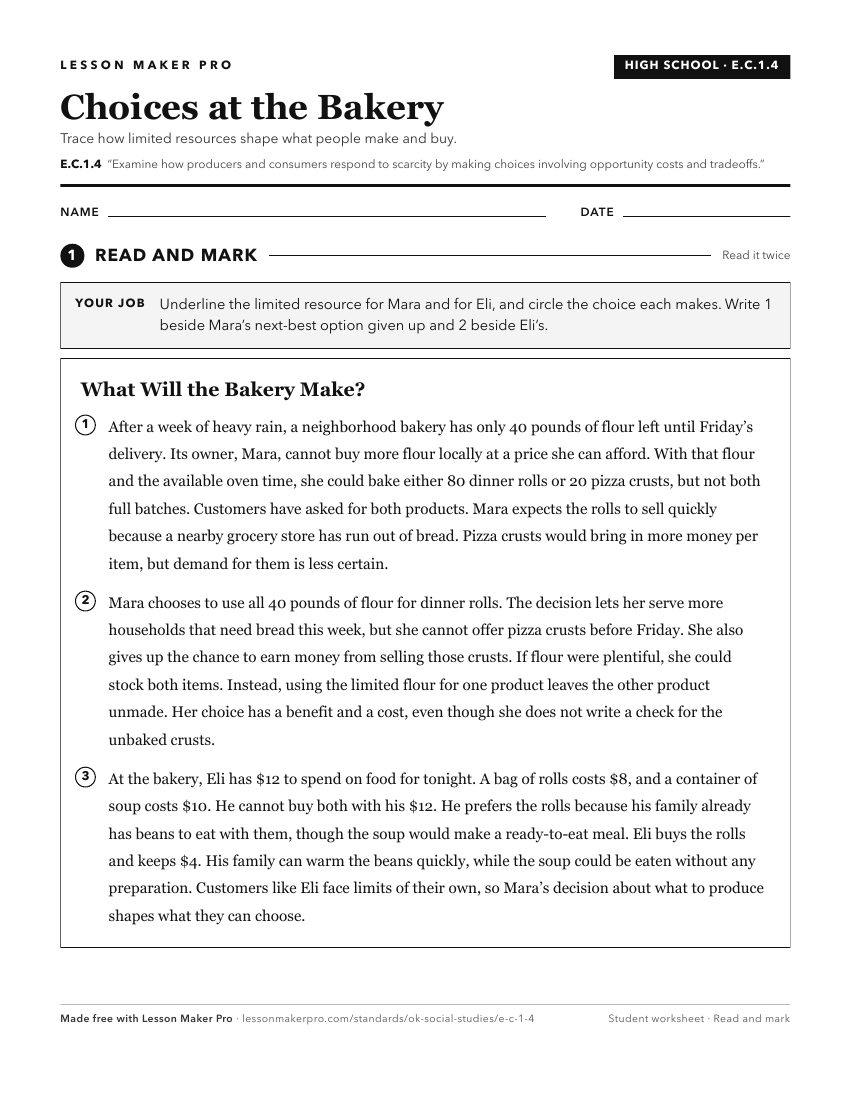
A ready-to-print activity worksheet aligned to E.C.1.4, with an answer key for the teacher on its own page. No account needed.
PDF, US Letter, prints cleanly in black and white.
Download the worksheetKeep exploring
Related Standards
- E.C.8.3
Explain that prices in a market economy act as signals of relative scarcity and help coordinate decisions of producers and consumers, and analyze how attempts t...
- E.C.1.2
Determine appropriate courses of economic actions by applying principles such as scarcity, opportunity cost, incentives, productive resources, and voluntary exc...
- E.C.1.1
Define and explain basic economic concepts (e.g., scarcity, surplus, opportunity cost, cost/benefit analysis, risk/reward relationship, incentive, and trade-off...
- 3.C.4.1.B
Describe how the laws of supply and demand impact people's choices about producing and consuming goods and services.
Turn this exact standard into a lesson
Grade, subject, topic, and the complete standard are prefilled. Create one free, no account needed.
Also for this standard:Make a WorksheetMake a QuizMake a Sub Lesson