Oklahoma Social Studies AWH.P.3.2
Standard Cluster
Students will apply critical reading and thinking skills to interpret, evaluate, and respond to a variety of complex texts and perspectives. Evaluate the extent to which historical or cultural perspectives affect an author’s stated or implied purpose. Evaluate the author’s point of view, potential bias, and how authors can reach different conclusions regarding the same issue. Actively listen, evaluate, and analyze a speaker’s message, asking questions while engaged in collaborative discussions about social studies topics and texts.
Oklahoma Academic Standards for Social Studies (2026)
Cluster contents
Standards in This Cluster
AWH.P.3.2 is a cluster heading. These are the individual standards under it.
- AWH.P.3.2.A
Evaluate the extent to which historical or cultural perspectives affect an author’s stated or implied purpose.
- AWH.P.3.2.B
Evaluate the author’s point of view, potential bias, and how authors can reach different conclusions regarding the same issue.
- AWH.P.3.2.C
Actively listen, evaluate, and analyze a speaker’s message, asking questions while engaged in collaborative discussions about social studies topics and texts.
Teacher's field guide
What This Cluster Means
What Students Need to Do
- Students compare accounts of the same issue. They use each writer’s time, culture, and role to explain their purpose and why their conclusions differ. They listen to classmates, ask questions, and respond with evidence.
What Mastery Looks Like
- A student points to a phrase that suggests a writer’s purpose or bias, even when the writer does not state it. They explain how two writers reached different conclusions and ask a question that helps them understand a classmate’s view.
Common Misconceptions
- Students may call a source biased just because they disagree with it, or assume a calm tone means it is neutral. They may treat a writer’s claim as a fact without checking the evidence or what the writer leaves out.
How to Assess It
- Give students two short arguments about factory safety after the 1911 Triangle Shirtwaist fire, one from a business leader and one from a union organizer. Ask: “What does each writer want readers to think, which phrase gives you a clue, and why might their views differ?”
Lesson moves
Ways to Teach It
Print two accounts of the Triangle Shirtwaist fire; pairs underline claims and circle words that suggest each writer’s purpose.
After a partner explains a factory safety proposal, ask, “Whose view is missing?” Restate their answer before giving your own.
Play evidence match: pair two opposing factory safety claims with source excerpts, then identify one fact a writer leaves out.
Print two comments on a proposed bus route, one from a rider and one from a shop owner; compare whose needs each puts first.
Free download
Printable AWH.P.3.2 Worksheet
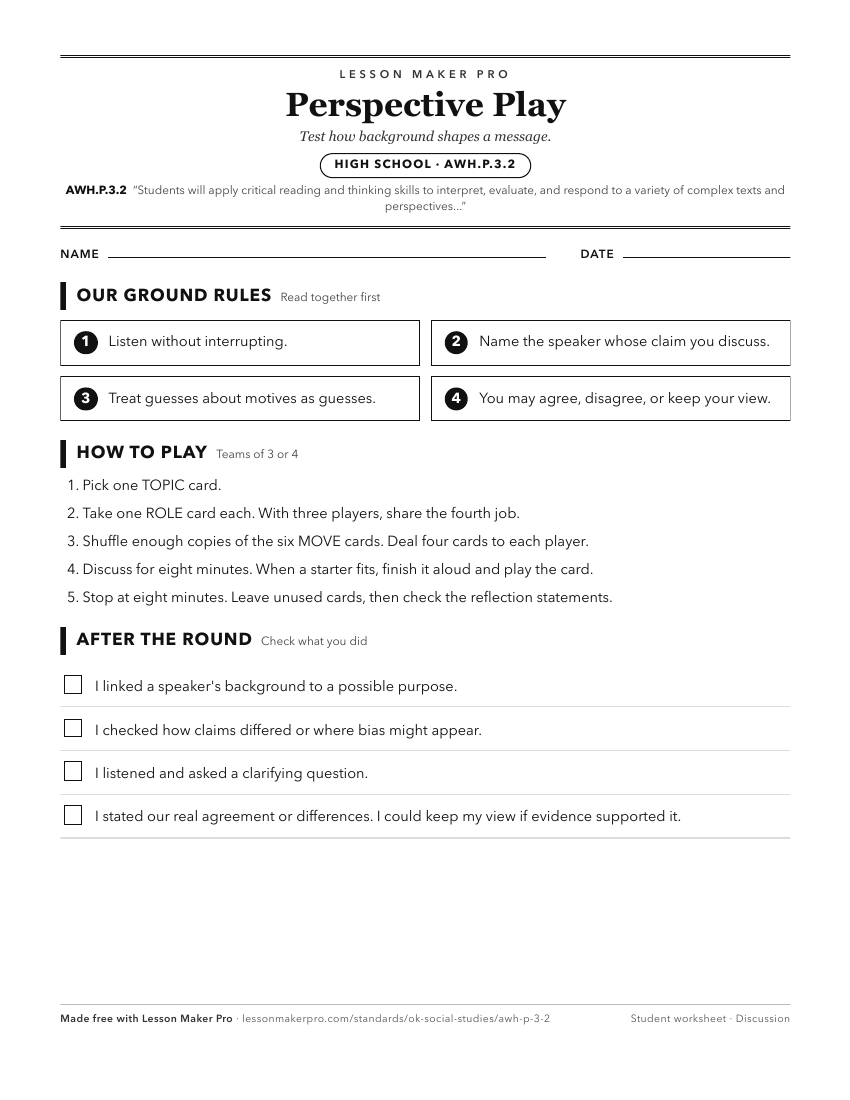
A ready-to-print activity worksheet aligned to AWH.P.3.2, with an answer key for the teacher on its own page. No account needed.
PDF, US Letter, prints cleanly in black and white.
Download the worksheetKeep exploring
Related Standards
- TOT.P.3.2
Students will apply critical reading and thinking skills to interpret, evaluate, and respond to a variety of complex texts and perspectives.
- MWH.P.3.2
Apply critical reading and thinking skills to interpret, evaluate, and respond to a variety of complex texts and perspectives.
- 6.P.3.2
Apply critical reading and thinking skills to interpret, evaluate, and respond to a variety of complex texts and perspectives.
- E.P.3.2
Apply critical reading and thinking skills to interpret, evaluate, and respond to a variety of complex texts and perspectives.
Turn this cluster into a lesson
Grade, subject, topic, and the complete cluster are prefilled. Create one free, no account needed.
Also for this cluster:Make a WorksheetMake a QuizMake a Sub Lesson