Oklahoma Social Studies AWH.P.2.2
Standard Cluster
Develop skills which demonstrate an understanding of historical events and the people who shaped our history. Gather and evaluate the usefulness of various formats of evidence for specific inquiry, analyzing the broader historical context, and assessing potential bias and credibility of sources. Analyze complex and interacting factors that influence multiple perspectives during different historical eras and contemporary events. Evaluate how multiple, complex events are shaped by unique circumstances of time and place; construct and interpret parallel timelines.
Oklahoma Academic Standards for Social Studies (2026)
Cluster contents
Standards in This Cluster
AWH.P.2.2 is a cluster heading. These are the individual standards under it.
- AWH.P.2.2.A
Gather and evaluate the usefulness of various formats of evidence for specific inquiry, analyzing the broader historical context, and assessing potential bias a...
- AWH.P.2.2.B
Analyze complex and interacting factors that influence multiple perspectives during different historical eras and contemporary events.
- AWH.P.2.2.C
Evaluate how multiple, complex events are shaped by unique circumstances of time and place; construct and interpret parallel timelines.
Teacher's field guide
What This Cluster Means
What Students Need to Do
- Students ask a focused question about an event and gather evidence from news reports, official records, and personal accounts. They decide which sources help answer the question, check for bias, and explain how local conditions shaped different views. They build parallel timelines to compare what happened in two places.
What Mastery Looks Like
- A student can explain why a dated health order is useful for studying a city closure and what it cannot reveal about residents' views. They can place events from two cities on parallel timelines and use evidence to explain why the cities made different choices.
Common Misconceptions
- Students may treat a newspaper headline as neutral or assume one eyewitness tells the whole story. They may put events from different cities on one timeline and miss how timing and local conditions affected decisions.
How to Assess It
- Give students a dated 1918 Philadelphia parade report and a dated St. Louis closure notice. Ask them to place both events on parallel timelines and name one question each source cannot answer.
Lesson moves
Ways to Teach It
Hand out dated 1918 Philadelphia parade coverage and St. Louis closure notices; students build two timeline rows and mark each city's decision.
Ask how a Philadelphia parade organizer and a St. Louis health officer might defend their 1918 decisions using local conditions.
Run a source-sort race: teams rank a 1918 headline, health order, and diary entry for answering why Philadelphia held its parade.
Have students compare a 2020 county mask order with a 1918 St. Louis closure notice, noting dates, affected groups, and stated reasons.
Free download
Printable AWH.P.2.2 Worksheet
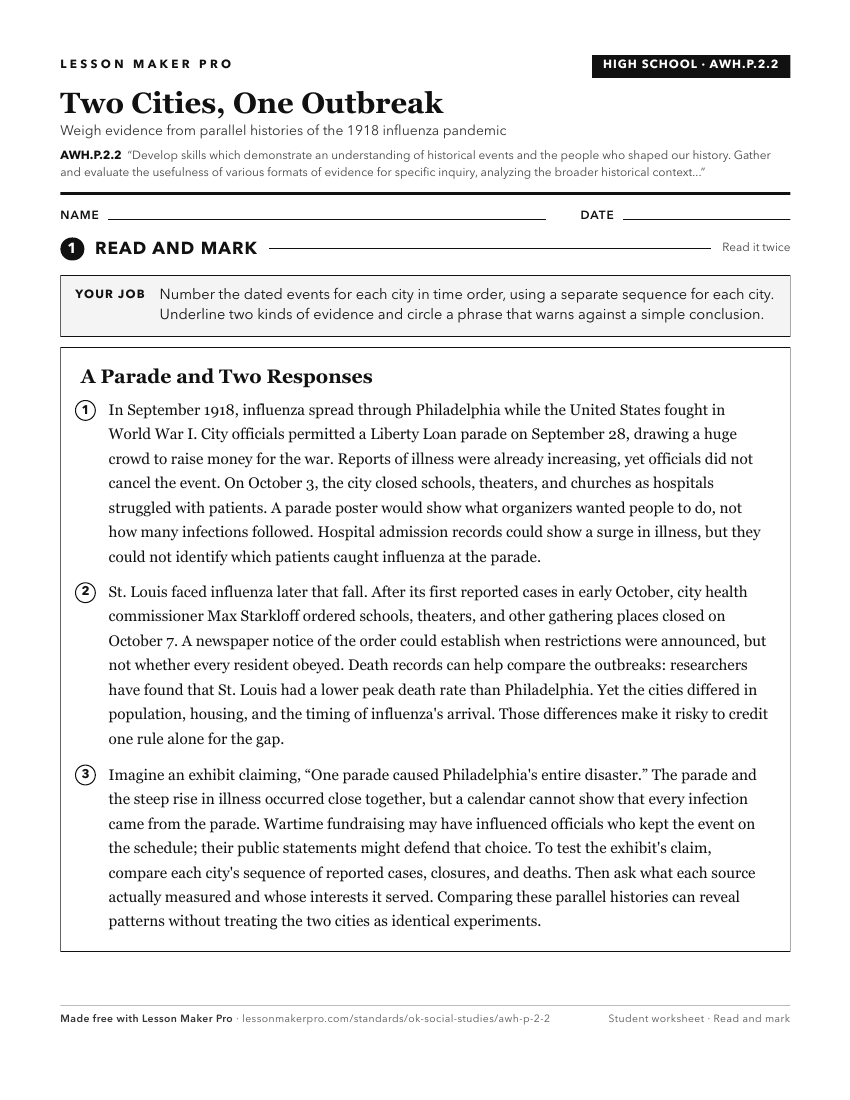
A ready-to-print activity worksheet aligned to AWH.P.2.2, with an answer key for the teacher on its own page. No account needed.
PDF, US Letter, prints cleanly in black and white.
Download the worksheetKeep exploring
Related Standards
- 4.P.2.2
Develop skills which demonstrate an understanding of historical events and the people who shaped our history.
- TOT.P.2.2
Develop skills which demonstrate an understanding of historical events and the people who shaped our history.
- 5.P.2.2
Develop skills which demonstrate an understanding of historical events and the people who shaped our history.
- OKH.P.2.2
Develop skills which demonstrate an understanding of historical events and the people who shaped our history.
Turn this cluster into a lesson
Grade, subject, topic, and the complete cluster are prefilled. Create one free, no account needed.
Also for this cluster:Make a WorksheetMake a QuizMake a Sub Lesson