Oklahoma Social Studies AWH.C.8.4
The Standard
Explain the origins of Shintoism and its central feature of ritual practices carried out with discipline to maintain connections with the ancient past.
Oklahoma Academic Standards for Social Studies (2026)
Teacher's field guide
What This Standard Means
What Students Need to Do
- Students explain how Shinto grew from older Japanese practices centered on kami, rather than from one founder. They describe how carefully repeated shrine rituals connect worshippers with earlier generations.
What Mastery Looks Like
- A student can name purification before prayer and explain that it means more than getting physically clean. They can explain how repeating the ritual carries forward practices from the past.
Common Misconceptions
- Students may think Shinto was founded by one person or began with Buddhism. They may mistake ritual washing for ordinary hygiene or assume shrine practices have never changed.
How to Assess It
- Exit ticket: Explain where Shinto came from. Then describe how careful hand washing before prayer at a shrine can connect worshippers with earlier generations.
Lesson moves
Ways to Teach It
Give pairs cards labeled torii, water basin, offering box, and prayer; have them order a shrine visit and explain each step.
After reading a short shrine visitor guide, ask students to write how repeated actions can connect worshippers with earlier generations.
Have students sort four claim cards as accurate or inaccurate: one founder, local Japanese roots, kami, and washing only for hygiene.
Compare photos of a shrine festival today and an older depiction; have students list repeated practices and visible changes.
Free download
Printable AWH.C.8.4 Worksheet
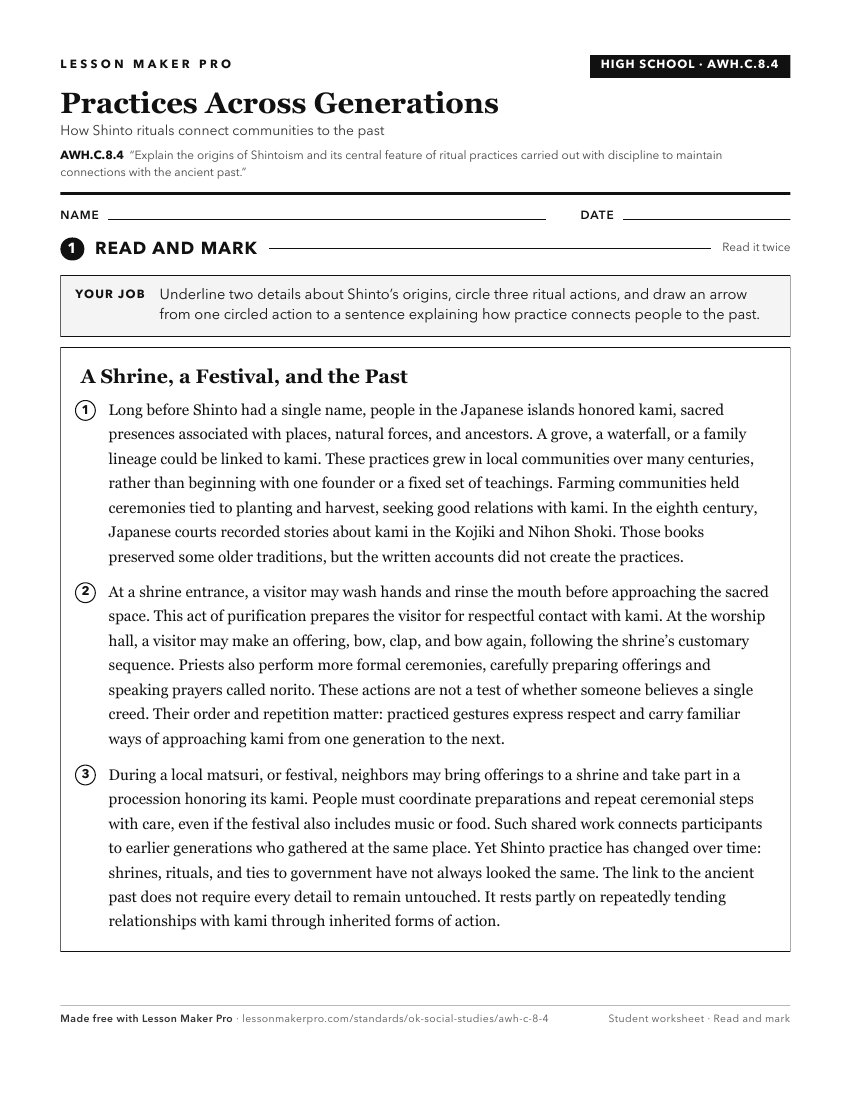
A ready-to-print activity worksheet aligned to AWH.C.8.4, with an answer key for the teacher on its own page. No account needed.
PDF, US Letter, prints cleanly in black and white.
Download the worksheetKeep exploring
Related Standards
- AWH.C.2.2
Describe the basic religious belief of polytheism, as practiced by Mesopotamian civilizations.
- AWH.C.8.5
Examine significant aspects of Confucian philosophy and its role in the continuity of Chinese civilization, focusing on the life and teachings of Confucius, the...
- AWH.C.5.2
Examine Judaism and its primary beliefs (e.g., monotheism, emphasis on ritual, individual worth and responsibility, adherence to moral obligations) and the role...
- 7.C.5.3
Examine the dominant religions of the world, including Chrisitanity, Judaism, Islam, Hinduism, and Buddhism. Examine how major belief systems influence societie...
Turn this exact standard into a lesson
Grade, subject, topic, and the complete standard are prefilled. Create one free, no account needed.
Also for this standard:Make a WorksheetMake a QuizMake a Sub Lesson