Oklahoma Social Studies AWH.C.7.6
The Standard
Explain the reasons for the growth and longevity of the Roman Empire (e.g., military organization, tactics, conquests, functions of taxes, use of a standard currency, road construction, protection of trade routes, benefits of a Pax Romana, network of Roman roads and aqueducts).
Oklahoma Academic Standards for Social Studies (2026)
Teacher's field guide
What This Standard Means
What Students Need to Do
- Students explain how Rome gained territory and how it kept control of a large empire. They connect the army, taxes, coins, roads, and protected trade to specific results.
What Mastery Looks Like
- A student can explain how roads helped soldiers reach distant provinces and merchants move goods. They can also explain how taxes paid for the army and public works, while shared coins made trade easier.
Common Misconceptions
- Students may think roads were built only for trade, when they also moved troops. Some assume the Pax Romana meant there was no conflict, or that conquest alone kept the empire together.
How to Assess It
- Exit ticket: Name one reason Rome gained territory and two reasons it kept control. For each, write one sentence explaining how it worked.
Lesson moves
Ways to Teach It
On a Roman road map, trace routes with yarn, then move soldier and merchant tokens from Rome to two provinces.
Ask, “Who benefited more from Roman roads, soldiers or merchants?” Have students defend an answer using two examples.
Give pairs cards labeled legions, taxes, coins, roads, and protected trade; sort them into expansion, control, or both, then justify one choice.
Compare a local bus route map with a Roman road map; ask how reliable routes help move people and supplies.
Free download
Printable AWH.C.7.6 Worksheet
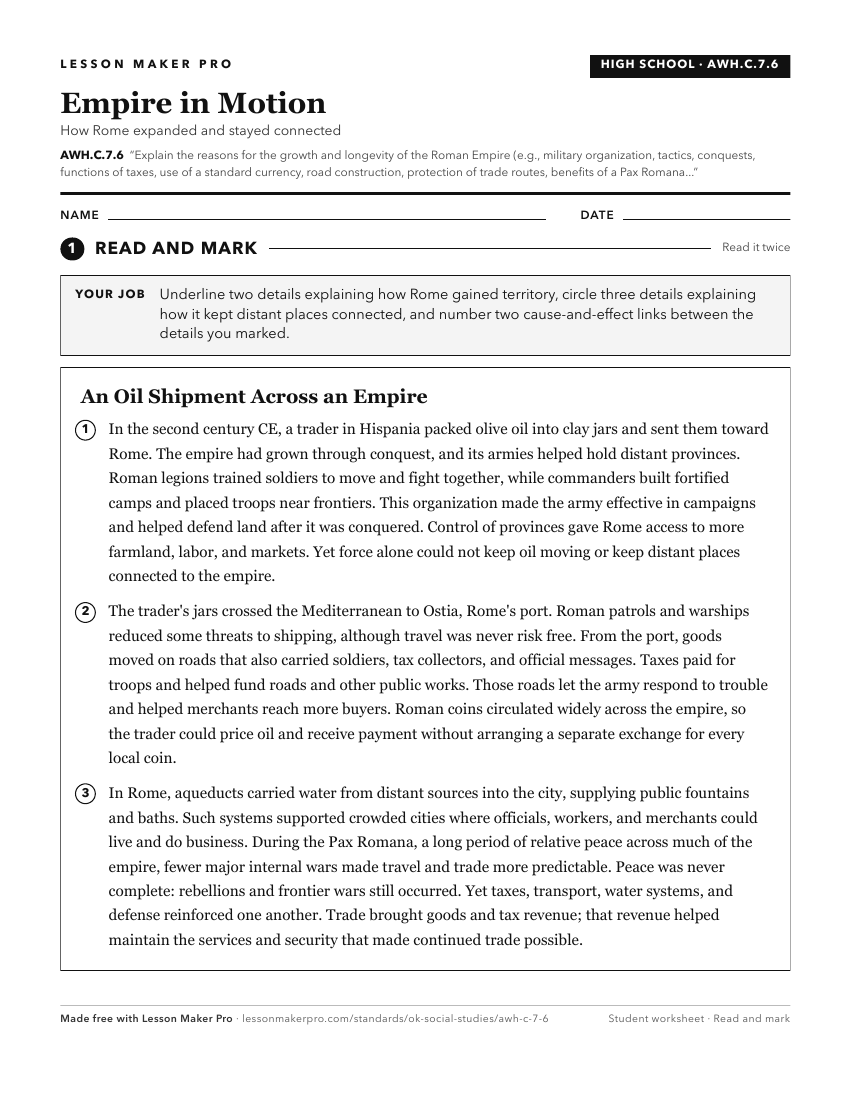
A ready-to-print activity worksheet aligned to AWH.C.7.6, with an answer key for the teacher on its own page. No account needed.
PDF, US Letter, prints cleanly in black and white.
Download the worksheetKeep exploring
Related Standards
- MWH.C.1.1.D
Evaluate the contributions of the Roman civilization to law and government by describing the Roman Republic’s development of the principle of separation of powe...
- AWH.C.7.1
Locate on a historical map ancient Rome, tracing the changing boundaries of the Roman Republic and Empire from 500 BC to 500 AD and explaining how the geographi...
- AWH.C.7.8
Explain how internal forces (e.g., the rise of autonomous military powers, political corruption, and economic and political instability) and external forces (e....
- AWH.C.7.10
Explain the contribution of Roman civilization to law, literature, architecture, engineering, and technology, including the spread and influence of the Latin la...
Turn this exact standard into a lesson
Grade, subject, topic, and the complete standard are prefilled. Create one free, no account needed.
Also for this standard:Make a WorksheetMake a QuizMake a Sub Lesson