Oklahoma Social Studies AWH.C.7.5
The Standard
Describe the collapse of the Roman Republic from the agrarian reform law of Tiberius Gracchus to the establishment of Julius Caesar’s dictatorship.
Oklahoma Academic Standards for Social Studies (2026)
Teacher's field guide
What This Standard Means
What Students Need to Do
- Trace events from Tiberius Gracchus's land reform to Caesar's dictatorship. Explain how political violence and generals using armies weakened the republic.
What Mastery Looks Like
- Students can place Gracchus's land bill, Sulla's march on Rome, Caesar's crossing of the Rubicon, and Caesar's dictatorship in order. They can explain how Sulla and Caesar used armies to settle political disputes.
Common Misconceptions
- Students may think Caesar was the first Roman leader to use an army against Rome, overlooking Sulla. They may also think Gracchus became dictator or that his land bill alone ended the republic.
How to Assess It
- Exit ticket: Put Gracchus's land bill, Sulla's march on Rome, Caesar's Rubicon crossing, and Caesar's dictatorship in order. Explain how Sulla's march weakened the republic.
Lesson moves
Ways to Teach It
Give pairs event cards for Gracchus's land bill, Sulla's march, Caesar's alliance with Pompey and Crassus, the Rubicon crossing, and Caesar's dictatorship; order them.
Ask students to write two sentences explaining how Sulla's march changed the way Roman leaders settled disputes.
Play 'Which came first?' using Gracchus's land bill, Sulla's march, and Caesar's Rubicon crossing; students vote and defend each answer.
Show a city council agenda with a public vote; ask what changes if one official can cancel votes and order police to enforce decisions.
Free download
Printable AWH.C.7.5 Worksheet
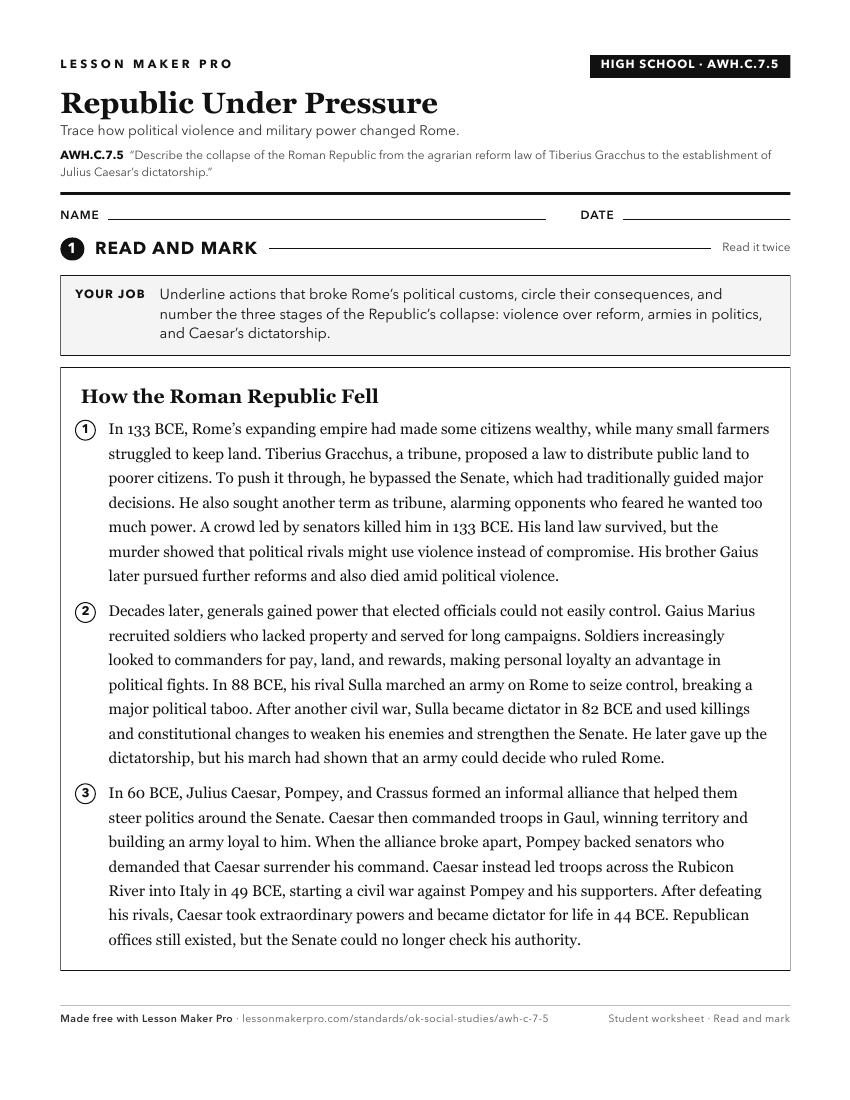
A ready-to-print activity worksheet aligned to AWH.C.7.5, with an answer key for the teacher on its own page. No account needed.
PDF, US Letter, prints cleanly in black and white.
Download the worksheetKeep exploring
Related Standards
- MWH.C.1.1.D
Evaluate the contributions of the Roman civilization to law and government by describing the Roman Republic’s development of the principle of separation of powe...
- AWH.C.7.8
Explain how internal forces (e.g., the rise of autonomous military powers, political corruption, and economic and political instability) and external forces (e....
- 7.C.6.2.B
Describe the government of the Roman Republic and its contribution to the development of representative self-government, including separation of powers, liberty...
- AWH.C.7.2
Explain the rise of the Roman Republic and the role of historical figures in Roman history, including Brutus, Cincinnatus, and Hannibal.
Turn this exact standard into a lesson
Grade, subject, topic, and the complete standard are prefilled. Create one free, no account needed.
Also for this standard:Make a WorksheetMake a QuizMake a Sub Lesson