Oklahoma Social Studies AWH.C.12.5
The Standard
Examine the sack of Constantinople in 1453 and its consequences, describing why the event is considered a turning point in medieval history.
Oklahoma Academic Standards for Social Studies (2026)
Teacher's field guide
What This Standard Means
What Students Need to Do
- Students explain how the Ottoman capture of Constantinople ended the Byzantine Empire. They describe how control of the city changed regional power and why historians often treat 1453 as a turning point.
What Mastery Looks Like
- A student can locate Constantinople on a map and explain why its position on the Bosporus mattered. They can connect the city's capture to the end of Byzantine rule and the growth of Ottoman power.
Common Misconceptions
- Students may confuse the Ottoman conquest in 1453 with the Crusader sack in 1204. Some think the city's fall immediately stopped all trade with Asia or caused the Renaissance by itself.
How to Assess It
- Exit ticket: Circle Constantinople on a map and label the Bosporus. Then name who captured the city in 1453 and give one consequence that makes the event a turning point.
Lesson moves
Ways to Teach It
Give pairs a blank regional map to label Constantinople, the Bosporus, and nearby trade routes, then mark who controlled the city after 1453.
Ask students to write three sentences answering: Why might a historian choose 1453 as the end of the medieval era?
Have students sort cards into causes, immediate effects, and later effects, including Ottoman siege, Byzantine collapse, and interest in sea routes.
Show a current map of ship traffic through Istanbul and ask students why control of that waterway still matters.
Free download
Printable AWH.C.12.5 Worksheet
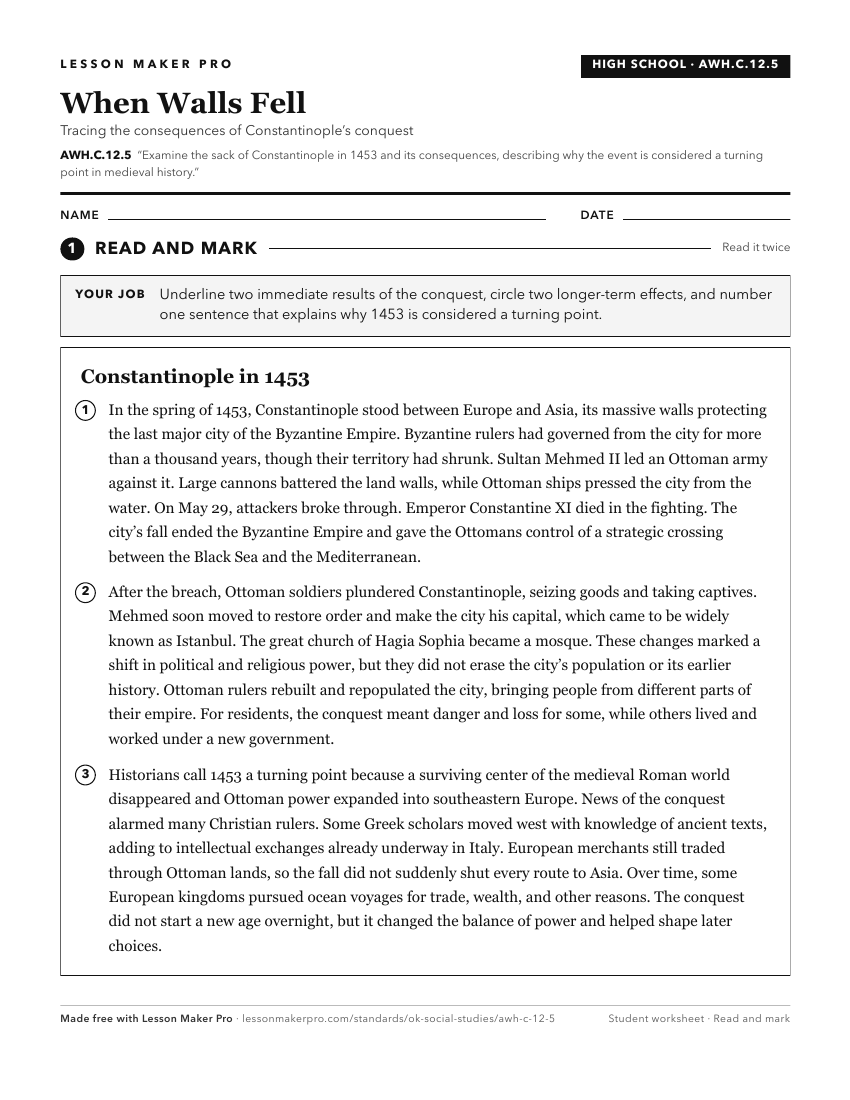
A ready-to-print activity worksheet aligned to AWH.C.12.5, with an answer key for the teacher on its own page. No account needed.
PDF, US Letter, prints cleanly in black and white.
Download the worksheetKeep exploring
Related Standards
- AWH.C.10.1
Explain the origins of iconoclasm and the schism between Orthodoxy and Catholicism in 1054.
- AWH.C.10.5
Examine religious, intellectual, cultural, technological, and economic developments in medieval Europe from the Norman Conquest to 1300.
- AWH.C.10.3.C
consequences of the European Crusades in the 11th to 13th centuries, including the Fourth Crusade, the Crusader conquest of Orthodox Christian Byzantium, and th...
- AWH.C.7.9
Describe the Sack of Rome, fall of the Western Roman Empire, and the establishment of Germanic kingdoms (e.g., Ostrogoths, Visigoths, Vandals, Franks, Anglo-Sax...
Turn this exact standard into a lesson
Grade, subject, topic, and the complete standard are prefilled. Create one free, no account needed.
Also for this standard:Make a WorksheetMake a QuizMake a Sub Lesson