Oklahoma Social Studies 8.P.3
Standard Cluster
Engage in critical, active reading of primary and secondary sources related to social studies concepts. Comprehend, evaluate, and synthesize textual sources to acquire and refine knowledge in the social studies. Paraphrase the main idea and cite evidence from primary and secondary sources; provide an accurate summary of a source distinct from prior knowledge or opinion. Integrate the use of visual information (e.g., maps, charts, photographs, videos, political cartoons, artwork) with textual information from primary and secondary sources to draw conclusions. Apply critical reading and thinking skills to interpret, evaluate, and respond to a variety of complex texts and perspectives. Analyze works written on the same topic and compare methods the authors use to achieve similar or different purposes. Evaluate textual evidence to determine whether a claim is substantiated. Engage in collaborative discussions about information presented in social studies texts, expressing ideas clearly while building on the ideas of others
Oklahoma Academic Standards for Social Studies (2026)
Cluster contents
Standards in This Cluster
8.P.3 is a cluster heading. These are the individual standards under it.
- 8.P.3.1
Comprehend, evaluate, and synthesize textual sources to acquire and refine knowledge in the social studies.
- 8.P.3.1.A
Paraphrase the main idea and cite evidence from primary and secondary sources; provide an accurate summary of a source distinct from prior knowledge or opinion.
- 8.P.3.1.B
Integrate the use of visual information (e.g., maps, charts, photographs, videos, political cartoons, artwork) with textual information from primary and seconda...
- 8.P.3.2
Apply critical reading and thinking skills to interpret, evaluate, and respond to a variety of complex texts and perspectives.
- 8.P.3.2.A
Analyze works written on the same topic and compare methods the authors use to achieve similar or different purposes.
- 8.P.3.2.B
Evaluate textual evidence to determine whether a claim is substantiated.
- 8.P.3.2.C
Engage in collaborative discussions about information presented in social studies texts, expressing ideas clearly while building on the ideas of others.
Teacher's field guide
What This Cluster Means
What Students Need to Do
- Students read a firsthand account and a later account of the same event. They put each main idea in their own words and keep their opinions out of the summary. They use details from the writing and an image to check claims and draw a conclusion.
What Mastery Looks Like
- A student can summarize each account without adding facts or opinions. They cite a line and a visible detail that support their conclusion. They explain how the writers' choices serve different purposes and respond to a classmate with evidence.
Common Misconceptions
- Students may treat a witness's memory as a complete account or assume a textbook account is neutral. They may say a photograph proves something it does not show. They may also add their own opinion to a summary or cite a detail that does not support their claim.
How to Assess It
- Show a survivor's account, a textbook paragraph, and a street photograph of the Triangle fire. Ask: "Summarize each account, explain how the writers' purposes differ, and use one line and one visible detail to support a claim about the scene."
Lesson moves
Ways to Teach It
Give pairs a survivor's account, a textbook paragraph, and a Triangle fire photo; have them highlight shared facts and circle details only the photo shows.
Ask pairs: "Why might a survivor and a historian describe the same fire differently?" Require one detail from each account.
Play claim check: post three claims about the fire, and have teams match each to a supporting line or mark it unsupported.
Compare the Triangle fire photograph with your classroom evacuation map; list one safety question each can and cannot answer.
Free download
Printable 8.P.3 Worksheet
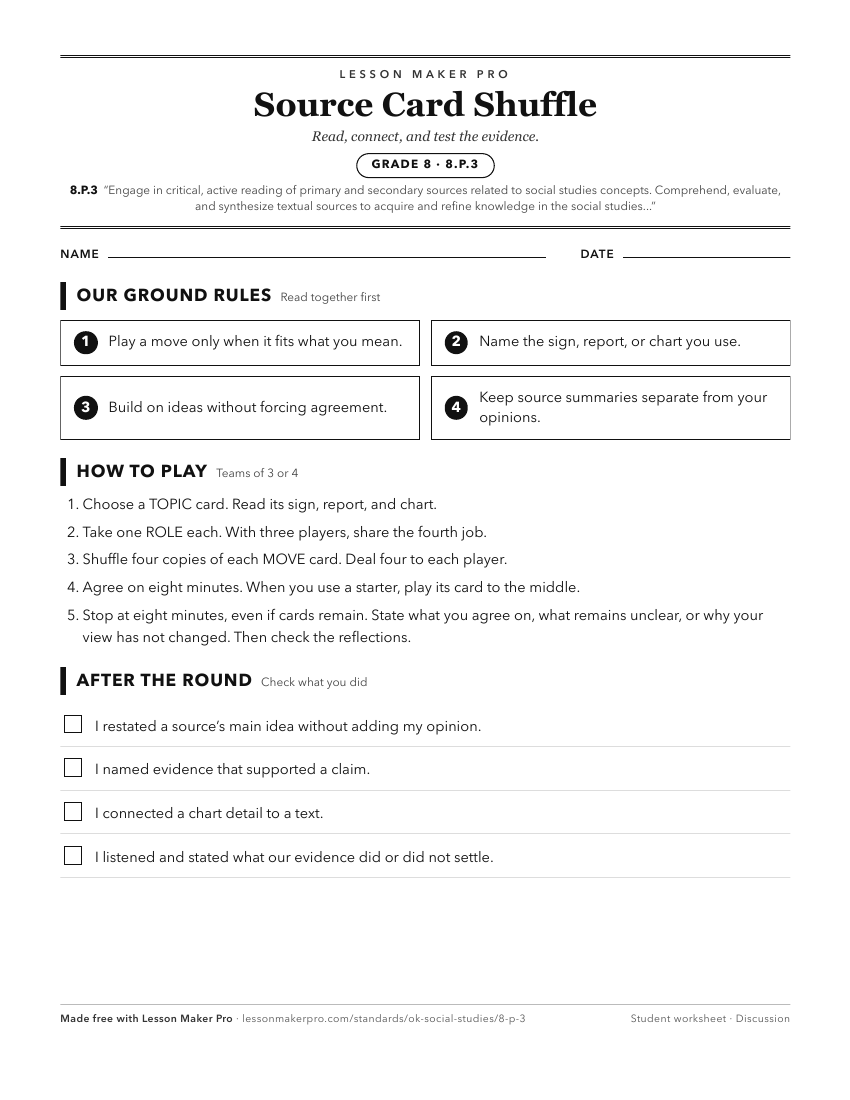
A ready-to-print activity worksheet aligned to 8.P.3, with an answer key for the teacher on its own page. No account needed.
PDF, US Letter, prints cleanly in black and white.
Download the worksheetKeep exploring
Related Standards
Turn this cluster into a lesson
Grade, subject, topic, and the complete cluster are prefilled. Create one free, no account needed.
Also for this cluster:Make a WorksheetMake a QuizMake a Sub Lesson