Oklahoma Social Studies 8.P.1.1
Standard Cluster
- 8.P.1
- Apply critical thinking skills to address authentic civic issues.
Demonstrate an understanding of the virtue of civil discourse to analyze and address real-world problems. Analyze why the acknowledgement of different perspectives can contribute to civil discourse and solutions to civic issues. Apply a range of deliberative and democratic procedures to discuss, make decisions, and propose action about real-world problems in and out of school. Use information to analyze how a specific problem can manifest itself in regional and global issues, describing options for solutions.
Oklahoma Academic Standards for Social Studies (2026) · 8.P.1
Cluster contents
Standards in This Cluster
8.P.1.1 is a cluster heading. These are the individual standards under it.
- 8.P.1.1.A
Analyze why the acknowledgement of different perspectives can contribute to civil discourse and solutions to civic issues.
- 8.P.1.1.B
Apply a range of deliberative and democratic procedures to discuss, make decisions, and propose action about real-world problems in and out of school.
- 8.P.1.1.C
Use information to analyze how a specific problem can manifest itself in regional and global issues, describing options for solutions.
Teacher's field guide
What This Cluster Means
What Students Need to Do
- Students listen to different views on a local problem and use evidence to explain why people disagree. They compare possible fixes and use a fair process to choose an action. They explain how the problem also appears across a region and around the world.
What Mastery Looks Like
- A student can use a school litter tally, a county creek cleanup tally, and a world plastic waste map to explain a possible connection without claiming all the litter came from school. They can describe two viewpoints fairly, weigh two fixes, and propose a school action and a request to local officials.
Common Misconceptions
- Students may think civil discussion means everyone must agree, or that a majority vote makes other views irrelevant. They may assume every wrapper near a school drain reaches the ocean. They may also treat one cleanup as a solution to plastic waste everywhere.
How to Assess It
- Give students these facts: a school counts 40 wrappers near a drain, a county cleanup finds 200 in a creek, and a world map shows plastic waste in oceans. Ask: “Whose views should we hear, how might these problems connect, and how should the class choose one response?”
Lesson moves
Ways to Teach It
Walk school grounds with clipboards, tally visible litter near drains, and mark possible runoff paths on a printed map.
Give students role cards for a student, cafeteria worker, and creek cleanup volunteer; ask which concerns overlap and what fix each might accept.
Hand groups three litter policies and evidence cards; run a ranked-choice vote, then have each group explain one trade-off.
Draft a two-sentence email to the town council proposing a litter fix near a storm drain and naming one possible downstream effect.
Free download
Printable 8.P.1.1 Worksheet
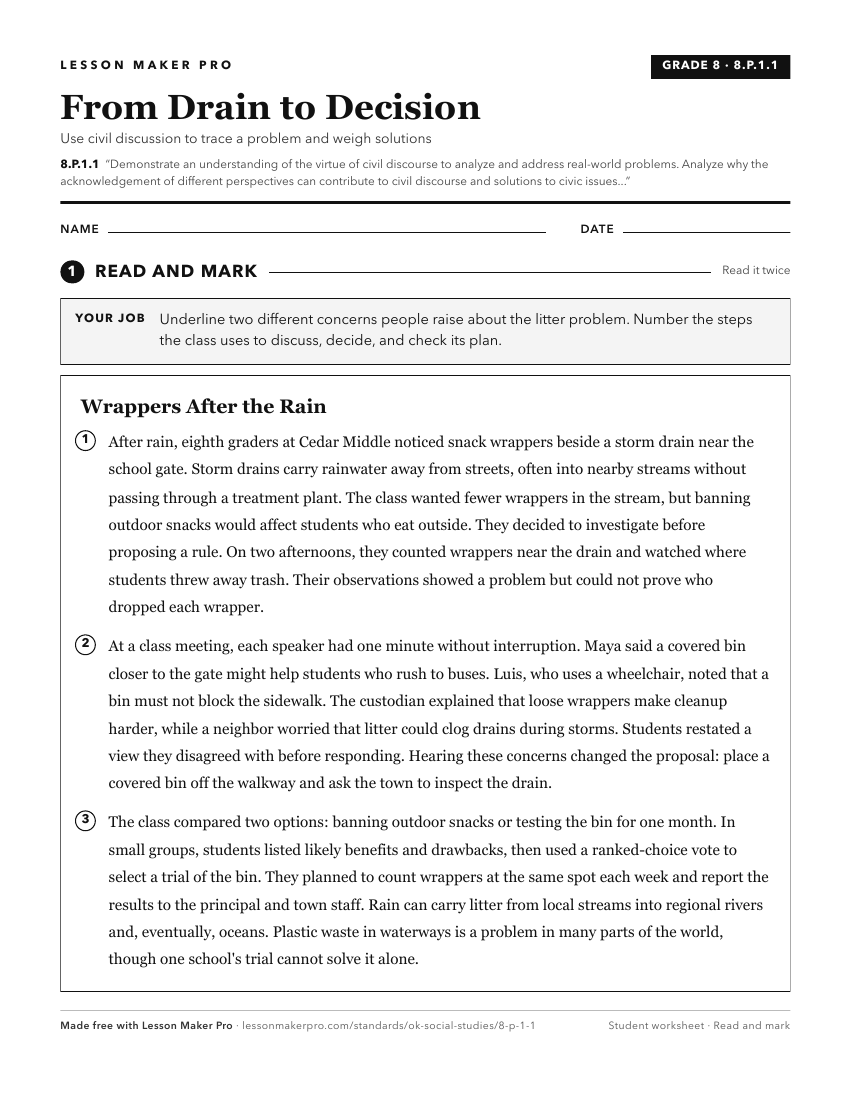
A ready-to-print activity worksheet aligned to 8.P.1.1, with an answer key for the teacher on its own page. No account needed.
PDF, US Letter, prints cleanly in black and white.
Download the worksheetKeep exploring
Related Standards
- OKH.P.1.1
Demonstrate an understanding of the virtue of civil discourse to analyze and address real- world problems.
- 2.P.1.1
The 2nd Grade version of this standard.
- MWH.P.1.1
Demonstrate an understanding of the virtue of civil discourse to analyze and address real- world problems.
- 7.P.1.1
The 7th Grade version of this standard.
Turn this cluster into a lesson
Grade, subject, topic, and the complete cluster are prefilled. Create one free, no account needed.
Also for this cluster:Make a WorksheetMake a QuizMake a Sub Lesson