Oklahoma Social Studies 8.C.5.1
Standard Cluster
- 8.C.5
- Examine the political and economic changes that occurred during the Early Federal Period.
Assess the legacy of President Washington on the nature of the presidency and the executive branch. Describe the purpose of the Cabinet as established by Washington and its role in today’s executive branch. Analyze the impact of the Whiskey Rebellion and the presidential authority to enforce federal law. Examine Washington’s attempt to develop a cohesive American Indian policy through treaties, assimilation, and the delineation of Tribal lands. Explain the intent and impact of Washington’s decision not to seek a third term in office. Read and discuss Washington’s advice as expressed in his Farewell Address regarding political factions, foreign alliances, and the relationship between morality and self-government.
Oklahoma Academic Standards for Social Studies (2026) · 8.C.5
Cluster contents
Standards in This Cluster
8.C.5.1 is a cluster heading. These are the individual standards under it.
- 8.C.5.1.A
Describe the purpose of the Cabinet as established by Washington and its role in today’s executive branch.
- 8.C.5.1.B
Analyze the impact of the Whiskey Rebellion and the presidential authority to enforce federal law.
- 8.C.5.1.C
Examine Washington’s attempt to develop a cohesive American Indian policy through treaties, assimilation, and the delineation of Tribal lands.
- 8.C.5.1.D
Explain the intent and impact of Washington’s decision not to seek a third term in office.
- 8.C.5.1.E
Read and discuss Washington’s advice as expressed in his Farewell Address regarding political factions, foreign alliances, and the relationship between morality...
Teacher's field guide
What This Cluster Means
What Students Need to Do
- Students explain why Washington formed a Cabinet and how it relates to presidential advisers today. They examine how he enforced federal law and how his treaties, assimilation efforts, and land boundaries affected Native nations. They explain his decision to leave office and discuss his warnings about factions, foreign alliances, and morality.
What Mastery Looks Like
- A student can explain that Cabinet secretaries advise the president and lead federal departments today. They can use the Whiskey Rebellion and the Treaty of Greenville to explain federal authority and Native land loss. They can distinguish Washington’s two-term precedent from a law and explain his Farewell Address warnings.
Common Misconceptions
- Students may think the Cabinet makes laws or that the Whiskey Rebellion made protest illegal. They may assume Native nations agreed freely to all land boundaries and assimilation policies. They may think the two-term limit was already law or that Washington wanted to end all foreign relations.
How to Assess It
- Use a five-line exit ticket. Ask students to explain the Cabinet’s job, what the Whiskey Rebellion showed, one effect of a Native land policy, why Washington left office, and one Farewell Address warning.
Lesson moves
Ways to Teach It
Give pairs a Treaty of Greenville map and policy cards; have them mark land ceded, then sort treaty and assimilation measures.
Give three Farewell Address excerpts and ask students to connect his concerns about factions, permanent alliances, and public morality to self-government.
Play a card match: students pair Cabinet, Whiskey Rebellion, and retirement with advice, law enforcement, and a two-term precedent.
Display a current Cabinet roster and have students match three secretaries to departments, then compare their jobs with Washington’s advisers.
Free download
Printable 8.C.5.1 Worksheet
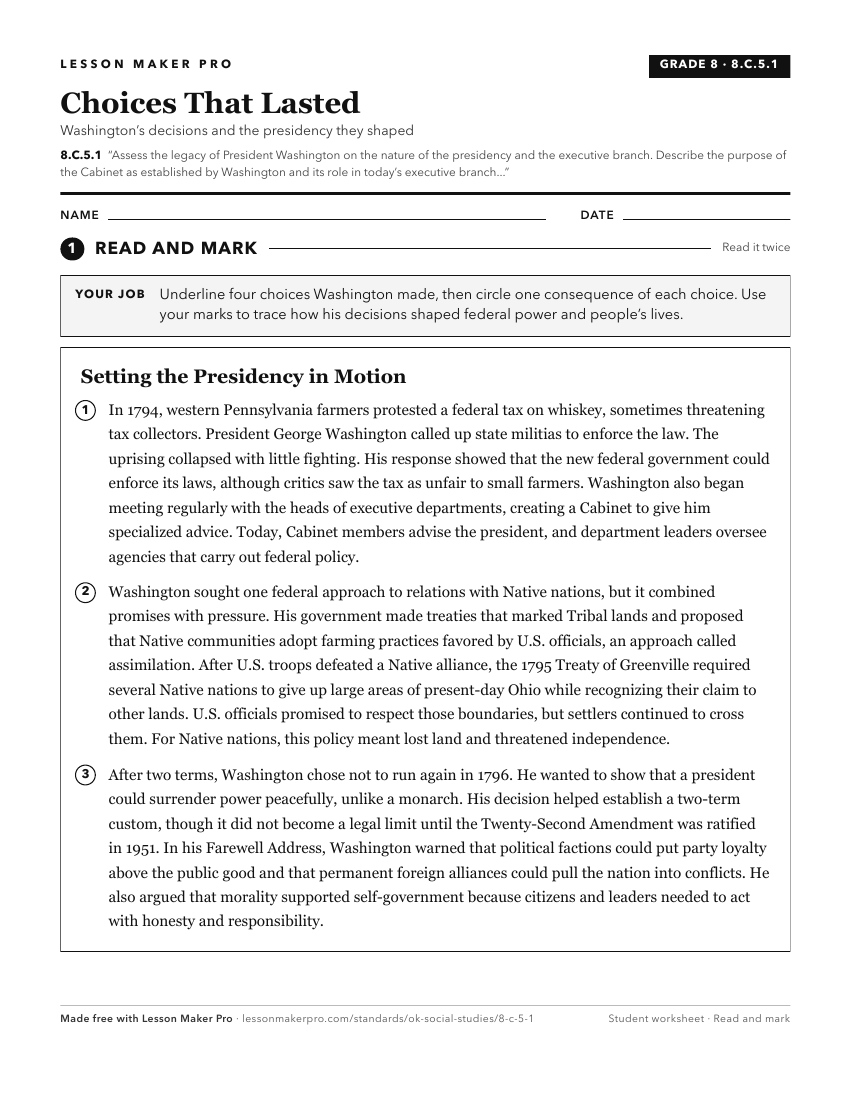
A ready-to-print activity worksheet aligned to 8.C.5.1, with an answer key for the teacher on its own page. No account needed.
PDF, US Letter, prints cleanly in black and white.
Download the worksheetKeep exploring
Related Standards
- USG.C.4.2
Examine the scope and powers of the executive branch as delineated in Article II of the Constitution of the United States of America.
- 5.C.7.1
Describe the presidential leadership of George Washington, including the
- USG.C.4.2.B
Compare the original intent of the Chief Executive's roles as described by Hamilton in Federalist Paper No.69 to the modern presidency.
Turn this cluster into a lesson
Grade, subject, topic, and the complete cluster are prefilled. Create one free, no account needed.
Also for this cluster:Make a WorksheetMake a QuizMake a Sub Lesson