Oklahoma Social Studies 8.C.2.2.D
The Standard
- 8.C.2
- Examine key military and diplomatic events of the Revolutionary War that resulted in an independent nation.
- 8.C.2.2
- Evaluate the motivations and points of view of various populations to remain loyal to Britain, join the patriot cause, or choose neutrality.
Describe how the promise of political equality impacted the views of women, by examining the writings of Mercy Otis Warren and Phillis Wheatley.
Oklahoma Academic Standards for Social Studies (2026) · 8.C.2.2
Teacher's field guide
What This Standard Means
What Students Need to Do
- Read short passages by Mercy Otis Warren and Phillis Wheatley. Explain how each woman responded to the Revolution's promises of liberty. Identify Warren's concern about government power and Wheatley's argument against slavery.
What Mastery Looks Like
- A student cites Warren's warning about unchecked government and Wheatley's claim that Africans have a natural right to freedom. They explain how both writers used the language of liberty, while making different arguments.
Common Misconceptions
- Students may assume that talk of equality meant women and enslaved people gained the right to vote. They may mistake Wheatley's argument against slavery for a call for women's voting rights. They may also assume Warren could vote because she wrote about politics.
How to Assess It
- Give students a short passage from Warren's Observations on the New Constitution and one from Wheatley's 1774 letter to Samson Occom. Ask: What does each writer say about liberty? Cite one phrase from each passage.
Lesson moves
Ways to Teach It
Print six quotation strips from Warren and Wheatley; students sort them by writer and underline each claim about liberty.
Ask students to write two sentences: How did each writer use the Revolution's language of liberty, and whom did she defend?
Play a quote match: pair four excerpts with Warren or Wheatley, then circle the words that support each choice.
Check a current voter eligibility chart; compare who can vote now with who could participate in politics during Warren's and Wheatley's lives.
Free download
Printable 8.C.2.2.D Worksheet
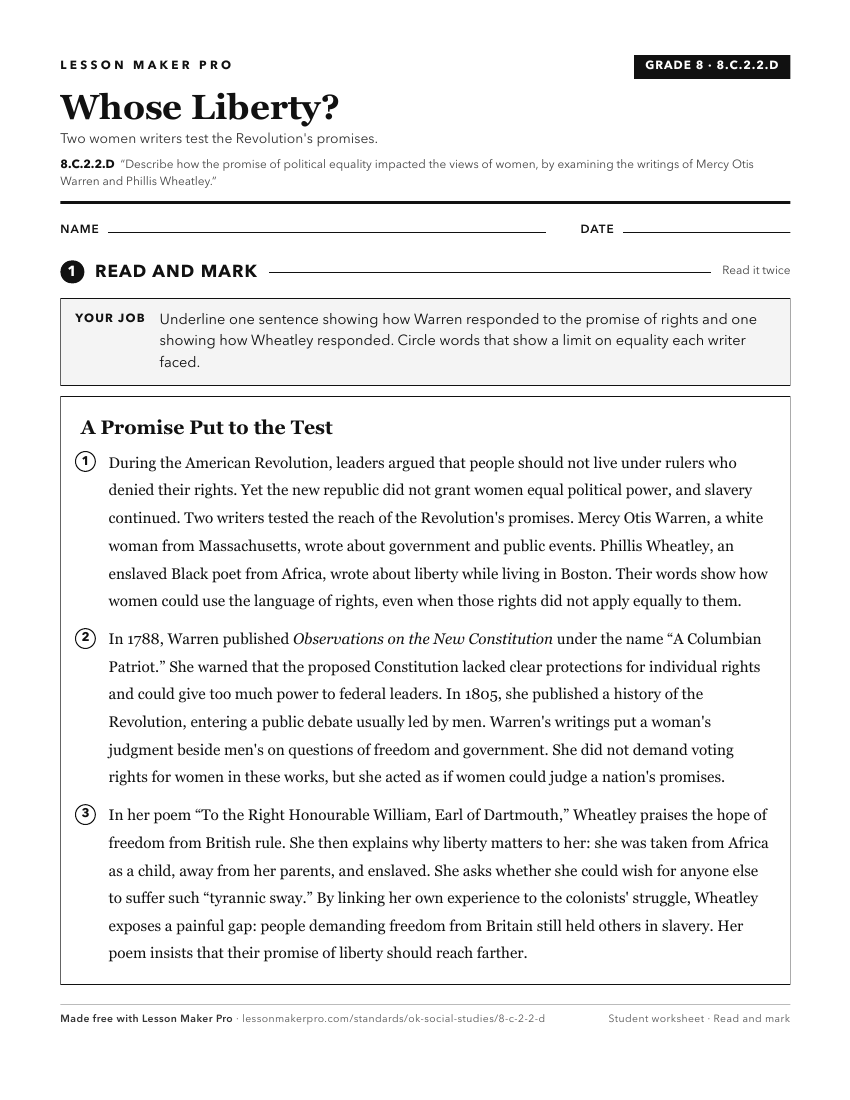
A ready-to-print activity worksheet aligned to 8.C.2.2.D, with an answer key for the teacher on its own page. No account needed.
PDF, US Letter, prints cleanly in black and white.
Download the worksheetKeep exploring
Related Standards
- 8.C.10.4
Evaluate the goals and efforts of the Women’s Suffrage Movement toward political equality.
- 5.C.4.5.E
ideological writing (e.g., Thomas Paine, Mercy Otis Warren, Phillis Wheatley).
- 8.C.10.1.D
Examine the role of women as the primary workforce in New England textile factories and leaders in the reform of working conditions.
- USH.C.7.2.E
Compare the changing roles of women including the goals of the Women’s Liberation Movement and the National Organization of Women, comparing the views of Betty ...
Turn this exact standard into a lesson
Grade, subject, topic, and the complete standard are prefilled. Create one free, no account needed.
Also for this standard:Make a WorksheetMake a QuizMake a Sub Lesson