Oklahoma Social Studies 7.P.2.1
Standard Cluster
- 7.P.2
- Use interdisciplinary tools to acquire, apply, and evaluate content understanding of the four strands of social studies.
Demonstrate an understanding of the principles of government, the benefits of democratic systems, and their responsibilities as citizens. Compare and analyze civic virtues and democratic principles in historic and global settings, explaining how they influence political institutions. Compare the powers and responsibilities of the United States of America’s government to other forms of government, including the roles and rights of citizens. Examine the impact of constitutions, laws, treaties, and international agreements on the limits of government, including the concepts of sovereignty and the rule of law.
Oklahoma Academic Standards for Social Studies (2026) · 7.P.2
Cluster contents
Standards in This Cluster
7.P.2.1 is a cluster heading. These are the individual standards under it.
- 7.P.2.1.A
Compare and analyze civic virtues and democratic principles in historic and global settings, explaining how they influence political institutions.
- 7.P.2.1.B
Compare the powers and responsibilities of the United States of America’s government to other forms of government, including the roles and rights of citizens.
- 7.P.2.1.C
Examine the impact of constitutions, laws, treaties, and international agreements on the limits of government, including the concepts of sovereignty and the rul...
Teacher's field guide
What This Cluster Means
What Students Need to Do
- Students compare who makes laws and what citizens can do in the United States, ancient Athens, and the United Kingdom. They explain how voting, constitutions, and agreements between countries shape government decisions.
What Mastery Looks Like
- A student can explain why only male citizens voted in ancient Athens and why U.S. citizens elect representatives. They can name a limit the U.S. Constitution places on leaders. They can explain how countries accept treaty commitments while keeping the power to govern themselves.
Common Misconceptions
- Students may assume everyone in ancient Athens could vote or that British citizens elect their prime minister directly. They may think a president can ignore the Constitution or that a treaty automatically overrides every country's laws.
How to Assess It
- Exit ticket: Who made decisions in ancient Athens, and who makes laws in the United States? Name one group Athens excluded and one limit the U.S. Constitution places on leaders.
Lesson moves
Ways to Teach It
Give pairs Athens, U.S., and U.K. cards; have them match printed descriptions of voters, lawmakers, and leaders to each government.
Ask, "Should a majority be able to silence a minority?" Have students use Athens and the U.S. Constitution to defend an answer.
Play "Who Can Do It?" Read "veto a bill" or "strike down a law"; students hold up president, Congress, or courts.
Read a short UN summary of the Paris Agreement; ask why countries can choose to join and what they promise to do.
Free download
Printable 7.P.2.1 Worksheet
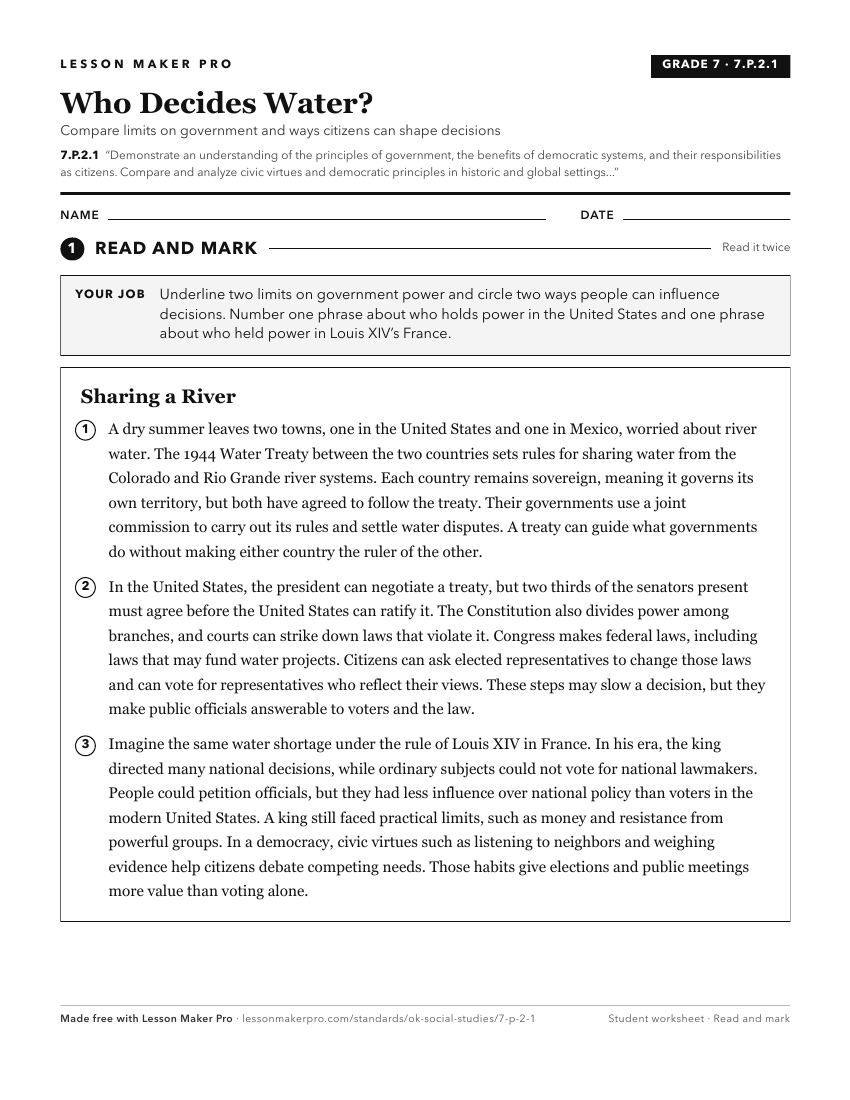
A ready-to-print activity worksheet aligned to 7.P.2.1, with an answer key for the teacher on its own page. No account needed.
PDF, US Letter, prints cleanly in black and white.
Download the worksheetKeep exploring
Related Standards
- E.P.2.1
Demonstrate an understanding of the principles of government, the benefits of democratic systems, and their responsibilities as citizens.
- 3.P.2.1
The 3rd Grade version of this standard.
- WG.P.2.1
Demonstrate an understanding of the principles of government, the benefits of democratic systems, and their responsibilities as citizens.
- 2.P.2.1
The 2nd Grade version of this standard.
Turn this cluster into a lesson
Grade, subject, topic, and the complete cluster are prefilled. Create one free, no account needed.
Also for this cluster:Make a WorksheetMake a QuizMake a Sub Lesson