Oklahoma Social Studies 3.P.2.1
Standard Cluster
- 3.P.2
- Use interdisciplinary tools to acquire, apply, and evaluate content understanding of the four strands of social studies.
Demonstrate an understanding of the principles of government, the benefits of democratic systems, and their responsibilities as citizens. Describe civic virtues and democratic principles such as equality, fairness, and respect for legitimate authority. Describe the basic structure of government at the local, state, and Tribal levels, including the importance of citizen participation. Explain the purposes of laws and government in the community and state, examining the role of elected officials in making laws.
Oklahoma Academic Standards for Social Studies (2026) · 3.P.2
Cluster contents
Standards in This Cluster
3.P.2.1 is a cluster heading. These are the individual standards under it.
- 3.P.2.1.A
Describe civic virtues and democratic principles such as equality, fairness, and respect for legitimate authority.
- 3.P.2.1.B
Describe the basic structure of government at the local, state, and Tribal levels, including the importance of citizen participation
- 3.P.2.1.C
Explain the purposes of laws and government in the community and state, examining the role of elected officials in making laws.
Teacher's field guide
What This Cluster Means
What Students Need to Do
- Students explain why communities make laws and how elected officials help make them. They compare local, state, and Tribal governments. They explain how voting, speaking up, fairness, and respect for lawful authority help communities make decisions.
What Mastery Looks Like
- A student can match a city council, state legislature, and Tribal council to the communities each serves. They can explain that Tribal nations govern themselves, not as branches of the state. They can give a fair reason for a law and describe how residents can share their views.
Common Misconceptions
- Students may think Tribal governments are branches of state government. They may think one leader makes laws without public input. They may think laws exist only to punish people, or that fairness means getting their own way.
How to Assess It
- Exit ticket: A town wants a rule that bikes must be walked through its crowded park. Name who could vote on the rule, how residents could speak up, and why the rule might be fair.
Lesson moves
Ways to Teach It
Give pairs government cards and issue cards, such as city park rules, state highways, and Tribal nation services; have them sort and explain.
Ask, "Should the town close its playground after dark?" Have students write one fair reason, one concern, and who should hear their views.
Play a card match with law, elected official, and citizen action cards; students build a chain showing how a safety rule gets made.
Read a city council agenda with students and ask which item affects families and how residents could comment.
Free download
Printable 3.P.2.1 Worksheet
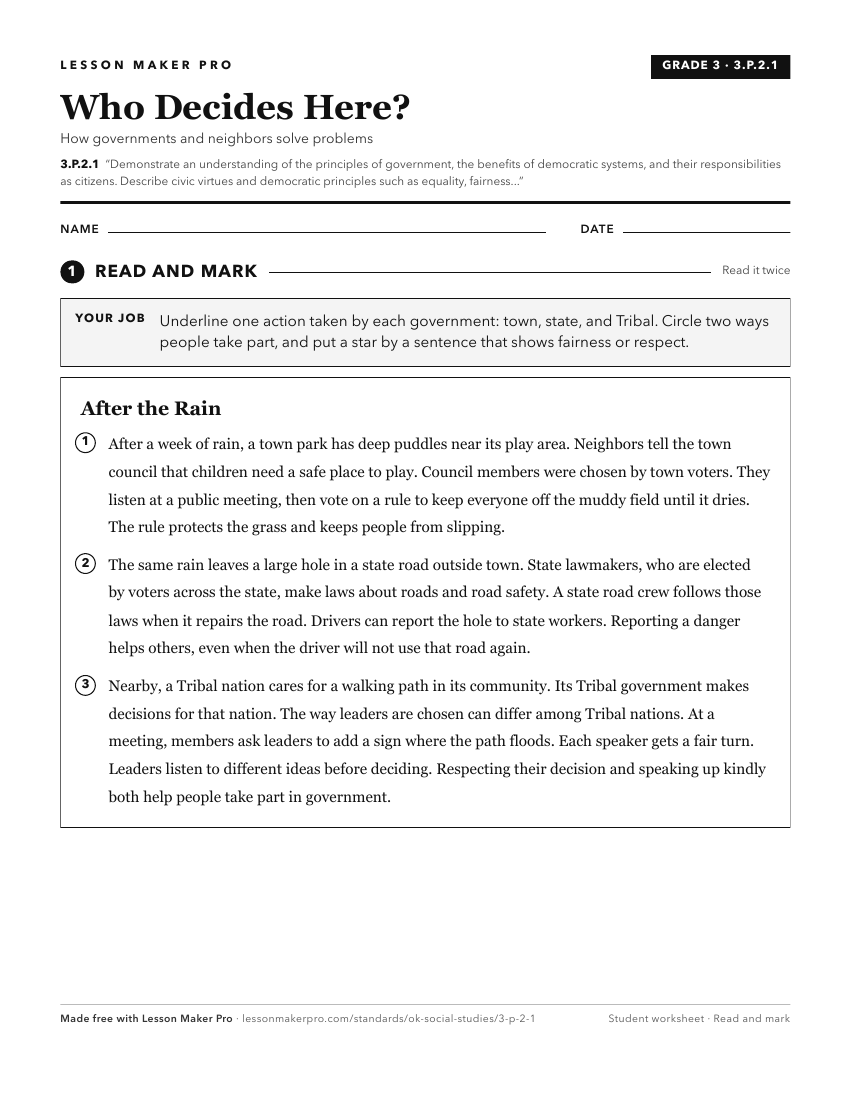
A ready-to-print activity worksheet aligned to 3.P.2.1, with an answer key for the teacher on its own page. No account needed.
PDF, US Letter, prints cleanly in black and white.
Download the worksheetKeep exploring
Related Standards
- 7.P.2.1
The 7th Grade version of this standard.
- E.P.2.1
Demonstrate an understanding of the principles of government, the benefits of democratic systems, and their responsibilities as citizens.
- WG.P.2.1
Demonstrate an understanding of the principles of government, the benefits of democratic systems, and their responsibilities as citizens.
- 2.P.2.1
The 2nd Grade version of this standard.
Turn this cluster into a lesson
Grade, subject, topic, and the complete cluster are prefilled. Create one free, no account needed.
Also for this cluster:Make a WorksheetMake a QuizMake a Sub Lesson