Oklahoma Social Studies 7.P.1.2
Standard Cluster
- 7.P.1
- Apply critical thinking skills to address authentic civic issues.
Develop practices which demonstrate an understanding that social studies involves the evaluation of evidence. Investigate and propose answers to essential questions representing complex enduring issues across the social studies disciplines. Answer supporting questions related to social studies content knowledge and make connections to different interpretations. Develop deeper critical thinking skills by questioning assumptions and identifying inconsistencies or errors in reasoning. Demonstrate understanding of social studies content through the development of self-driven inquiries and the completion of authentic tasks and assessments.
Oklahoma Academic Standards for Social Studies (2026) · 7.P.1
Cluster contents
Standards in This Cluster
7.P.1.2 is a cluster heading. These are the individual standards under it.
- 7.P.1.2.A
Investigate and propose answers to essential questions representing complex enduring issues across the social studies disciplines.
- 7.P.1.2.B
Answer supporting questions related to social studies content knowledge and make connections to different interpretations.
- 7.P.1.2.C
Develop deeper critical thinking skills by questioning assumptions and identifying inconsistencies or errors in reasoning.
- 7.P.1.2.D
Demonstrate understanding of social studies content through the development of self-driven inquiries and the completion of authentic tasks and assessments.
Teacher's field guide
What This Cluster Means
What Students Need to Do
- Students choose a question about a community issue or past event, then break it into smaller questions they can investigate. They compare sources, check claims, and use evidence to explain an answer while considering other views.
What Mastery Looks Like
- A student finds sources that help answer their question and explains what each source can and cannot show. They give an evidence-based answer, explain a different view, and point out an assumption that needs checking.
Common Misconceptions
- Students may treat a strong opinion as evidence or assume one source tells the whole story. They may think two different accounts mean one person is lying, rather than checking dates, purpose, and missing facts.
How to Assess It
- Exit ticket: The town may turn an empty lot into a park. Give students a sample $50,000 cost estimate and a resident quote, "Kids need play space," then ask for a tentative answer, one assumption, and one question to investigate next.
Lesson moves
Ways to Teach It
Give groups a neighborhood map, a sample park budget, and two resident quotes; have them sort each source by what it can and cannot show.
Ask, "Should an empty lot become a park? Who might disagree with you, and what evidence could change your mind?"
Play Claim Check: teams draw a claim about the lot and race to match it to a source or flag an assumption.
Use a posted city council agenda to pick a proposed decision; write a three-sentence recommendation and list one fact you still need.
Free download
Printable 7.P.1.2 Worksheet
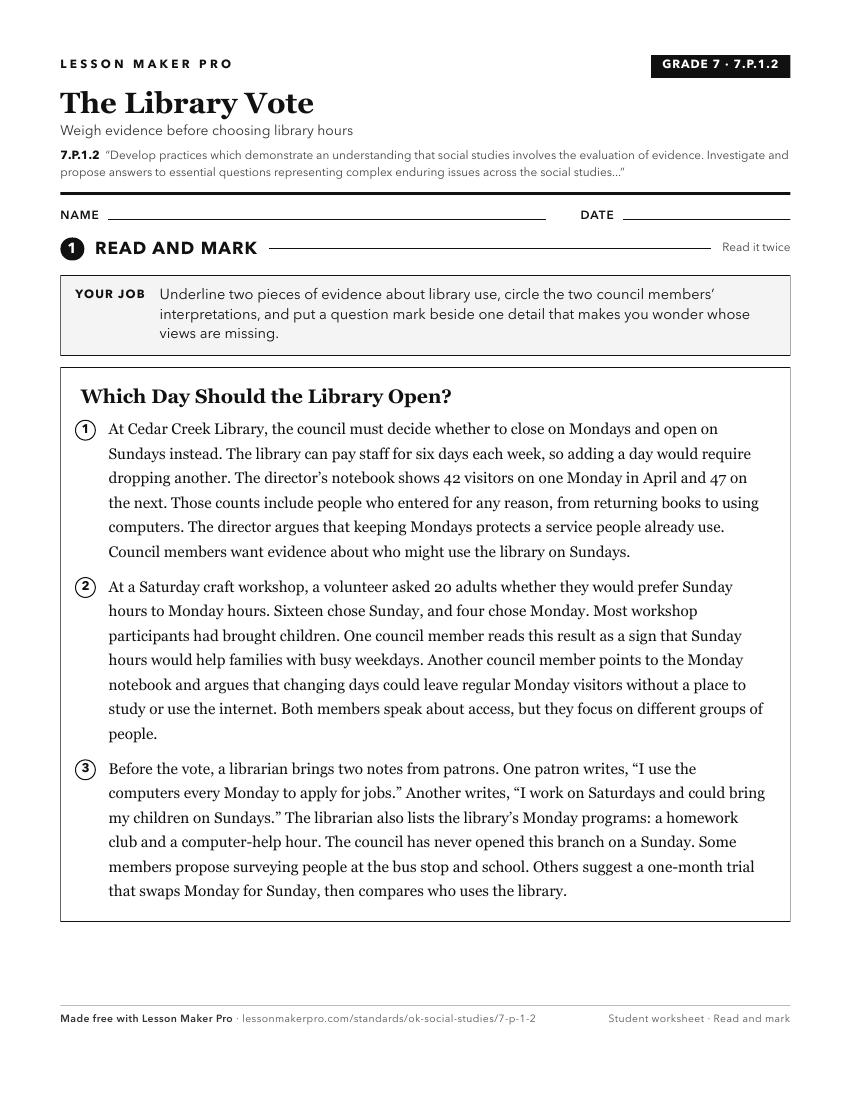
A ready-to-print activity worksheet aligned to 7.P.1.2, with an answer key for the teacher on its own page. No account needed.
PDF, US Letter, prints cleanly in black and white.
Download the worksheetKeep exploring
Related Standards
Turn this cluster into a lesson
Grade, subject, topic, and the complete cluster are prefilled. Create one free, no account needed.
Also for this cluster:Make a WorksheetMake a QuizMake a Sub Lesson