Oklahoma Social Studies 6.P.1.2
Standard Cluster
- 6.P.1
- Apply critical thinking skills to address authentic civic issues.
Develop practices which demonstrate an understanding that social studies involves the evaluation of evidence. Investigate and propose answers to essential questions representing complex enduring issues across the social studies disciplines. Answer supporting questions related to social studies content knowledge and make connections to different interpretations. Develop deeper critical thinking skills by questioning assumptions and identifying inconsistencies or errors in reasoning. Demonstrate understanding of social studies content through the development of self-driven inquiries and the completion of authentic tasks and assessments.
Oklahoma Academic Standards for Social Studies (2026) · 6.P.1
Cluster contents
Standards in This Cluster
6.P.1.2 is a cluster heading. These are the individual standards under it.
- 6.P.1.2.A
Investigate and propose answers to essential questions representing complex enduring issues across the social studies disciplines.
- 6.P.1.2.B
Answer supporting questions related to social studies content knowledge and make connections to different interpretations.
- 6.P.1.2.C
Develop deeper critical thinking skills by questioning assumptions and identifying inconsistencies or errors in reasoning.
- 6.P.1.2.D
Demonstrate understanding of social studies content through the development of self-driven inquiries and the completion of authentic tasks and assessments.
Teacher's field guide
What This Cluster Means
What Students Need to Do
- Students ask a broad question about an issue people have faced in different places and times. They break it into smaller questions and check maps, data, and accounts before answering. They consider other views and question their own assumptions.
What Mastery Looks Like
- A student asks who uses a town's water and why, then uses a chart and two accounts to answer. They write a short recommendation that cites evidence, addresses another view, and names a fact they still need.
Common Misconceptions
- Students may treat a personal opinion or one person's quote as proof. They may assume the group using the most water is wasting it. They may dismiss a conflicting account without checking who made it and why.
How to Assess It
- Show this data: homes use 20% of town water, and farms use 60%. Ask, 'Should the town ban lawn watering?' Require one claim backed by the data, one missing fact, and one other viewpoint.
Lesson moves
Ways to Teach It
Give pairs a water-use chart, drought map, and two resident quotes; have them sort cards into evidence, claims, and unanswered questions.
Ask, 'Should farms or homes cut water use first?' Have students cite the chart and challenge one assumption in a partner's answer.
Play evidence match: teams pair three water policy claims with source cards, then earn a point for naming a claim the sources cannot support.
Use a local water bill or city conservation notice to draft a three-sentence recommendation for a town meeting, with one question for officials.
Free download
Printable 6.P.1.2 Worksheet
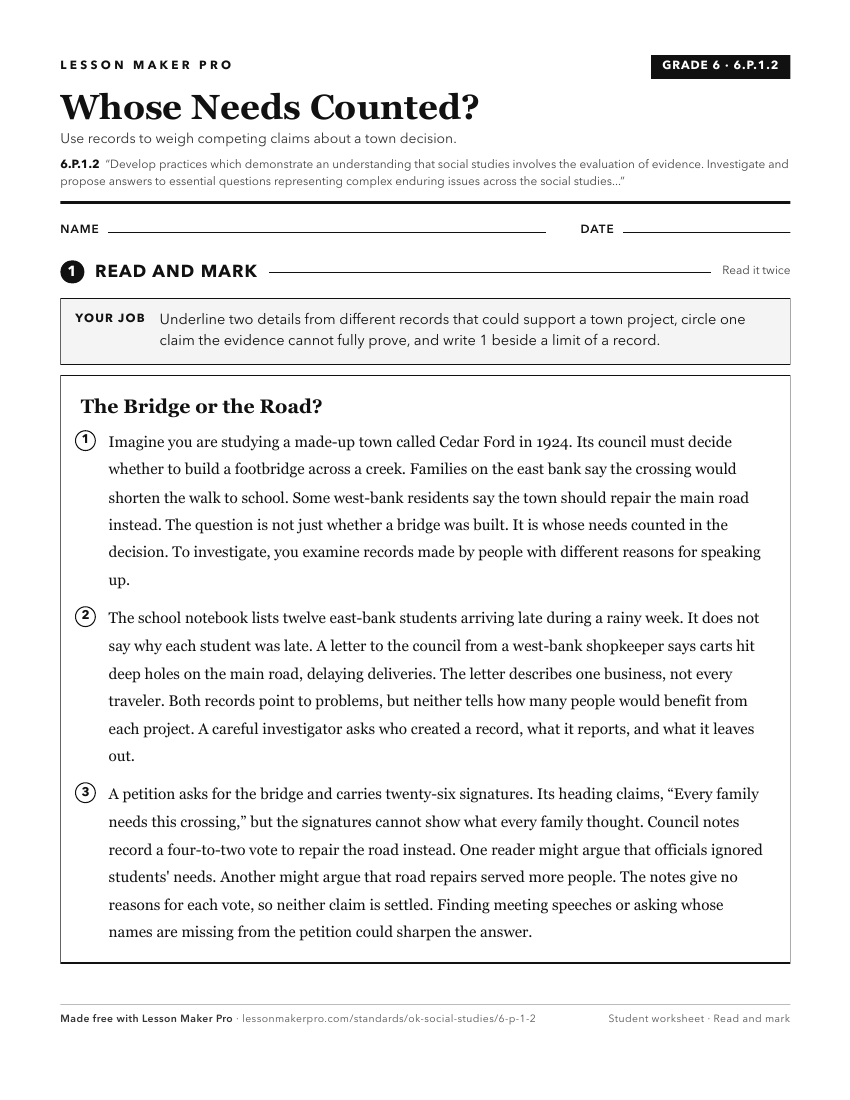
A ready-to-print activity worksheet aligned to 6.P.1.2, with an answer key for the teacher on its own page. No account needed.
PDF, US Letter, prints cleanly in black and white.
Download the worksheetKeep exploring
Related Standards
Turn this cluster into a lesson
Grade, subject, topic, and the complete cluster are prefilled. Create one free, no account needed.
Also for this cluster:Make a WorksheetMake a QuizMake a Sub Lesson