Oklahoma Social Studies 7.C.3.5
Standard Cluster
- 7.C.3
- Identify the distribution and demographic patterns of human populations of the Eastern Hemisphere.
Describe the reasons for emigration and immigration. Examine the role of pull factors (e.g., economic opportunity, education, family) and the role of push factors (e.g., political unrest, religious persecution, war, famine, natural disasters) which motivate both emigration and immigration, differentiating between involuntary and voluntary migration. Describe contemporary reasons and examples of migration (e.g., drought in agricultural eastern Africa resulting in urbanization, overpopulation of India’s cities due to employment options in high-tech industries).
Oklahoma Academic Standards for Social Studies (2026) · 7.C.3
Cluster contents
Standards in This Cluster
7.C.3.5 is a cluster heading. These are the individual standards under it.
- 7.C.3.5.A
Examine the role of pull factors (e.g., economic opportunity, education, family) and the role of push factors (e.g., political unrest, religious persecution, wa...
- 7.C.3.5.B
Describe contemporary reasons and examples of migration (e.g., drought in agricultural eastern Africa resulting in urbanization, overpopulation of India’s citie...
Teacher's field guide
What This Cluster Means
What Students Need to Do
- Students explain why people leave one place and choose another, using push and pull factors. They identify where a person emigrates from and immigrates to when crossing a national border. They compare moves people choose with moves made under pressure from war, drought, or other threats.
What Mastery Looks Like
- Given a short migration story, a student names the departure and destination and explains the reasons for leaving and arriving. They use emigrant and immigrant correctly for a cross-border move and call a move within one country internal migration. They use details from the story to explain how much choice the person had.
Common Misconceptions
- Students may call a move from a farm to a city immigration, even when no national border is crossed. They may call a job at the destination a push factor rather than a pull factor. They may treat every move as either fully chosen or fully forced, even when drought leaves few options.
How to Assess It
- Exit ticket: A family leaves a drought-hit Ethiopian farm for jobs in Addis Ababa; a worker leaves Ethiopia for a job in Kenya. For each move, name a push or pull factor, label it internal or cross-border, and say who can be called an emigrant and an immigrant.
Lesson moves
Ways to Teach It
Give pairs a map and four migration cards; have them trace routes, mark each move internal or cross-border, and label push and pull factors.
Ask: “Why might a family leave a drought-hit farm for a city even if they would rather stay?” Have students cite two clues.
Play push-or-pull bingo: read short war, drought, school, and family reunion scenarios; students mark push or pull and explain one choice.
Show a Bengaluru job listing and a city map; students sketch a worker's move from a rural area and name the pull factor.
Free download
Printable 7.C.3.5 Worksheet
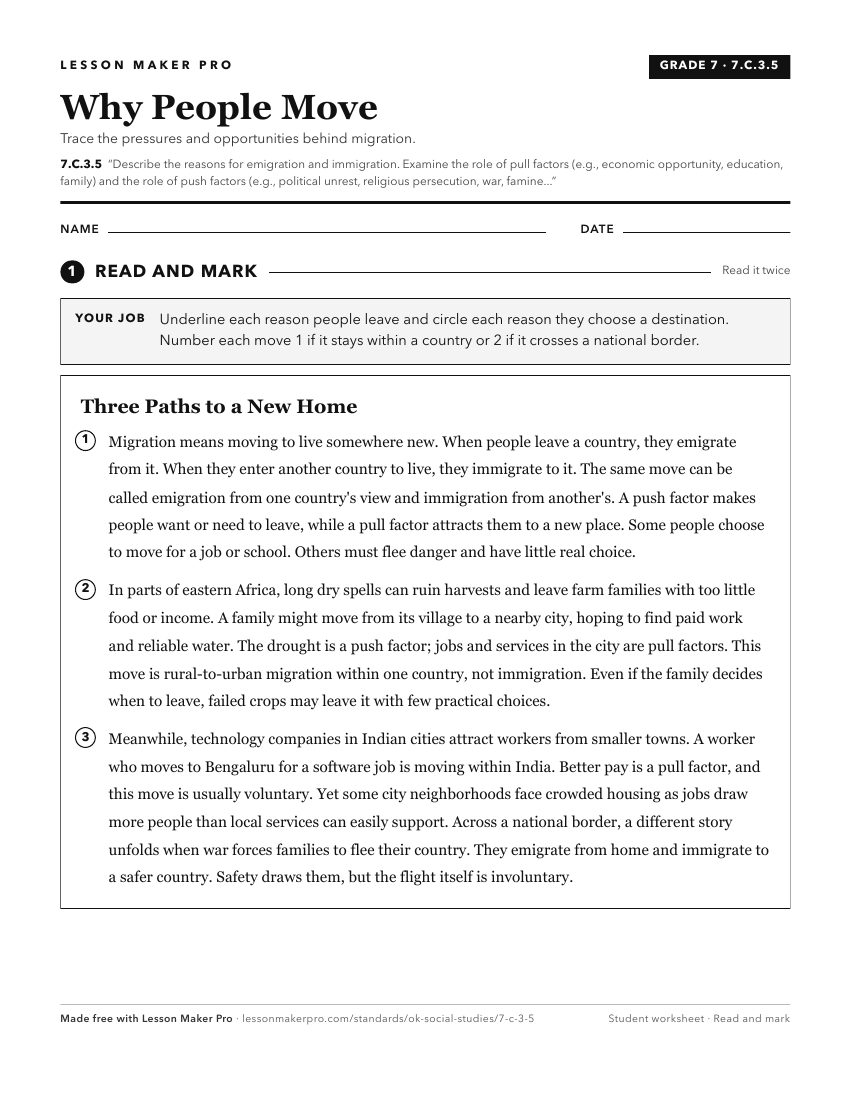
A ready-to-print activity worksheet aligned to 7.C.3.5, with an answer key for the teacher on its own page. No account needed.
PDF, US Letter, prints cleanly in black and white.
Download the worksheetKeep exploring
Related Standards
Turn this cluster into a lesson
Grade, subject, topic, and the complete cluster are prefilled. Create one free, no account needed.
Also for this cluster:Make a WorksheetMake a QuizMake a Sub Lesson