Oklahoma Social Studies 6.C.2.3
The Standard
- 6.C.2
- Analyze the physical systems of the major regions of the Western Hemisphere.
Explain how the factors of latitude, elevation, and proximity to bodies of water influence climate and human activities.
Oklahoma Academic Standards for Social Studies (2026) · 6.C.2
Teacher's field guide
What This Standard Means
What Students Need to Do
- Students compare places using latitude, elevation, and distance from large bodies of water. They explain how those factors affect climate, then connect the climate to choices about crops, clothing, or housing.
What Mastery Looks Like
- A student can explain why a place farther from the equator is generally cooler than a similar place closer to it. They can also explain why a mountain town is cooler or a coastal town has milder temperature swings, then predict a sensible choice for daily life.
Common Misconceptions
- Students may think every place near the equator is hot, even high on a mountain. They may assume coastal towns are always warmer than inland towns, rather than expecting smaller temperature swings. Some confuse latitude with elevation.
How to Assess It
- Exit ticket: Towns B, C, and D are like low-latitude coastal Town A, except B is farther from the equator, C is inland, and D is higher up. For each town, predict a climate difference and one possible change to farming, clothing, or housing.
Lesson moves
Ways to Teach It
Give pairs a globe, flashlight, and four town cards labeled with elevation and coast distance; have them sort the towns by likely climate.
Ask students to write why farmers might choose different crops in a coastal valley and a nearby mountain village at the same latitude.
Play climate detective with town cards; read 'cool summers, high elevation,' and have pairs name the town and explain their choice.
Look up January average temperatures for Denver and San Francisco; have students pack for each trip and explain their choices.
Free download
Printable 6.C.2.3 Worksheet
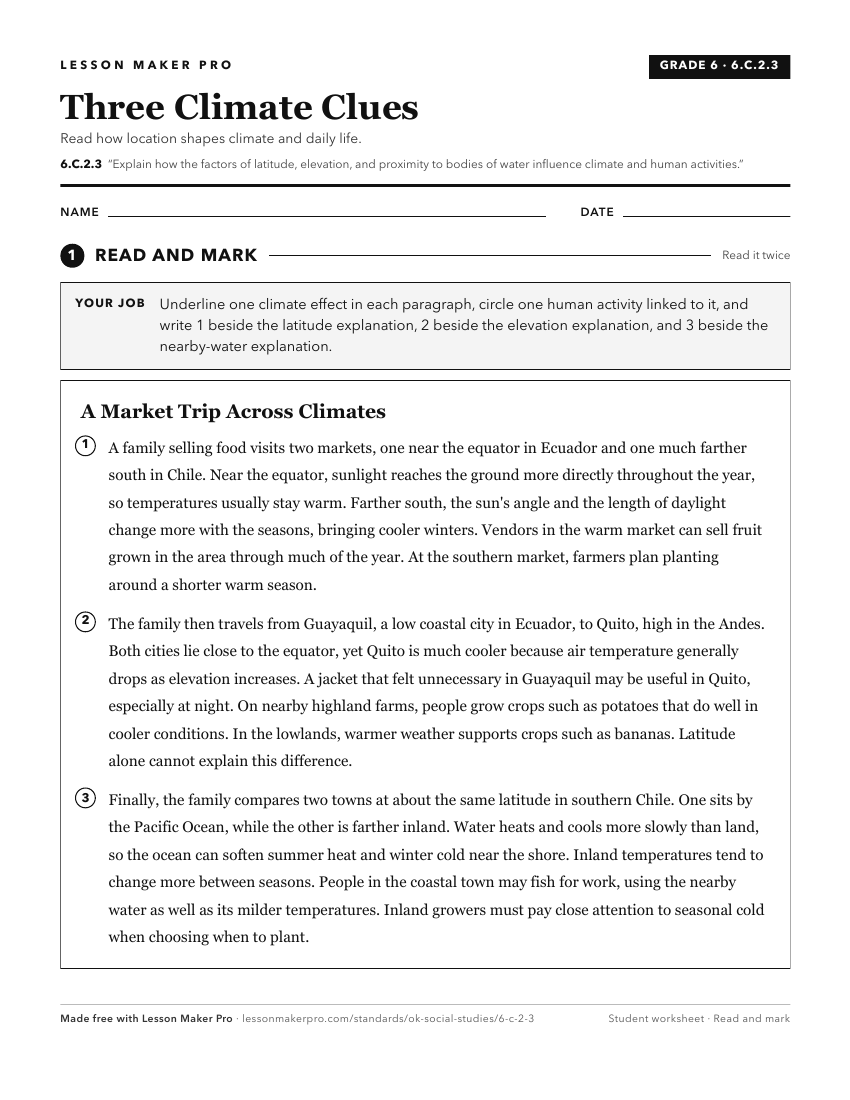
A ready-to-print activity worksheet aligned to 6.C.2.3, with an answer key for the teacher on its own page. No account needed.
PDF, US Letter, prints cleanly in black and white.
Download the worksheetKeep exploring
Related Standards
- 2.C.3.7
Examine how weather patterns, seasons, climate, and the physical features of a place can affect where and how people live.
- 4.C.2.2.C
Draw conclusions from geographic data to explain how climate, vegetation, and bodies of water can affect the location and growth of settlements and the developm...
- WG.C.6.5
Explain how changes in the physical environment and political environment influence changes in economic activity within a region.
- 7.C.2.2
Describe how the physical environment can influence human population distribution, population growth, settlement patterns, land use, and economic activities.
Turn this exact standard into a lesson
Grade, subject, topic, and the complete standard are prefilled. Create one free, no account needed.
Also for this standard:Make a WorksheetMake a QuizMake a Sub Lesson