Oklahoma Social Studies 5.P.2.2.A
The Standard
- 5.P.2
- Use interdisciplinary tools to acquire, apply, and evaluate content understanding of the four strands of social studies.
- 5.P.2.2
- Develop skills which demonstrate an understanding of historical events and the people who shaped our history.
Compare and analyze primary and secondary sources from the past and present, including the intended audience and author’s purpose.
Oklahoma Academic Standards for Social Studies (2026) · 5.P.2.2
Teacher's field guide
What This Standard Means
What Students Need to Do
- Students compare a record made at the time with a later account of the same event. They use dates, wording, and other clues to explain who made each source, who it was for, and why it was made.
What Mastery Looks Like
- A student can tell why an old bicycle ad is a firsthand source and a modern history article is a later account. They can point to words in each that show its audience and explain why the ad sells while the article informs.
Common Misconceptions
- Students may think every old source is firsthand and every new source is a later account. They may miss that an ad can leave out problems because its writer wants to sell something.
How to Assess It
- Exit ticket: Compare these sample sources: a 1910 bicycle ad says, “Buy our safe new model!” and a modern textbook says, “Bicycles changed city travel.” Name each source type, its likely audience and purpose, and one difference in what it tells you.
Lesson moves
Ways to Teach It
Print a 1910 bicycle ad and a current bicycle history article; pairs underline clues to each audience and purpose.
Ask students to write who would read the bicycle ad and the history article, then name one detail each might leave out.
Play a source sort with a parade attendee's diary, a historian's article, today's parade interview, and a museum summary; require one clue per choice.
Compare today's cafeteria menu with a local news report about school lunches; name each audience and explain why the details differ.
Free download
Printable 5.P.2.2.A Worksheet
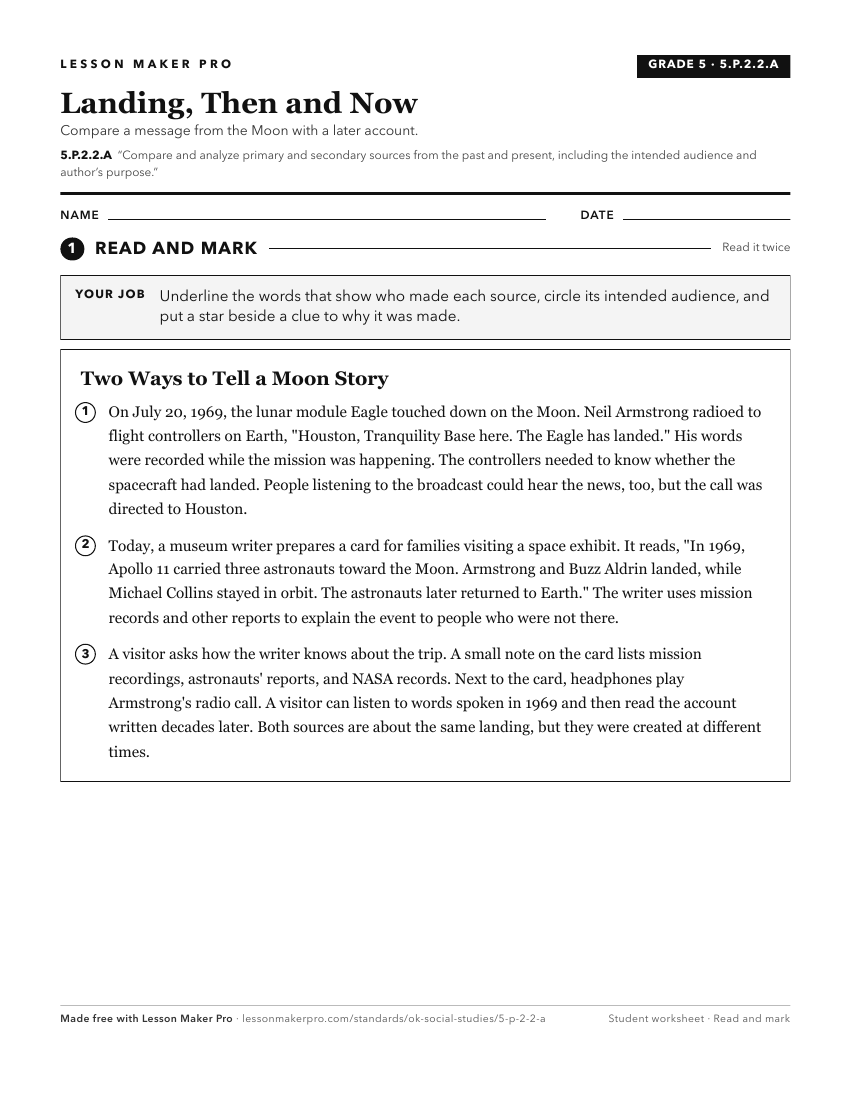
A ready-to-print activity worksheet aligned to 5.P.2.2.A, with an answer key for the teacher on its own page. No account needed.
PDF, US Letter, prints cleanly in black and white.
Download the worksheetKeep exploring
Related Standards
- 6.P.2.2.A
Gather and draw conclusions from sources of evidence, identifying plausible author, occasion, audience, purpose, and possible bias.
- 8.P.2.2.A
Gather and draw conclusions from sources of evidence, identifying plausible author, occasion, audience, purpose, and possible bias.
- 4.P.2.2.A
The 4th Grade version of this standard.
- 7.P.2.2.A
Gather and draw conclusions from sources of evidence, identifying plausible author, occasion, audience, purpose, and possible bias.
Turn this exact standard into a lesson
Grade, subject, topic, and the complete standard are prefilled. Create one free, no account needed.
Also for this standard:Make a WorksheetMake a QuizMake a Sub Lesson