Oklahoma Social Studies 5.C.3.4
Standard Cluster
- 5.C.3
- Analyze the series of events and policies which led colonists to seek and declare independence.
Explain the meaning of the key ideals expressed in the Declaration of Independence, drafted by Thomas Jefferson and the Committee of Five, adopted July 4, 1776, including natural, unalienable rights, such as life, liberty, and the pursuit of happiness the equality of all individuals the purpose of government the principle of self-rule by consent of the governed specific colonial grievances and rights as British citizens.
Oklahoma Academic Standards for Social Studies (2026) · 5.C.3
Cluster contents
Standards in This Cluster
5.C.3.4 is a cluster heading. These are the individual standards under it.
Teacher's field guide
What This Cluster Means
What Students Need to Do
- Students explain the claim that people are equal and have rights to life, liberty, and the pursuit of happiness. They describe government's job as protecting those rights with the people's consent. They link complaints about taxes without consent and denied jury trials to the decision to leave Britain.
What Mastery Looks Like
- A student explains that rights belong to people and that government should protect them. They use a complaint about taxes or jury trials to explain why colonists objected to British rule. They distinguish the Declaration's claim of equality from how enslaved people and women were treated in 1776.
Common Misconceptions
- Some students think government gives people natural rights, rather than protecting rights people already have. Others think the claim of equality meant everyone was treated equally in 1776. Students may think colonists opposed all taxes, rather than taxes imposed without their consent.
How to Assess It
- On an exit ticket, ask: "Why did colonists object to taxes imposed without their consent? Name one right the Declaration said government should protect."
Lesson moves
Ways to Teach It
Have pairs sort four printed Declaration excerpts into rights, consent, and grievances, then explain one placement.
Ask students to write: Who was left out of the Declaration's promise of equality in 1776?
Give teams cards labeled "taxes without consent," "trial by jury," and "consent of the governed" to match with plain-language meanings.
Look up a local city council agenda and identify elected members; connect elections to consent of the governed.
Free download
Printable 5.C.3.4 Worksheet
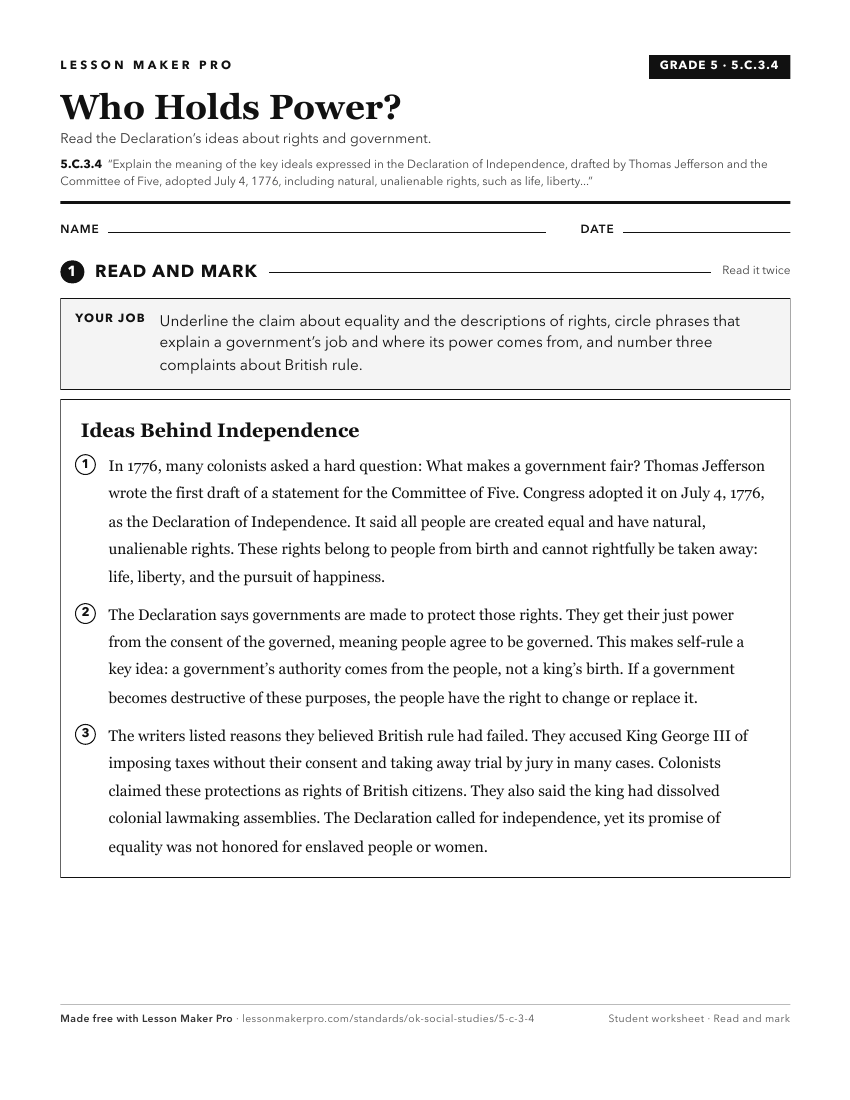
A ready-to-print activity worksheet aligned to 5.C.3.4, with an answer key for the teacher on its own page. No account needed.
PDF, US Letter, prints cleanly in black and white.
Download the worksheetKeep exploring
Related Standards
- 8.C.1.5
Analyze the significance of the Declaration of Independence as a founding statement of American thought on the constitutional republic and the purpose of govern...
- 5.C.5.3
Read, discuss, and explain the Declaration of Independence and how it has shaped the United States of America. Explain the key debates and compromises of the Co...
- 4.C.1.1.E
Explain basic principles expressed in the Declaration of Independence.
- 8.C.1.5.A
Read and discuss the Declaration of Independence as drafted by Thomas Jefferson, influenced by the Committee of Five, and adopted July 4, 1776.
Turn this cluster into a lesson
Grade, subject, topic, and the complete cluster are prefilled. Create one free, no account needed.
Also for this cluster:Make a WorksheetMake a QuizMake a Sub Lesson