Oklahoma Social Studies 4.P.2.1
Standard Cluster
- 4.P.2
- Use interdisciplinary tools to acquire, apply, and evaluate content understanding of the four strands of social studies.
Demonstrate an understanding of the principles of government, the benefits of democratic systems, and their responsibilities as citizens. Explain democratic principles in historic documents by identifying examples of civic virtues and principles at work in state and national settings. Explain the structure, responsibilities, and powers exercised by officials of the national government and describe ways informed citizens can and should participate. Examine the principles of the Constitution of the United States of America, including how laws are made in a democratic society and are used to protect individual rights.
Oklahoma Academic Standards for Social Studies (2026) · 4.P.2
Cluster contents
Standards in This Cluster
4.P.2.1 is a cluster heading. These are the individual standards under it.
- 4.P.2.1.A
Explain democratic principles in historic documents by identifying examples of civic virtues and principles at work in state and national settings.
- 4.P.2.1.B
Explain the structure, responsibilities, and powers exercised by officials of the national government and describe ways informed citizens can and should partici...
- 4.P.2.1.C
Examine the principles of the Constitution of the United States of America, including how laws are made in a democratic society and are used to protect individu...
Teacher's field guide
What This Cluster Means
What Students Need to Do
- Students find ideas about rights and the people’s voice in excerpts from the U.S. and Oklahoma constitutions. They explain what Congress, the president, and federal courts do with laws. They describe how citizens can learn about issues and speak up respectfully.
What Mastery Looks Like
- A student uses a line from either constitution to explain a right or the people’s role in government. They say Congress passes bills, the president signs or vetoes them, and courts can check laws against the Constitution. They use a fact to write a respectful note to an elected official.
Common Misconceptions
- Students may think the president makes laws alone or that courts vote on bills. They may think majority rule means people can ignore others’ rights, or that voting is the only way to participate.
How to Assess It
- Show “We the People” on an exit slip. Ask students what it says about government, who passes federal laws, and one way they could learn about and respond to a proposed law.
Lesson moves
Ways to Teach It
Give students Congress, president, and court role cards; act out a proposed national park law, a veto, and a rights challenge.
Put short lines from the Oklahoma and U.S. constitutions side by side; ask, “Where do you see fairness or power from the people?”
Play a three-branch sorting race with cards reading “votes on a bill,” “signs a bill,” and “checks whether a law violates rights.”
Print a short news report about a proposed federal law; students draft a two-sentence message to their representative citing one fact.
Free download
Printable 4.P.2.1 Worksheet
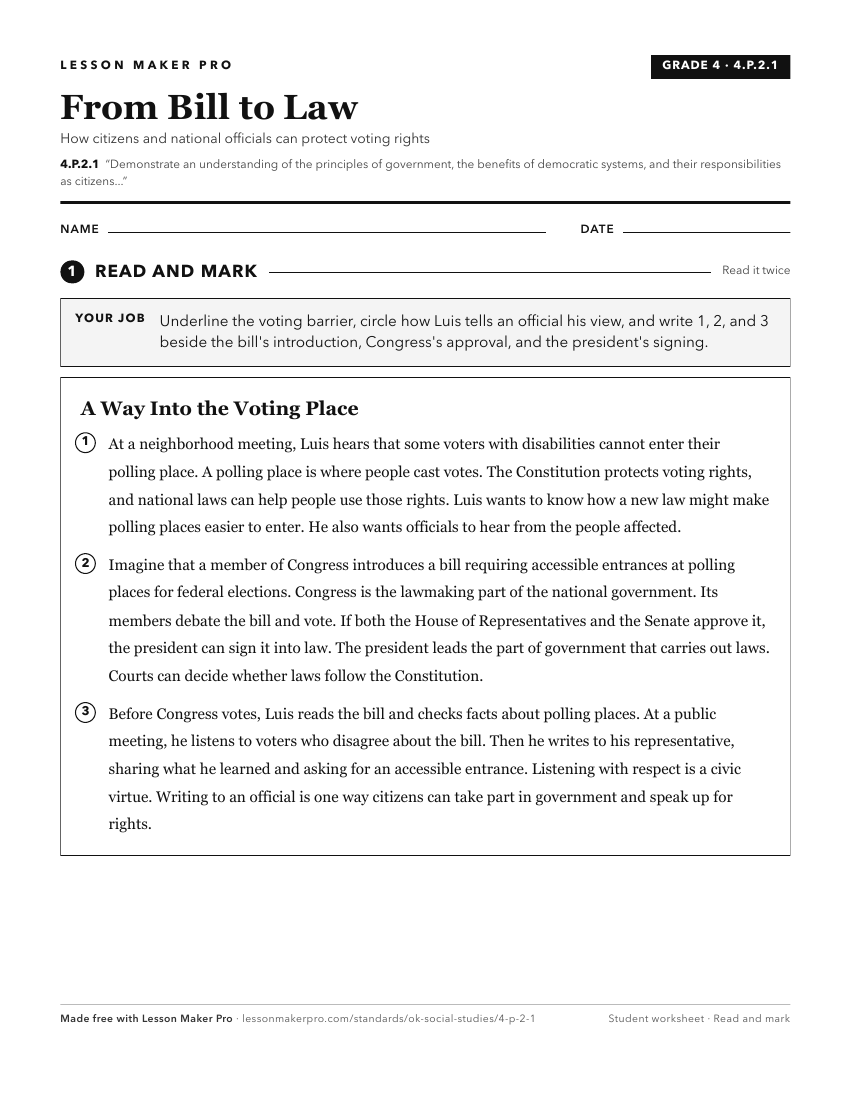
A ready-to-print activity worksheet aligned to 4.P.2.1, with an answer key for the teacher on its own page. No account needed.
PDF, US Letter, prints cleanly in black and white.
Download the worksheetKeep exploring
Related Standards
- TOT.P.2.1
Demonstrate an understanding of the principles of government, the benefits of democratic systems, and their responsibilities as citizens.
- OKH.P.2.1
Demonstrate an understanding of the principles of government, the benefits of democratic systems, and their responsibilities as citizens.
- USG.P.2.1
Demonstrate an understanding of the principles of government, the benefits of democratic systems, and their responsibilities as citizens.
- 8.P.2.1
The 8th Grade version of this standard.
Turn this cluster into a lesson
Grade, subject, topic, and the complete cluster are prefilled. Create one free, no account needed.
Also for this cluster:Make a WorksheetMake a QuizMake a Sub Lesson