Oklahoma Social Studies 1.C.4
Standard Cluster
Describe the characteristics of free enterprise. Explain how citizens are free to make choices about what to buy and that choices are necessary because wants cannot always be met. Differentiate between natural resources and human-made products. Explain how goods are produced from natural resources using human labor, identifying examples of goods and services that people in the local community produce (e.g., agricultural products, oil and gas, aerospace industry). Explain how people are paid for their labor and how some people own their own businesses to earn money. Compare the roles of consumers and producers in the United States of America’s economy and explain how individuals are both producers and consumers. Explain the costs and benefits of spending and saving in order to meet one’s needs and wants. Describe how setting goals and creating a budget help people obtain their needs and wants. Explain how historical American inventors and entrepreneurs used their ideas to help others (e.g., Robert Fulton, Samuel Morse, Alexander Graham Bell, Thomas Edison).
Oklahoma Academic Standards for Social Studies (2026)
Cluster contents
Standards in This Cluster
1.C.4 is a cluster heading. These are the individual standards under it.
- 1.C.4.1
Explain how citizens are free to make choices about what to buy and that choices are necessary because wants cannot always be met.
- 1.C.4.2
Differentiate between natural resources and human-made products.
- 1.C.4.3
Explain how goods are produced from natural resources using human labor, identifying examples of goods and services that people in the local community produce (...
- 1.C.4.4
Explain how people are paid for their labor and how some people own their own businesses to earn money.
- 1.C.4.5
Compare the roles of consumers and producers in the United States of America’s economy and explain how individuals are both producers and consumers.
- 1.C.4.6
Explain the costs and benefits of spending and saving in order to meet one’s needs and wants.
- 1.C.4.7
Describe how setting goals and creating a budget help people obtain their needs and wants.
- 1.C.4.8
Explain how historical American inventors and entrepreneurs used their ideas to help others (e.g., Robert Fulton, Samuel Morse, Alexander Graham Bell, Thomas Ed...
Teacher's field guide
What This Cluster Means
What Students Need to Do
- Students explain why people choose what to buy when money is limited. They trace goods from natural resources through paid work and name goods and services made locally. They identify buyers and sellers, plan spending and saving, and explain how an inventor's idea helped people.
What Mastery Looks Like
- Given $5, a $3 lunch, and a $4 toy, a student budgets for lunch, saves $2, and explains why the toy must wait. They name cotton as a natural resource, a shirt as a made good, and a haircut as a paid service. They explain that a baker can own a shop, sell bread, and buy apples, and that Bell's telephone helped people talk across distances.
Common Misconceptions
- Children may call a cotton shirt a natural resource rather than a product made from cotton. They may think a baker is only a seller, or that a haircut is not something people pay for. They may assume every worker owns the shop, or that saving means never spending money.
How to Assess It
- Exit ticket: Show a cotton plant, a shirt, and a baker selling bread and buying apples. Ask students to circle the natural resource, tell when the baker is a seller and a buyer, and plan how to use $5 when lunch costs $3 and a toy costs $4.
Lesson moves
Ways to Teach It
Give pairs raw cotton, fabric scraps, and tape to make tiny pillows; label the natural material, finished good, and work.
Ask students, 'With $5, a $3 lunch, and a $4 toy, what will you buy, save for, and why?'
Sort picture cards of a baker selling bread, that baker buying apples, and a barber cutting hair into producer, consumer, and service roles.
Show a photo of a local farm stand and an early telephone; ask what farmers sell and how Bell's invention helped people.
Free download
Printable 1.C.4 Worksheet
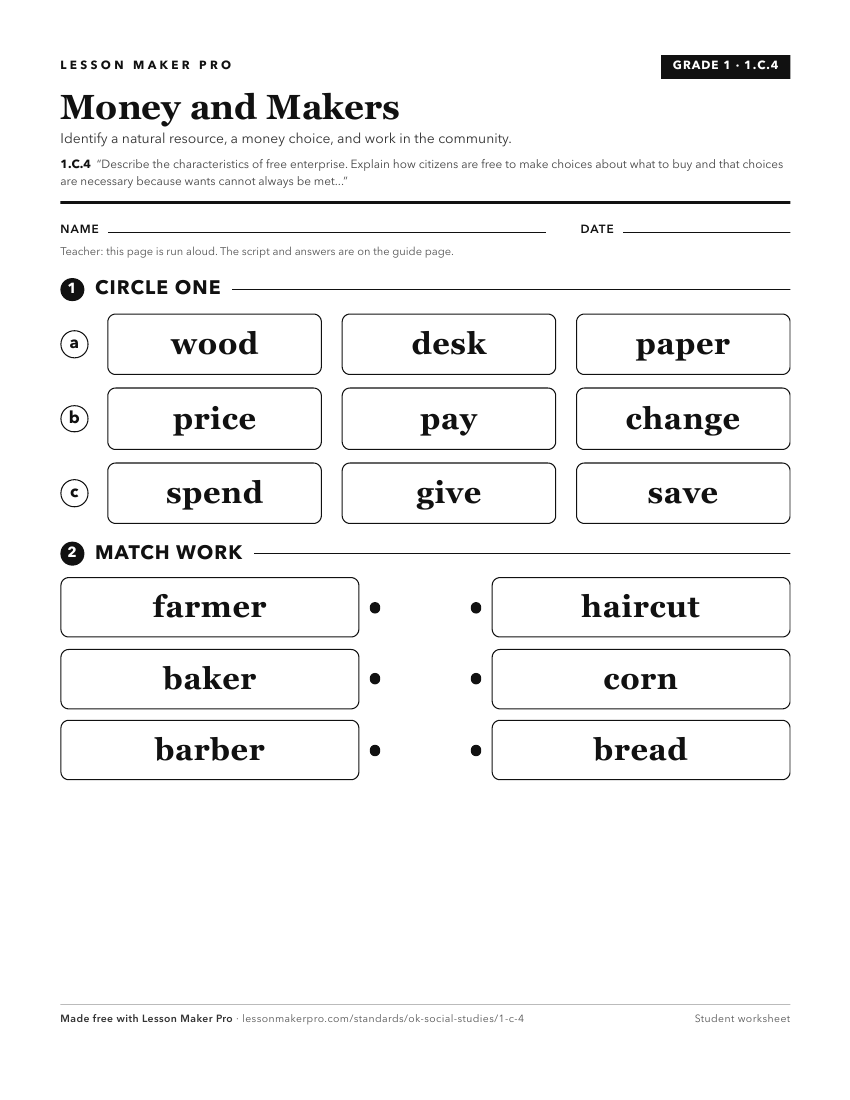
A ready-to-print activity worksheet aligned to 1.C.4, with an answer key for the teacher on its own page. No account needed.
PDF, US Letter, prints cleanly in black and white.
Download the worksheetKeep exploring
Related Standards
- 2.P.2.4.B
Describe freedom of choice when determining needs and wants in a free market, including costs and benefits resulting from economic decisions.
- 2.C.4
Understand basic economic concepts of a free market.
- 2.C.4.1
Describe how citizens live and work in a free market where they can make decisions about their work, what they want to produce, and what they want to buy.
- 3.P.2.4.B
Describe freedom of choice when determining needs and wants in a free market, including costs and benefits resulting from economic decisions.
Turn this cluster into a lesson
Grade, subject, topic, and the complete cluster are prefilled. Create one free, no account needed.
Also for this cluster:Make a WorksheetMake a QuizMake a Sub Lesson