Oklahoma Social Studies 2.C.4
Standard Cluster
Understand basic economic concepts of a free market. Describe how citizens live and work in a free market where they can make decisions about their work, what they want to produce, and what they want to buy. Explain how goods are produced by using natural resources (e.g., water, soil, wood, coal), human resources (e.g., people at work), and capital resources (e.g., machines, tools, computers, buildings). Explain that goods and services can be purchased by consumers using both money and credit. Explain how prices of goods and services are affected by supply and demand, using examples relevant to student experiences. Explain that scarcity is a condition of not being able to have all of the goods and services that a person wants or needs. Define trade and explain how trade can lead to interdependence among people and communities. Identify and describe financial institutions in the community, such as banks, as businesses that provide services to help people manage and save their earnings. Use biographies of American inventors and entrepreneurs, explaining how their ideas and work helped the nation grow (e.g., George Washington Carver, John Deere, Robert Fulton, Madam C.J. Walker, Henry Ford). Examine how inventors from other nations and other times made a difference in the way people live today (e.g., Leonardo da Vinci, Marie Curie, Louis Braille, Albert Einstein).
Oklahoma Academic Standards for Social Studies (2026)
Cluster contents
Standards in This Cluster
2.C.4 is a cluster heading. These are the individual standards under it.
- 2.C.4.1
Describe how citizens live and work in a free market where they can make decisions about their work, what they want to produce, and what they want to buy.
- 2.C.4.2
Explain how goods are produced by using natural resources (e.g., water, soil, wood, coal), human resources (e.g., people at work), and capital resources (e.g., ...
- 2.C.4.3
Explain that goods and services can be purchased by consumers using both money and credit.
- 2.C.4.4
Explain how prices of goods and services are affected by supply and demand, using examples relevant to student experiences.
- 2.C.4.5
Explain that scarcity is a condition of not being able to have all of the goods and services that a person wants or needs.
- 2.C.4.6
Define trade and explain how trade can lead to interdependence among people and communities.
- 2.C.4.7
Identify and describe financial institutions in the community, such as banks, as businesses that provide services to help people manage and save their earnings.
- 2.C.4.8
Use biographies of American inventors and entrepreneurs, explaining how their ideas and work helped the nation grow (e.g., George Washington Carver, John Deere,...
- 2.C.4.9
Examine how inventors from other nations and other times made a difference in the way people live today (e.g., Leonardo da Vinci, Marie Curie, Louis Braille, Al...
Teacher's field guide
What This Cluster Means
What Students Need to Do
- Students explain how people choose jobs, what to make, and which goods or services to buy with money or credit. They identify the natural materials, workers, and tools used to make goods. They explain scarcity, price changes, trade, banks, and how inventors changed daily life.
What Mastery Looks Like
- Given a loaf of bread, students name wheat, bakers, and ovens as natural, human, and capital resources. They explain why prices may rise when five shoppers want three loaves. They describe how towns depend on trade, how banks help people save, and how an inventor's work changed lives.
Common Misconceptions
- Students may call an oven a natural resource or count a baker as a tool. They may think higher prices always mean better goods, rather than more buyers or fewer items for sale. Some think credit is free money or that trade helps only one side.
How to Assess It
- Exit ticket: A baker has wheat, an oven, and a helper, but only three loaves for five buyers. Name each type of resource and tell what may happen to the price.
Lesson moves
Ways to Teach It
Use clay, student workers, and plastic molds to make bricks; label clay as natural, workers as human, and molds as capital.
Read one-page biographies of George Washington Carver and Louis Braille; ask, 'What did each change, and who benefits now?'
Give five buyers coins and three paper apples; let sellers set a price, then add five apples and set a new price.
Show a local bank's savings page and a credit card image; ask how saving differs from borrowing to buy a bike.
Free download
Printable 2.C.4 Worksheet
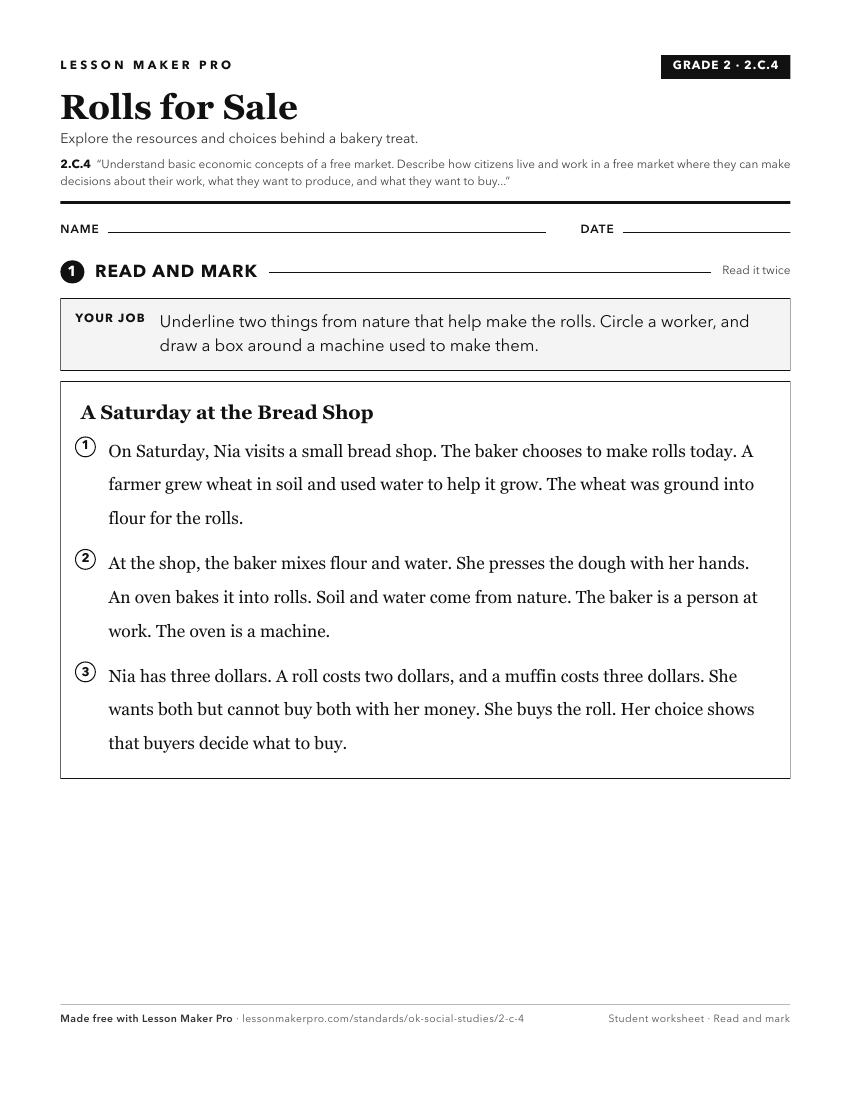
A ready-to-print activity worksheet aligned to 2.C.4, with an answer key for the teacher on its own page. No account needed.
PDF, US Letter, prints cleanly in black and white.
Download the worksheetKeep exploring
Related Standards
- 2.P.2.4
Identify the principles of economic systems and develop an understanding of the benefits of a market system in local, national, and global settings.
- K.C.4
Identify basic economic concepts.
- E.C.1.1
Define and explain basic economic concepts (e.g., scarcity, surplus, opportunity cost, cost/benefit analysis, risk/reward relationship, incentive, and trade-off...
- 5.P.2.4
Identify the principles of economic systems and develop an understanding of the benefits of a market system in local, national, and global settings.
Turn this cluster into a lesson
Grade, subject, topic, and the complete cluster are prefilled. Create one free, no account needed.
Also for this cluster:Make a WorksheetMake a QuizMake a Sub Lesson