Oklahoma Math S.DC.1.5
The Standard
- S.DC.1
- Distinguish among different types of study designs for collecting data, and know the scope of inference for each design type.
Determine when a cause-and-effect inference can be drawn from an association, based on how the data were collected.
Oklahoma Academic Standards for Mathematics (2022)
Teacher's field guide
What This Standard Means
What Students Need to Do
- Students check how groups were formed before deciding what a pattern in data means. They tell when a study shows only an association and when random assignment supports a causal claim.
What Mastery Looks Like
- Given two studies of the same question, students identify which one randomly assigned a treatment. They explain how choice or another factor could account for the pattern in the other study.
Common Misconceptions
- Students often treat a strong association as proof of cause. They may also confuse randomly selecting people for a survey with randomly assigning people to treatments.
How to Assess It
- Exit ticket: Two studies link a five-minute review to higher quiz scores. One lets students choose to review, and one randomly assigns review. Which supports a causal claim, and why?
Lesson moves
Ways to Teach It
Randomly assign half the class a 10-word list with pictures and half the same words without pictures, then compare recall scores.
Ask: A survey finds students who sleep longer get higher grades; what else could explain the link?
Give teams six study cards with randomly assigned or self-selected groups to sort into causal-claim and association-only piles.
Show a headline saying exercise raises grades based on a survey, then have students rewrite it without a causal claim.
Free download
Printable S.DC.1.5 Worksheet
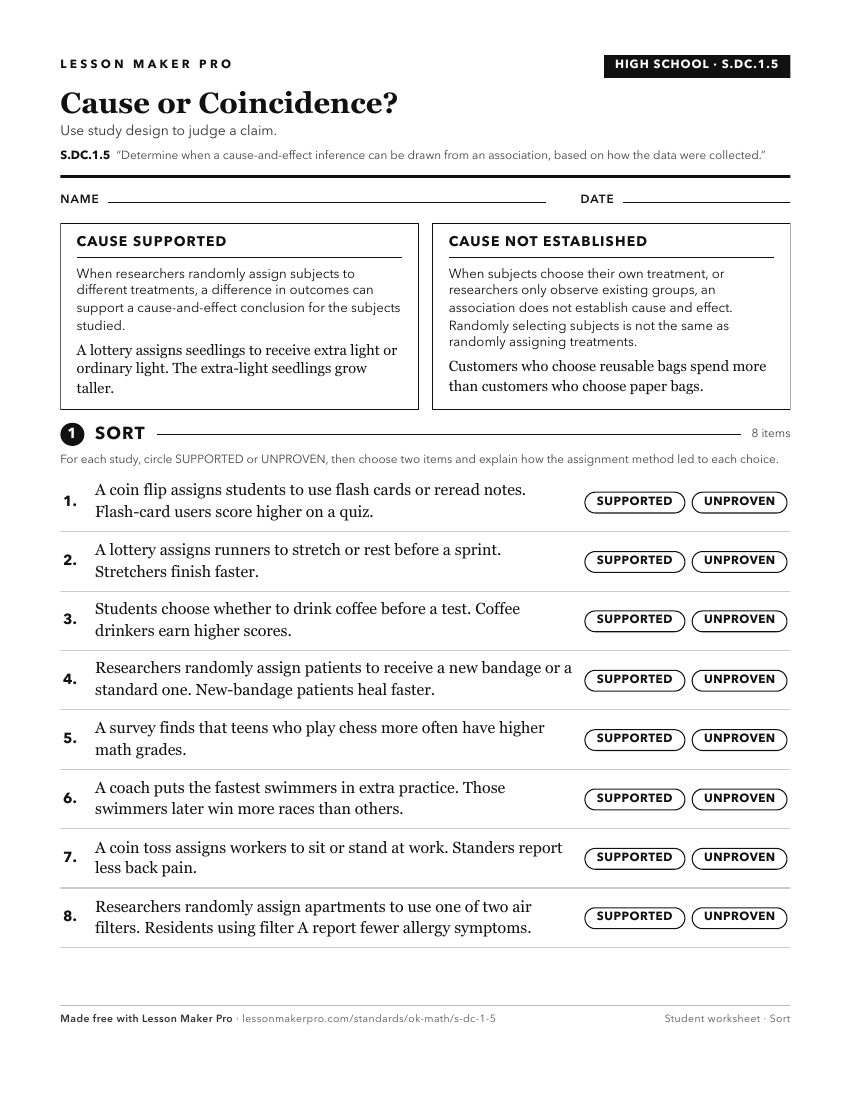
A ready-to-print activity worksheet aligned to S.DC.1.5, with an answer key for the teacher on its own page. No account needed.
PDF, US Letter, prints cleanly in black and white.
Download the worksheetKeep exploring
Related Standards
- S.DC.1.3
Determine the appropriate scope of inference for generalizing results.
- S.DC.1
Distinguish among different types of study designs for collecting data, and know the scope of inference for each design type.
- S.IR.2.2
Identify potential lurking variables which may explain an association between two variables.
- A2.D.2
Analyze statistical thinking to draw inferences, make predictions, and justify conclusions.
Turn this exact standard into a lesson
Grade, subject, topic, and the complete standard are prefilled. Create one free, no account needed.
Also for this standard:Make a WorksheetMake a QuizMake a Sub Lesson