Oklahoma Math A1.A.4.2
The Standard
- A1.A.4
- Analyze real-world and mathematical problems involving linear equations.
Analyze and interpret mathematical models involving lines that are parallel, perpendicular, horizontal, and vertical.
Oklahoma Academic Standards for Mathematics (2022)
Teacher's field guide
What This Standard Means
What Students Need to Do
- Students read equations and graphs to tell which lines are parallel, perpendicular, horizontal, or vertical. They use slope and line direction to explain those relationships in maps and other models.
What Mastery Looks Like
- A student can spot equal slopes on parallel lines and negative reciprocal slopes on perpendicular lines. They know horizontal lines have slope zero and vertical lines have undefined slope. They can use those facts to explain a street map drawn on a grid.
Common Misconceptions
- Students may give vertical lines a slope of zero instead of an undefined slope. They may think opposite slopes always make lines perpendicular. They may call any crossing a right angle without checking.
How to Assess It
- Exit ticket: Roads follow y=2x+1, y=2x-3, y=-1/2x+1, x=4, and y=3. Name one parallel pair, two perpendicular pairs, and the horizontal and vertical roads. Explain your choices.
Lesson moves
Ways to Teach It
On graph paper, lay yarn along y=2x+1, y=2x-3, and y=-1/2x+1; mark parallel paths and right angles.
Ask: Why are x=4 and y=3 perpendicular even though x=4 has no slope?
Sort equation cards, including x=2 with y=5 and y=3x+1 with y=-1/3x+4, into parallel, perpendicular, or neither.
Use a printed neighborhood street map to mark parallel streets and right-angle crossings; overlay grid paper to estimate each street's slope.
Free download
Printable A1.A.4.2 Worksheet
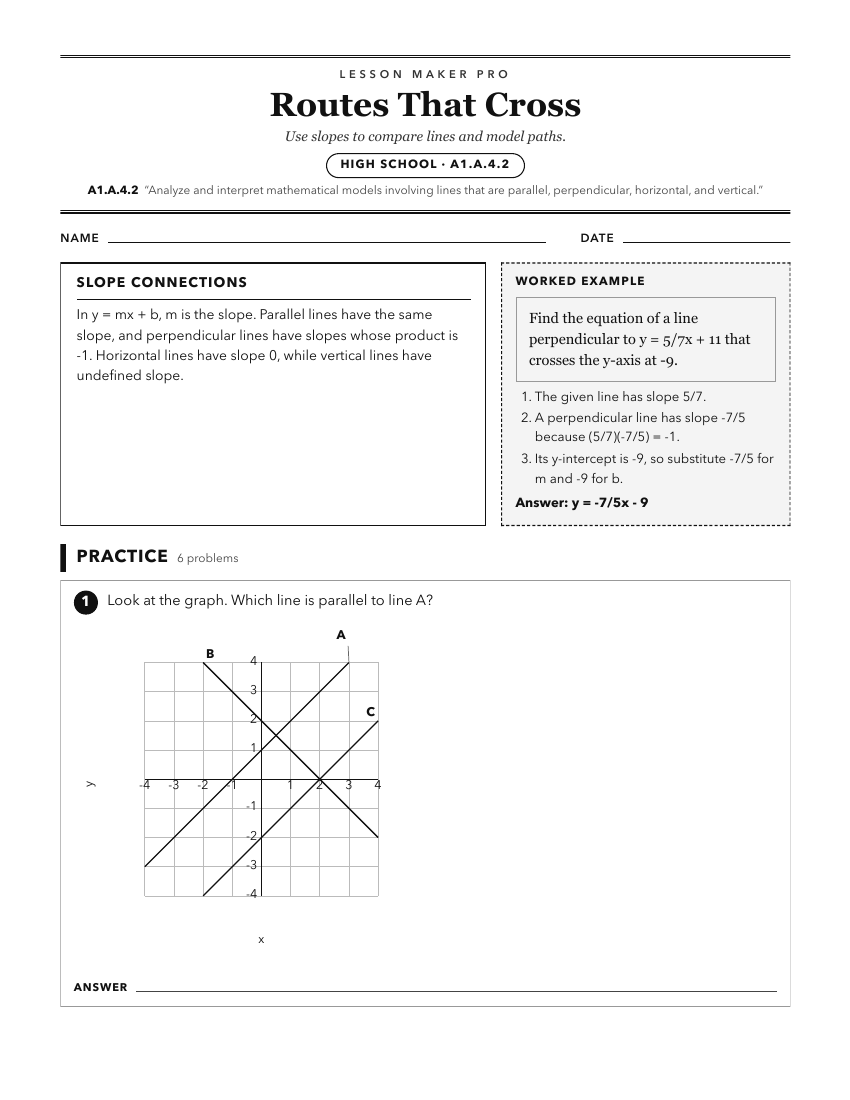
A ready-to-print activity worksheet aligned to A1.A.4.2, with an answer key for the teacher on its own page. No account needed.
PDF, US Letter, prints cleanly in black and white.
Download the worksheetKeep exploring
Related Standards
- 4.GM.1.1
Identify points, lines, line segments, rays, angles, endpoints, and parallel and perpendicular lines in various models.
- A1.A.4.1
Analyze, use and apply mathematical models and other data sets (e.g., graphs, equations, two points, a set of data points) to calculate and interpret slope and ...
- A1.A.4
Analyze real-world and mathematical problems involving linear equations.
- G.2D.1.1
Use properties of parallel lines cut by a transversal to determine angle relationships and solve problems.
Turn this exact standard into a lesson
Grade, subject, topic, and the complete standard are prefilled. Create one free, no account needed.
Also for this standard:Make a WorksheetMake a QuizMake a Sub Lesson