Oklahoma Math A1.A.4
Standard Cluster
Analyze real-world and mathematical problems involving linear equations. Analyze, use, and apply mathematical models and other data sets (e.g., graphs, equations, two points, a set of data points) to calculate and interpret slope and the x- and y-intercepts of a line. Analyze and interpret mathematical models involving lines that are parallel, perpendicular, horizontal, and vertical. Write the equation of the line given its slope and y-intercept, slope and one point, two points, x- and y-intercepts, or a set of data points. Express linear equations in slope-intercept, point-slope, and standard forms. Convert between these forms. Analyze and interpret associations between graphical representations and written scenarios.
Oklahoma Academic Standards for Mathematics (2022)
Cluster contents
Standards in This Cluster
A1.A.4 is a cluster heading. These are the individual standards under it.
- A1.A.4.1
Analyze, use and apply mathematical models and other data sets (e.g., graphs, equations, two points, a set of data points) to calculate and interpret slope and ...
- A1.A.4.2
Analyze and interpret mathematical models involving lines that are parallel, perpendicular, horizontal, and vertical.
- A1.A.4.3
Write the equation of the line given its slope and y-intercept, slope and one point, two points, x- and y-intercepts, or a set of data points.
- A1.A.4.4
Express linear equations in slope-intercept, point-slope, and standard forms. Convert between these forms.
- A1.A.4.5
Analyze and interpret associations between graphical representations and written scenarios.
Teacher's field guide
What This Cluster Means
What Students Need to Do
- Students find slope and intercepts from graphs, equations, and data, then explain what they mean. They write line equations from points, slopes, or intercepts and change between three equation forms. They match graphs to situations and compare parallel, perpendicular, horizontal, and vertical lines.
What Mastery Looks Like
- Given two points from a tank-draining problem, a student finds the rate, starting amount, and time the tank empties, with units. They write the equation in slope-intercept, point-slope, and standard form. They identify parallel and perpendicular lines by slope and know a vertical line has no defined slope.
Common Misconceptions
- Students swap rise and run or confuse the x-intercept with the y-intercept. They think perpendicular slopes are just negatives, or give a vertical line a slope of zero. They may interpret an intercept that falls outside the useful range of a real-world model.
How to Assess It
- Exit ticket: A tank starts with 20 gallons and loses 4 gallons each minute. Write its equation in slope-intercept and standard form, interpret both intercepts, and give the slope of a perpendicular line.
Lesson moves
Ways to Teach It
On a taped floor grid, place sticky notes at (0, 6) and (3, 0); walk the rise and run and name both intercepts.
Show a tank-draining graph and ask, “What do the slope and intercepts mean, and when does the model stop making sense?”
Give groups equation and graph cards for slanted, horizontal, and vertical lines; match them, then sort parallel and perpendicular pairs.
Give students two taxi fare tables; have them write and graph each equation, then find the distance where fares match.
Free download
Printable A1.A.4 Worksheet
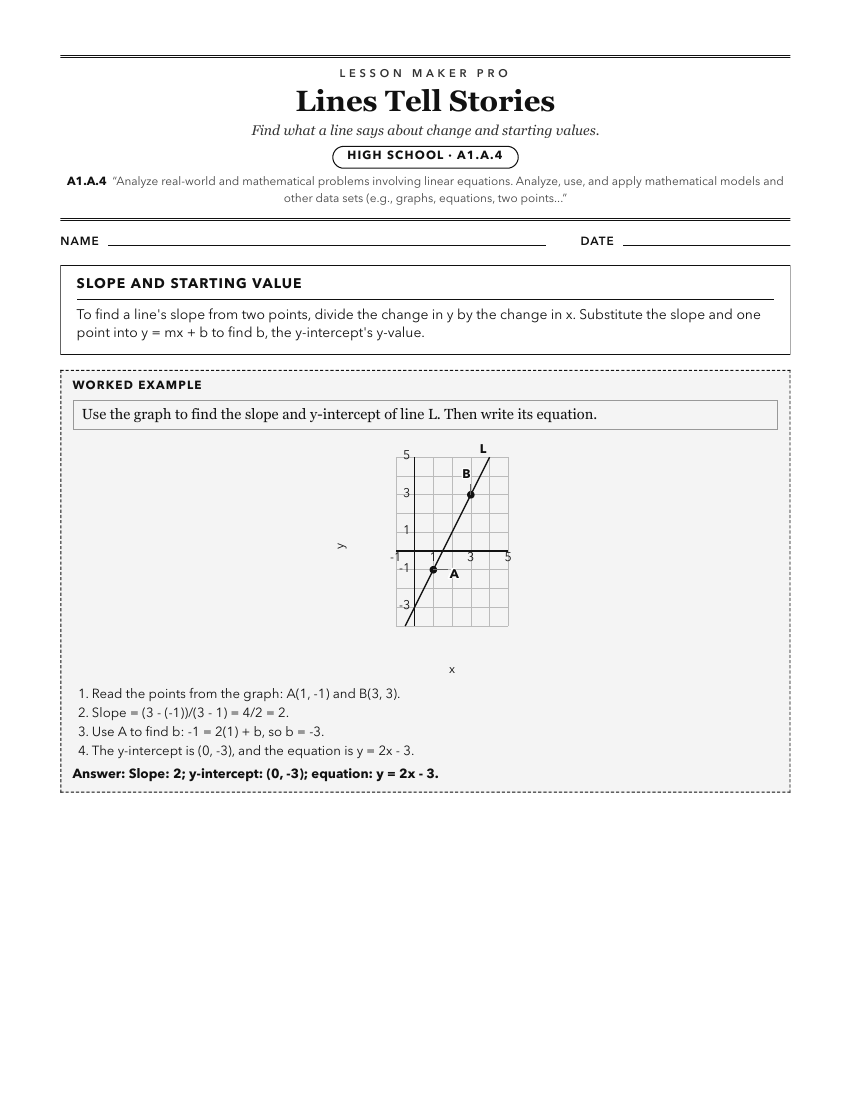
A ready-to-print activity worksheet aligned to A1.A.4, with an answer key for the teacher on its own page. No account needed.
PDF, US Letter, prints cleanly in black and white.
Download the worksheetKeep exploring
Related Standards
- A1.A.1
Represent and solve mathematical and real-world problems using linear equations, absolute value equations, and systems of equations; interpret solutions in the ...
- A2.A.1
Represent and solve mathematical and real-world problems using nonlinear equations, systems of linear equations, and systems of linear inequalities; interpret t...
- PA.A.4
Represent and solve problems using mathematical models and situations with equations and inequalities involving linear expressions.
- A1.A.1.3
Analyze, use and apply mathematical models to solve problems involving systems of linear equations with a maximum of two variables by graphing, substitution, an...
Turn this cluster into a lesson
Grade, subject, topic, and the complete cluster are prefilled. Create one free, no account needed.
Also for this cluster:Make a WorksheetMake a QuizMake a Sub Lesson