Oklahoma Math 7.GM.4.2
The Standard
- 7.GM.4
- Analyze the effect of translations, reflections, rotations, and dilations on the attributes of two-dimensional figures on and off the coordinate plane.
Apply proportions, ratios, and scale factors to solve problems involving scale drawings and to determine side lengths and areas of similar triangles and rectangles.
Oklahoma Academic Standards for Mathematics (2022)
Teacher's field guide
What This Standard Means
What Students Need to Do
- Students use a drawing's scale to find real lengths. They use matching sides of similar triangles and rectangles to find missing lengths. They square the scale factor to find how areas change.
What Mastery Looks Like
- Given similar triangles with sides 3, 4, 5 and 6, 8, 10, students identify a scale factor of 2 and an area factor of 4. They use the same reasoning to find a rectangle's missing side or its actual area from a scale drawing.
Common Misconceptions
- Students may multiply area by the side-length scale factor instead of its square. They may pair sides that do not match or flip the scale ratio when converting drawing lengths.
How to Assess It
- Exit ticket: A 3 cm by 5 cm rectangle on a plan uses 1 cm = 2 m. Find the real side lengths and area, and show the ratios you used.
Lesson moves
Ways to Teach It
Draw a 3 cm by 4 cm rectangle on grid paper, double each side, then count squares to compare areas.
Ask: If each side of a rectangle triples, why does its area become nine times larger? Sketch both rectangles.
Give partners similar triangle cards with one missing side; have them match each card to its scale ratio and missing length.
Use a 1 cm to 2 m floor plan to calculate the real dimensions and carpet area of a drawn room.
Free download
Printable 7.GM.4.2 Worksheet
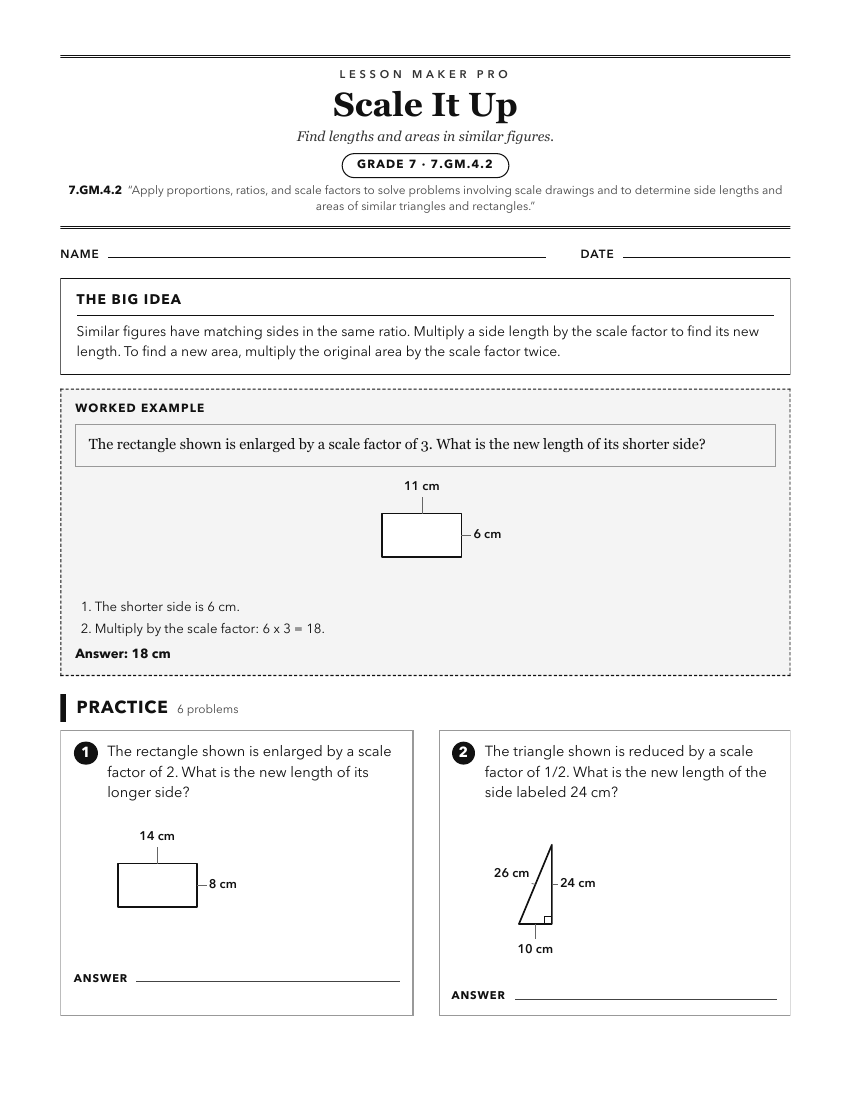
A ready-to-print activity worksheet aligned to 7.GM.4.2, with an answer key for the teacher on its own page. No account needed.
PDF, US Letter, prints cleanly in black and white.
Download the worksheetKeep exploring
Related Standards
- 6.GM.2
Use mathematical modeling to calculate the area of squares, parallelograms, and triangles to solve problems.
- G.3D.1.2
Use ratios derived from similar three-dimensional figures to make conjectures, generalize, and to solve for unknown values such as angles, side lengths, perimet...
- G.RT.1
Apply mathematical relationships of right triangles and trigonometric ratios to solve real-world and mathematical problems.
- 7.A.2.3
Use proportional reasoning to solve problems involving ratios.
Turn this exact standard into a lesson
Grade, subject, topic, and the complete standard are prefilled. Create one free, no account needed.
Also for this standard:Make a WorksheetMake a QuizMake a Sub Lesson