Oklahoma Math G.RT.1
Standard Cluster
Apply mathematical relationships of right triangles and trigonometric ratios to solve real-world and mathematical problems. Apply the distance formula, the Pythagorean theorem, and the Pythagorean theorem converse (approximate and exact values, including Pythagorean triples) to solve problems, using algebraic and logical reasoning and mathematical models. Verify and apply properties of right triangles, including properties of 45-45-90 and 30-60-90 triangles, to solve problems using algebraic and logical reasoning. Use the definition of the trigonometric functions to determine the sine, cosine, and tangent ratio of an acute angle in a right triangle. Apply the inverse trigonometric functions to find the measure of an acute angle in right triangles. Apply the trigonometric functions as ratios (sine, cosine, tangent) to find side lengths in right triangles in mathematical models, including the coordinate plane.
Oklahoma Academic Standards for Mathematics (2022)
Cluster contents
Standards in This Cluster
G.RT.1 is a cluster heading. These are the individual standards under it.
- G.RT.1.1
Apply the distance formula, the Pythagorean theorem, and the Pythagorean theorem converse (approximate and exact values, including Pythagorean triples) to solve...
- G.RT.1.2
Verify and apply properties of right triangles, including properties of 45-45-90 and 30-60-90 triangles, to solve problems using algebraic and logical reasoning...
- G.RT.1.3
Use the definition of the trigonometric functions to determine the sine, cosine, and tangent ratio of an acute angle in a right triangle. Apply the inverse trig...
- G.RT.1.4
Apply the trigonometric functions as ratios (sine, cosine, tangent) to find side lengths in right triangles in mathematical models, including the coordinate pla...
Teacher's field guide
What This Cluster Means
What Students Need to Do
- Students find missing sides and angles in right triangles using side-length relationships and trig ratios. They find distances on a coordinate grid and check whether three lengths form a right triangle. They use exact values when possible and round measurements when needed.
What Mastery Looks Like
- A student labels the hypotenuse and chooses an equation that fits the given information. They recognize 45-45-90 and 30-60-90 triangles, use inverse trig to find acute angles, and explain how they checked for a right angle.
Common Misconceptions
- Students may call the longest side the hypotenuse without checking for a right angle. They may mix up opposite and adjacent when the marked angle changes. Some round too early or assume a triangle is right because its side lengths look close to a familiar triple.
How to Assess It
- Exit ticket: A ramp rises 3 feet over a horizontal run of 8 feet. Find its length and incline angle to the nearest degree, and show both equations.
Lesson moves
Ways to Teach It
Use string to make triangles with sides 3, 4, 5 and 4, 5, 6, then test each right angle with a square.
Ask, "Why is the diagonal of a 5-by-5 square 5√2, not 10?" Have students sketch and explain.
Play equation sort with 45-45-90, 30-60-90, and labeled acute-angle cards matched to side-length equations.
Measure the distance to a wall and its angle of elevation with a clinometer, then use tangent and eye height to estimate wall height.
Free download
Printable G.RT.1 Worksheet
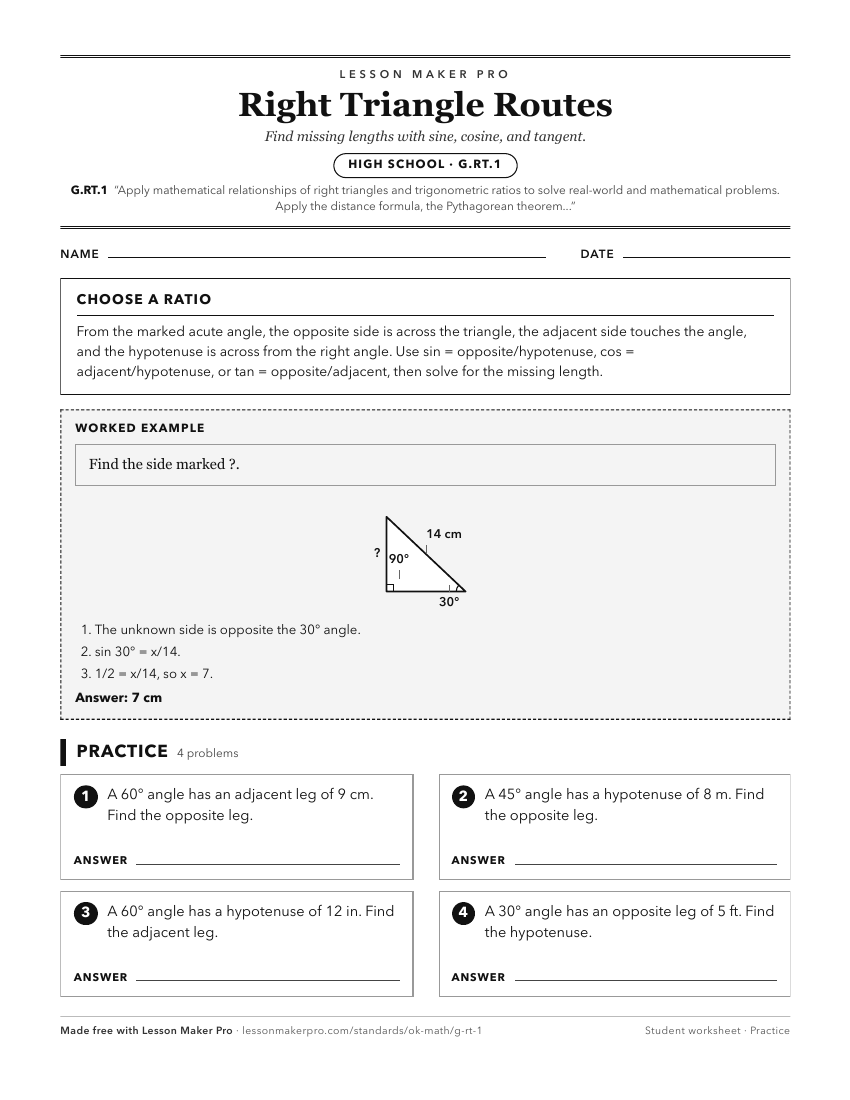
A ready-to-print activity worksheet aligned to G.RT.1, with an answer key for the teacher on its own page. No account needed.
PDF, US Letter, prints cleanly in black and white.
Download the worksheetKeep exploring
Related Standards
Turn this cluster into a lesson
Grade, subject, topic, and the complete cluster are prefilled. Create one free, no account needed.
Also for this cluster:Make a WorksheetMake a QuizMake a Sub Lesson