Oklahoma Math 7.GM.4
Standard Cluster
Analyze the effect of translations, reflections, rotations, and dilations on the attributes of two-dimensional figures on and off the coordinate plane. Describe the properties of similarity, compare geometric figures for similarity, and determine scale factors resulting from dilations. Apply proportions, ratios, and scale factors to solve problems involving scale drawings and to determine side lengths and areas of similar triangles and rectangles. Graph and describe translations (with directional and algebraic instructions), reflections across the x- and y-axes, and rotations in 90° increments about the origin of figures on a coordinate plane, and determine the coordinates of the vertices of a figure after a transformation.
Oklahoma Academic Standards for Mathematics (2022)
Cluster contents
Standards in This Cluster
7.GM.4 is a cluster heading. These are the individual standards under it.
- 7.GM.4.1
Describe the properties of similarity, compare geometric figures for similarity, and determine scale factors resulting from dilations.
- 7.GM.4.2
Apply proportions, ratios, and scale factors to solve problems involving scale drawings and to determine side lengths and areas of similar triangles and rectang...
- 7.GM.4.3
Graph and describe translations (with directional and algebraic instructions), reflections across the x- and y-axes, and rotations in 90̊ increments about the o...
Teacher's field guide
What This Cluster Means
What Students Need to Do
- Students move and resize shapes on paper and on grids, noting which lengths, angles, and areas change. They plot translations from directions or coordinate rules, reflections across either axis, and 90-degree turns about the origin. They compare shapes for similarity and use scale factors to find missing sides and areas.
What Mastery Looks Like
- A student can plot a translation from a rule such as (x, y) to (x + 3, y - 2) and list the new vertices. They can also plot axis reflections and quarter-turns about the origin. They check angles and side ratios to decide if shapes are similar, then use the scale factor for lengths and its square for areas.
Common Misconceptions
- Students may change the wrong coordinate when reflecting across an axis, or rotate a figure around its center instead of the origin. They may assume any two rectangles are similar or add the scale factor to side lengths instead of multiplying. They may use the side-length scale factor, rather than its square, to find a new area.
How to Assess It
- Exit ticket: Translate triangle A(1, 1), B(3, 1), C(1, 2) two units right, then dilate it by a factor of 2 about the origin. List the final vertices and the ratio of the new area to the original area.
Lesson moves
Ways to Teach It
Give students paper triangles, rulers, and tracing paper; have them double each side, compare angles and areas, and record the scale factor.
Ask: Why are all squares similar, but not all rectangles? Have partners sketch examples and use side ratios to explain.
Play coordinate relay: teams draw cards with translation rules, axis reflections, or 90-degree turns about the origin and plot the new vertices.
Hand out a schoolyard map with a scale of 1 cm to 5 m; students measure a rectangle and calculate its actual area.
Free download
Printable 7.GM.4 Worksheet
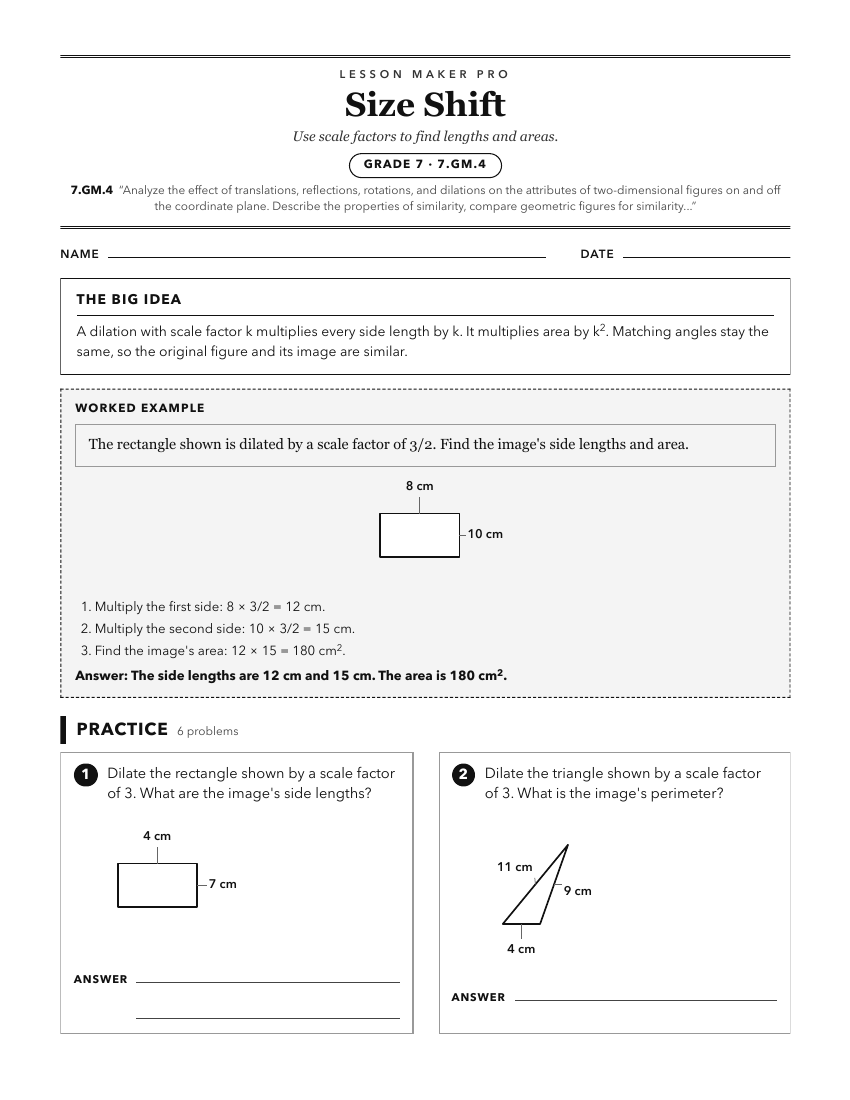
A ready-to-print activity worksheet aligned to 7.GM.4, with an answer key for the teacher on its own page. No account needed.
PDF, US Letter, prints cleanly in black and white.
Download the worksheetKeep exploring
Related Standards
- G.2D.1.11
Use numeric, graphic, and algebraic representations of transformations in two dimensions (e.g., reflections, translations, dilations, rotations about the origin...
- 6.GM.1.1
Predict, describe, and apply translations (slides), reflections (flips), and rotations (turns) to a two-dimensional figure.
- 2.GM.1
Analyze attributes of two- and three-dimensional figures and develop generalizations about their properties.
Turn this cluster into a lesson
Grade, subject, topic, and the complete cluster are prefilled. Create one free, no account needed.
Also for this cluster:Make a WorksheetMake a QuizMake a Sub Lesson