Oklahoma Math 6.GM.1
Standard Cluster
Use translations, reflections, and rotations to establish congruence and understand symmetry (not on a coordinate plane). Predict, describe, and apply translations (slides), reflections (flips), and rotations (turns) to a two-dimensional figure. Recognize that translations, reflections, and rotations preserve congruence and use them to show that two figures are congruent. Identify and describe the line(s) of symmetry in two-dimensional shapes.
Oklahoma Academic Standards for Mathematics (2022)
Cluster contents
Standards in This Cluster
6.GM.1 is a cluster heading. These are the individual standards under it.
- 6.GM.1.1
Predict, describe, and apply translations (slides), reflections (flips), and rotations (turns) to a two-dimensional figure.
- 6.GM.1.2
Recognize that translations, reflections, and rotations preserve congruence and use them to show that two figures are congruent.
- 6.GM.1.3
Identify and describe the line(s) of symmetry in two-dimensional shapes.
Teacher's field guide
What This Cluster Means
What Students Need to Do
- Students slide, flip, and turn paper shapes without changing their size or shape. They predict where a shape will land, describe moves that match two figures, and mark lines of symmetry.
What Mastery Looks Like
- Given a triangle and a moved copy, a student can show the move that lines them up exactly. They can explain why the figures are congruent and find all four lines of symmetry in a square.
Common Misconceptions
- Students may call a flip a turn when a shape faces the other way. They may think differently oriented figures cannot be congruent. They may draw a symmetry line even when the two sides do not match.
How to Assess It
- Show a scalene triangle and three copies, one slid, one flipped across a marked line, and one turned around a marked point. Ask students to label each move, say whether the copies are congruent, and draw all symmetry lines on a square.
Lesson moves
Ways to Teach It
Give students tracing-paper triangles and matching cutouts; have them slide, flip, and turn the tracing to cover each cutout exactly.
Place an L-shaped cutout beside a quarter-turned copy and ask, 'Would a slide match these? Show the move that works.'
Give pairs paper triangles and boards of moved copies; call 'slide right,' 'flip across the line,' or 'quarter-turn clockwise'; players cover matches.
Lay out square paper tiles to model a bathroom floor; slide and turn one tile onto another, then mark the tile's symmetry lines.
Free download
Printable 6.GM.1 Worksheet
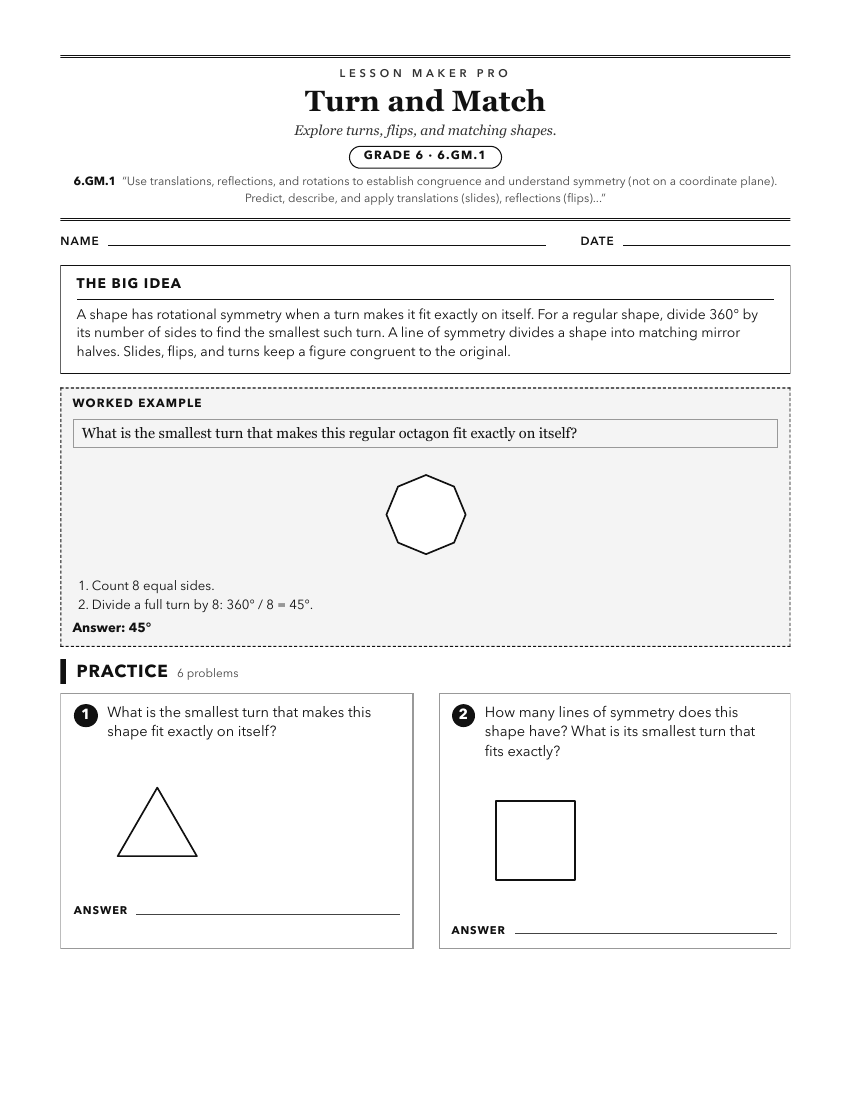
A ready-to-print activity worksheet aligned to 6.GM.1, with an answer key for the teacher on its own page. No account needed.
PDF, US Letter, prints cleanly in black and white.
Download the worksheetKeep exploring
Related Standards
- G.2D.1.11
Use numeric, graphic, and algebraic representations of transformations in two dimensions (e.g., reflections, translations, dilations, rotations about the origin...
- 7.GM.4.3
Graph and describe translations (with directional and algebraic instructions), reflections across the x- and y-axes, and rotations in 90̊ increments about the o...
- 7.GM.4
Analyze the effect of translations, reflections, rotations, and dilations on the attributes of two-dimensional figures on and off the coordinate plane.
Turn this cluster into a lesson
Grade, subject, topic, and the complete cluster are prefilled. Create one free, no account needed.
Also for this cluster:Make a WorksheetMake a QuizMake a Sub Lesson