Oklahoma Math 6.GM.1.3
The Standard
- 6.GM.1
- Use translations, reflections, and rotations to establish congruence and understand symmetry (not on a coordinate plane).
Identify and describe the line(s) of symmetry in two-dimensional shapes.
Oklahoma Academic Standards for Mathematics (2022)
Teacher's field guide
What This Standard Means
What Students Need to Do
- Students find lines that split a flat shape into matching mirror halves. They draw every line that works and recognize when a shape has none.
What Mastery Looks Like
- Students find all four lines on a square and both lines on a non-square rectangle. They use a fold or small mirror to check each line.
Common Misconceptions
- Students may mark any line through the center, even when the halves do not match. They may count a rectangle’s diagonals or miss a square’s diagonals.
How to Assess It
- On an exit ticket, ask students to draw every symmetry line on a square and a non-square rectangle. Have them explain how a fold would check one line.
Lesson moves
Ways to Teach It
Give students paper squares, rectangles, and triangles to fold, then have them mark each crease that makes the halves match.
Show a square and a non-square rectangle and ask, “Why does a diagonal work for one but not the other?”
Play a shape-card sort: students group shapes by how many symmetry lines they have, then check with small mirrors.
Give students photos of logos and road signs to mark symmetry lines, checking that colors and details match too.
Free download
Printable 6.GM.1.3 Worksheet
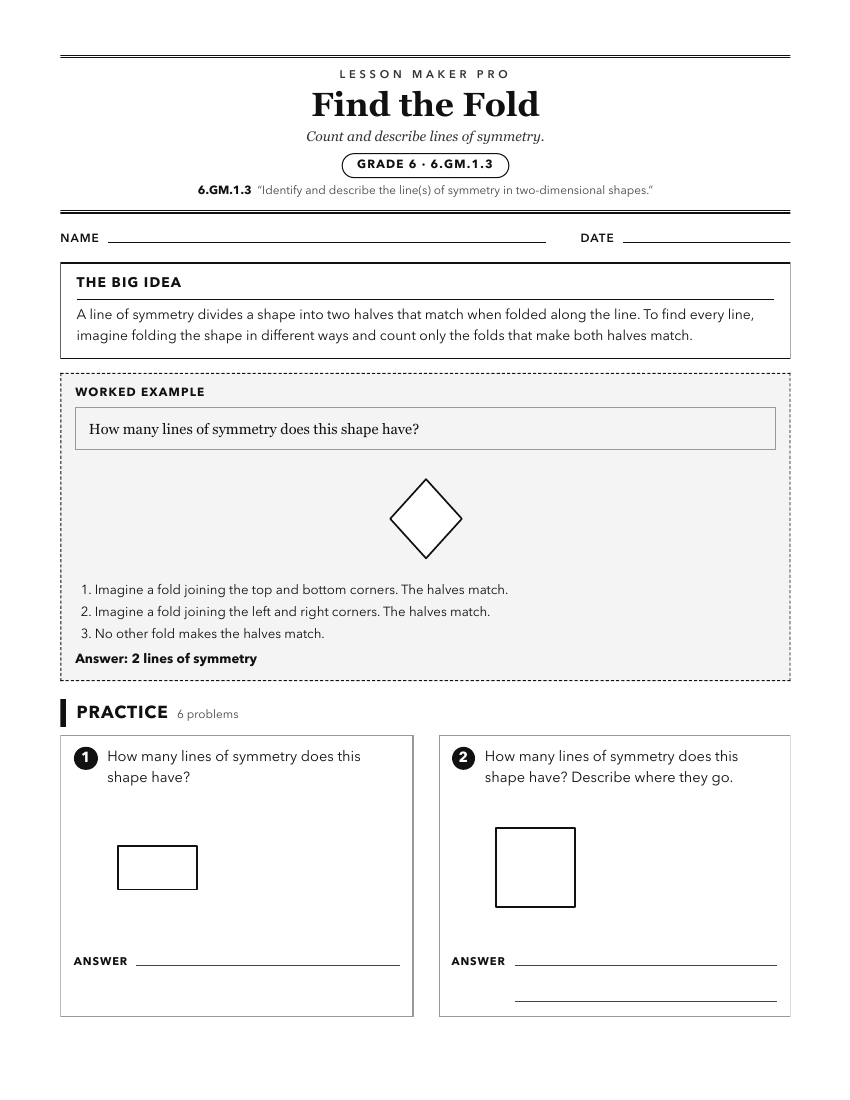
A ready-to-print activity worksheet aligned to 6.GM.1.3, with an answer key for the teacher on its own page. No account needed.
PDF, US Letter, prints cleanly in black and white.
Download the worksheetKeep exploring
Related Standards
- K.GM.1.3
Identify attributes of two-dimensional shapes using informal and formal geometric language interchangeably, such as the number of corners/vertices and the numbe...
- G.2D.1.11
Use numeric, graphic, and algebraic representations of transformations in two dimensions (e.g., reflections, translations, dilations, rotations about the origin...
- 4.GM.1.3
Given two three-dimensional shapes, identify each shape. Compare and contrast their similarities and differences based on their attributes.
- K.GM.1
Recognize and sort basic two-dimensional shapes; use two-dimensional and three-dimensional shapes to represent real-world objects.
Turn this exact standard into a lesson
Grade, subject, topic, and the complete standard are prefilled. Create one free, no account needed.
Also for this standard:Make a WorksheetMake a QuizMake a Sub Lesson