Oklahoma Math 1.GM.1
Standard Cluster
Recognize and compose two- and three-dimensional shapes. Identify regular and irregular trapezoids and hexagons by pointing to the shape when given the name. Compose larger, defined shapes using smaller two-dimensional shapes. Compose structures with three-dimensional shapes. Recognize three-dimensional shapes such as cubes, cones, cylinders, pyramids, and spheres.
Oklahoma Academic Standards for Mathematics (2022)
Cluster contents
Standards in This Cluster
1.GM.1 is a cluster heading. These are the individual standards under it.
- 1.GM.1.1
Identify regular and irregular trapezoids and hexagons by pointing to the shape when given the name.
- 1.GM.1.2
Compose larger, defined shapes using smaller two-dimensional shapes.
- 1.GM.1.3
Compose structures with three-dimensional shapes.
- 1.GM.1.4
Recognize three-dimensional shapes such as cubes, cones, cylinders, pyramids, and spheres.
Teacher's field guide
What This Cluster Means
What Students Need to Do
- Students point to trapezoids and hexagons when they hear the names, even when the shapes are uneven. They join flat shapes to make a named larger shape. They name cubes, cones, cylinders, pyramids, and spheres, then use solid shapes to build a structure.
What Mastery Looks Like
- A student finds a hexagon or trapezoid even when it is tilted or uneven. They arrange six triangle tiles into a larger hexagon without gaps. They name the five solids and build a structure that stands.
Common Misconceptions
- Students may reject a tilted or uneven shape because it does not look like the one on the classroom poster. They may call a cylinder a circle or confuse a cone with a pyramid. Some leave gaps when joining small shapes.
How to Assess It
- Give students regular and uneven cutouts of hexagons and trapezoids, plus a pentagon. Say, "Point to every hexagon. Now point to every trapezoid," then ask them to make a hexagon with six triangle tiles.
Lesson moves
Ways to Teach It
Give pairs triangle tiles and solid blocks; ask them to make a large hexagon, then build a tower with cubes and cylinders.
Show an uneven hexagon beside a regular one and ask, "Are both hexagons? How do you know?"
Play shape callout with regular and uneven trapezoid and hexagon cutouts; name a shape and have students point to a match.
Set out a soup can, party hat, ball, cube block, and pyramid block; ask students to name the solid shape of each.
Free download
Printable 1.GM.1 Worksheet
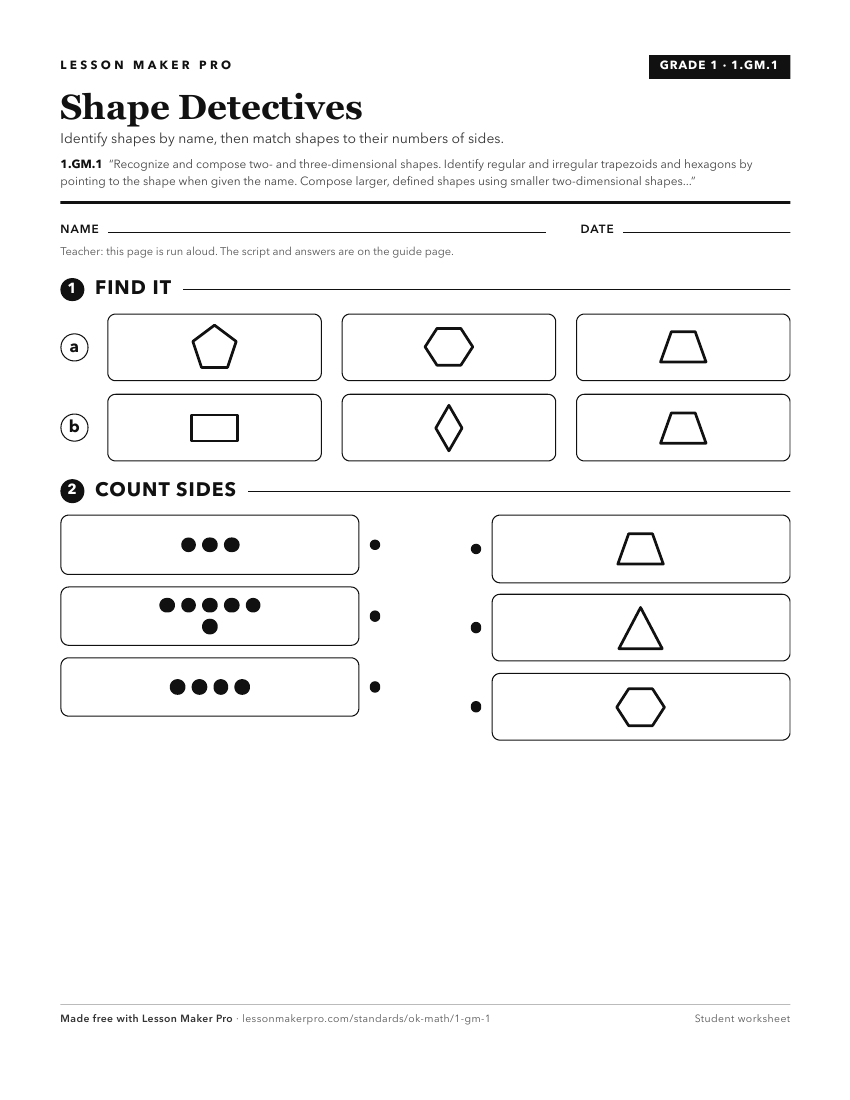
A ready-to-print activity worksheet aligned to 1.GM.1, with an answer key for the teacher on its own page. No account needed.
PDF, US Letter, prints cleanly in black and white.
Download the worksheetKeep exploring
Related Standards
- K.GM.1
Recognize and sort basic two-dimensional shapes; use two-dimensional and three-dimensional shapes to represent real-world objects.
- 2.GM.1.3
Compose and decompose two-dimensional shapes using triangles, squares, hexagons, trapezoids, and rhombi.
- 5.GM.1
Describe, identify, classify, and construct two- and three-dimensional figures using their geometric attributes.
Turn this cluster into a lesson
Grade, subject, topic, and the complete cluster are prefilled. Create one free, no account needed.
Also for this cluster:Make a WorksheetMake a QuizMake a Sub Lesson