Oklahoma Math 1.GM.1.1
The Standard
- 1.GM.1
- Recognize and compose two- and three-dimensional shapes.
Identify regular and irregular trapezoids and hexagons by pointing to the shape when given the name.
Oklahoma Academic Standards for Mathematics (2022)
Teacher's field guide
What This Standard Means
What Students Need to Do
- Students point to a trapezoid or hexagon when they hear its name. They recognize each shape when it is tilted or uneven.
What Mastery Looks Like
- A student points to both familiar and uneven examples in a mixed group of shapes. They can count six sides on a hexagon and find parallel sides on a trapezoid.
Common Misconceptions
- Some students think a hexagon must look like a honeycomb cell. Others miss a tilted trapezoid or call a five-sided shape a hexagon without counting.
How to Assess It
- Show each student six cutouts: two trapezoids, two hexagons, a triangle, and a pentagon. Say each name and ask them to point to both examples.
Lesson moves
Ways to Teach It
Give pairs familiar and uneven trapezoid and hexagon cutouts, then have them sort the pieces into two named piles.
Show a tilted, uneven hexagon and ask, "What tells you this is still a hexagon?"
Play point-to-it with six shape cards: call out trapezoid or hexagon, and have students point to every match.
Show photos of hexagonal floor tiles and trapezoid lampshade panels, then ask students to point to each shape.
Free download
Printable 1.GM.1.1 Worksheet
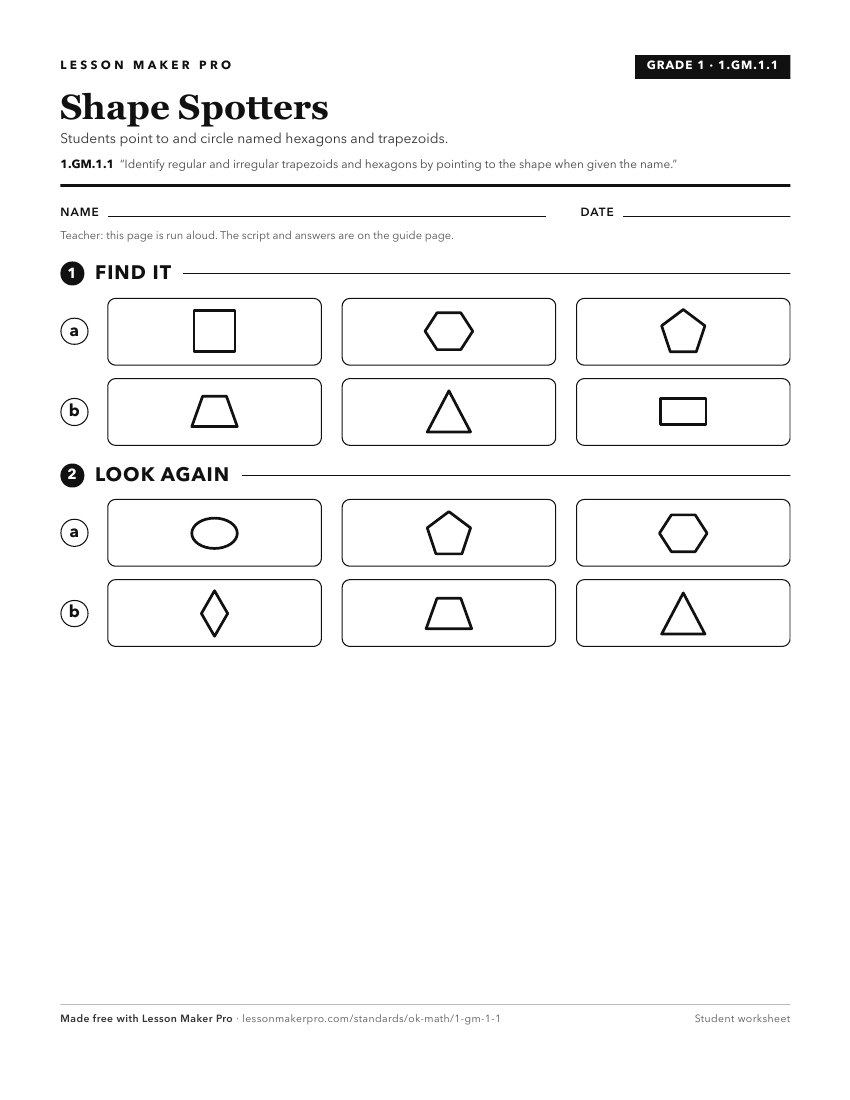
A ready-to-print activity worksheet aligned to 1.GM.1.1, with an answer key for the teacher on its own page. No account needed.
PDF, US Letter, prints cleanly in black and white.
Download the worksheetKeep exploring
Related Standards
- 2.GM.1.1
Recognize regular and irregular trapezoids and hexagons.
- 4.GM.1.2
Describe, classify, and construct quadrilaterals, including squares, rectangles, trapezoids, rhombuses, parallelograms, and kites. Recognize quadrilaterals in v...
- K.GM.1.1
Recognize squares, circles, triangles, and rectangles.
- K.GM.1.3
Identify attributes of two-dimensional shapes using informal and formal geometric language interchangeably, such as the number of corners/vertices and the numbe...
Turn this exact standard into a lesson
Grade, subject, topic, and the complete standard are prefilled. Create one free, no account needed.
Also for this standard:Make a WorksheetMake a QuizMake a Sub Lesson