Oklahoma ELA 8.3.W.1
The Standard
Students will compose narratives reflecting real or imagined experiences that: • include plots involving complex characters resolving conflicts • unfold in chronological or surprising sequence (e.g., flashback and foreshadowing) • include a narrator, precise language, sensory details, and dialogue to enhance the narrative • use sentence variety to create clarity • emulate literary elements and/or literary devices from mentor texts
Oklahoma Academic Standards for English Language Arts (2021)
Teacher's field guide
What This Standard Means
What Students Need to Do
- Students write a true or invented story about a character whose choices complicate a conflict before they resolve it. They tell events in order or use a flashback or hint about what comes next. They use a clear narrator, precise details, dialogue, varied sentences, and a technique from a model story.
What Mastery Looks Like
- A reader can tell what the character wants, why the conflict grows, and how the character's choice resolves it. A flashback or hint fits without confusing the timeline. Dialogue, sensory details, and sentence length help show the scene, as they do in the model story.
Common Misconceptions
- Students may give a character extra traits that never affect a choice. They may add a flashback without showing when it happened, or write dialogue that repeats what the narrator already said. Some copy a model story's plot instead of trying its technique.
How to Assess It
- Exit ticket: Write six sentences about a character deciding whether to confess a mistake. Include a marked flashback, one line of dialogue, a sensory detail, and an ending that shows the choice.
Lesson moves
Ways to Teach It
Pairs reorder six lost-phone event cards, then write a flashback that changes how readers judge the main character.
Read a short model paragraph aloud and ask students which detail shows fear without naming it; have them write their own version.
Play dialogue swap: students trade flat lines like 'I'm mad,' then rewrite them to show anger through words and actions.
Students write a scene about missing the bus, using dialogue and street sounds to show how they handled the problem.
Free download
Printable 8.3.W.1 Worksheet
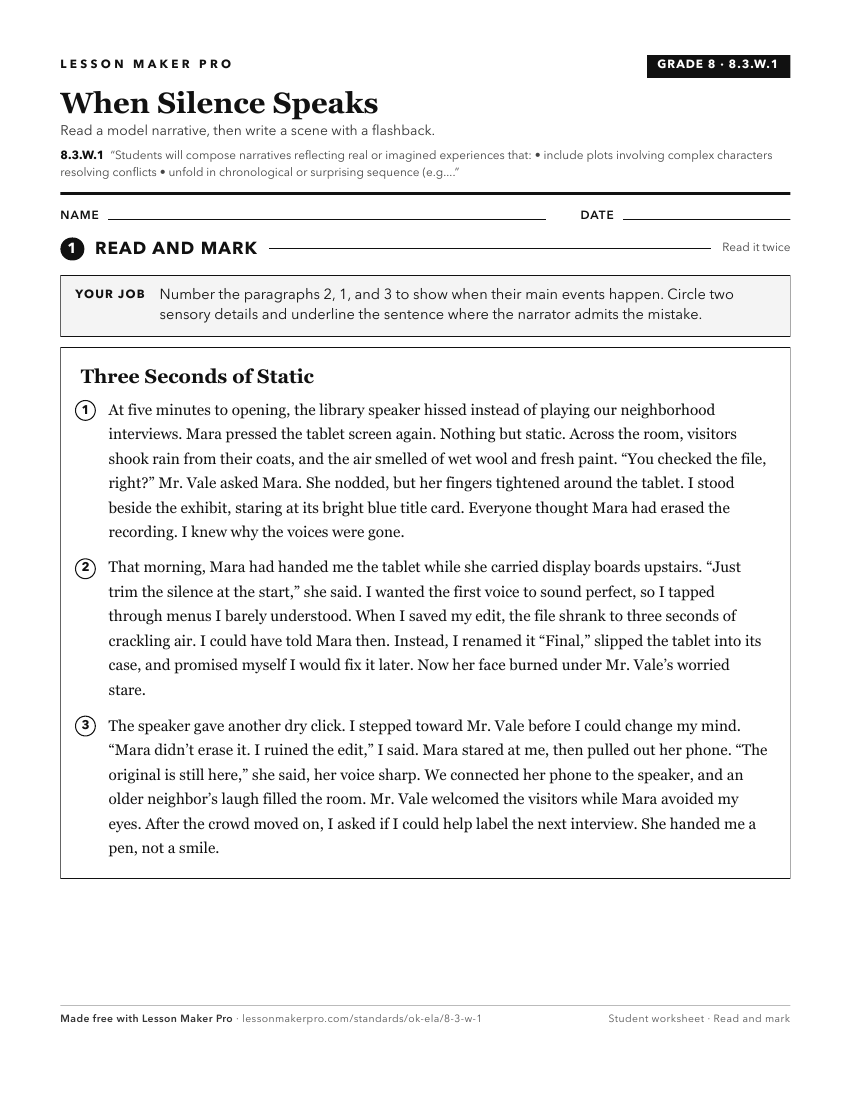
A ready-to-print activity worksheet aligned to 8.3.W.1, with an answer key for the teacher on its own page. No account needed.
PDF, US Letter, prints cleanly in black and white.
Download the worksheetKeep exploring
Related Standards
- 7.3.W.1
Compose narratives reflecting real or imagined experiences that:- include plots involving complex characters resolving conflicts- unfold in chronological or sur...
- 6.3.W.1
Compose narratives reflecting real or imagined experiences that:- include plots involving characters resolving conflicts- unfold in chronological sequence- incl...
- 12.3.W.1
Compose narratives reflecting real or imagined experiences that:- include engaging plots involving well-developed, complex characters resolving conflicts- estab...
- 9.3.W.1
Compose narratives reflecting real or imagined experiences that:- include engaging plots involving well-developed, complex characters resolving conflicts- estab...
Turn this exact standard into a lesson
Grade, subject, topic, and the complete standard are prefilled. Create one free, no account needed.
Also for this standard:Make a WorksheetMake a QuizMake a Sub Lesson