Oklahoma ELA 12.3.W.1
The Standard
Students will compose narratives reflecting real or imagined experiences that: • include engaging plots involving well-developed, complex characters resolving conflicts • establish narrator(s) that enhance(s) the narrative • are intentionally sequenced in a way to achieve a specific effect (e.g., create suspense, establish mood, reflect theme) • provide clear descriptions, using precise language, sensory details, and dialogue • include varied syntax to enhance readability • emulate literary elements and/or literary devices from mentor texts
Oklahoma Academic Standards for English Language Arts (2021)
Teacher's field guide
What This Standard Means
What Students Need to Do
- Students write a story about a real or imagined conflict with a character whose choices are not simple. They choose a narrator and arrange scenes to create suspense, mood, or a theme. They use dialogue, sensory detail, varied sentences, and a technique from a mentor story.
What Mastery Looks Like
- The narrator's voice shapes what readers know. Each scene changes the conflict, and the character makes a believable choice that resolves it. Details and dialogue serve the story, while sentence length and a borrowed technique create a clear effect.
Common Misconceptions
- Students may write a string of events without a choice that changes the conflict. They may add a surprise ending that does not fit the character or switch narrators by accident. More adjectives do not always mean clearer description.
How to Assess It
- Exit ticket: In 100 words, narrate a student deciding whether to confess a lie and show the outcome. Add one line of dialogue, a sensory detail, and deliberate repetition borrowed from a mentor story; underline a short sentence used for tension.
Lesson moves
Ways to Teach It
Give groups four cards labeled discovery, accusation, choice, and aftermath; have them reorder the cards for suspense and draft a first-person opening.
Read the first paragraph of 'The Tell-Tale Heart'; discuss how the narrator's insistence affects trust, then write two lines using that move.
Run a two-minute revision race on 'I went into the room. I saw him. We talked,' adding dialogue, sensory detail, and sentence variety.
Draft a 150-word scholarship essay scene about a real setback, using one action and one line of dialogue to show change.
Free download
Printable 12.3.W.1 Worksheet
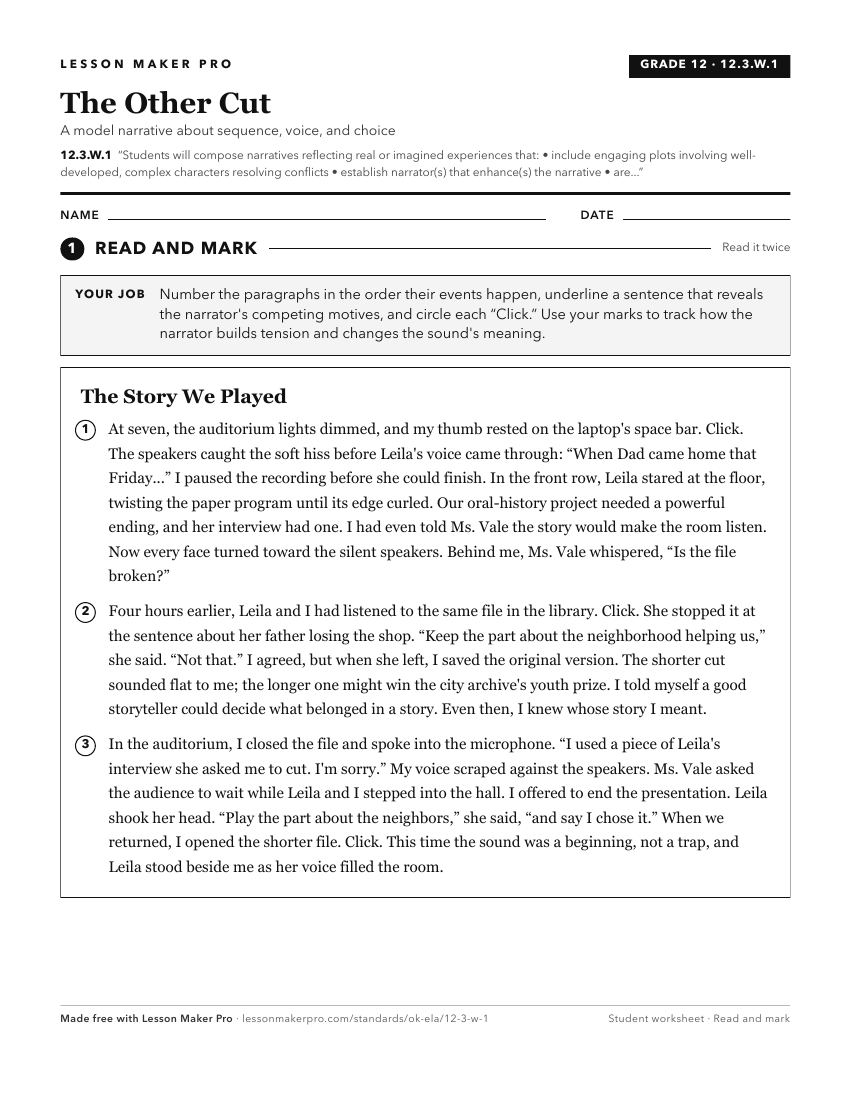
A ready-to-print activity worksheet aligned to 12.3.W.1, with an answer key for the teacher on its own page. No account needed.
PDF, US Letter, prints cleanly in black and white.
Download the worksheetKeep exploring
Related Standards
- 9.3.W.1
The 9th Grade version of this standard.
- 11.3.W.1
The 11th Grade version of this standard.
- 10.3.W.1
Compose narratives reflecting real or imagined experiences that:- include engaging plots involving well-developed, complex characters resolving conflicts- estab...
- 7.3.W.1
Compose narratives reflecting real or imagined experiences that:- include plots involving complex characters resolving conflicts- unfold in chronological or sur...
Turn this exact standard into a lesson
Grade, subject, topic, and the complete standard are prefilled. Create one free, no account needed.
Also for this standard:Make a WorksheetMake a QuizMake a Sub Lesson