Oklahoma ELA 11.3.W.1
The Standard
Students will compose narratives reflecting real or imagined experiences that: • include engaging plots involving well-developed, complex characters resolving conflicts • establish narrator(s) that enhance(s) the narrative • are intentionally sequenced in a way to achieve a specific effect (e.g., create suspense, establish mood, reflect theme) • provide clear descriptions, using precise language, sensory details, and dialogue • include varied syntax to enhance readability • emulate literary elements and/or literary devices from mentor texts
Oklahoma Academic Standards for English Language Arts (2021)
Teacher's field guide
What This Standard Means
What Students Need to Do
- Students write a story drawn from life or imagination. A character's choices drive a conflict and its outcome. Students choose a narrator, order scenes for effect, and use dialogue, sensory details, varied sentences, and a technique from a story they have read.
What Mastery Looks Like
- A reader can tell what the character wants, what stands in the way, and how the character's choices settle the conflict. The narrator and scene order shape what the reader knows and feels. Precise details, dialogue, and sentence variety make the scenes clear, while a borrowed technique adds to the effect.
Common Misconceptions
- Students may add a surprise ending that has no link to the character's earlier choices. They may switch between first and third person by accident or use a flashback that makes the timeline hard to follow. Some copy a mentor text's words instead of borrowing its technique.
How to Assess It
- Write on the board: "I waited. The hall waited with me." Give students 12 minutes to write an eight-sentence first-person scene that starts with the result of a difficult choice, then reveals the choice, using dialogue and a repeated phrase of their own.
Lesson moves
Ways to Teach It
Give groups six event cards for a missing-phone story; have them arrange the cards to build suspense and mark where the conflict resolves.
Ask, "How would the missing-phone story change if the accused student narrated it?" Have partners write two contrasting opening lines.
Give pairs a mentor paragraph and have them rewrite a flat scene using its repetition pattern, sharp details, and mixed sentence lengths.
Read two short accounts of a cafeteria spill, then write the custodian's account with dialogue that changes how readers judge the mess.
Free download
Printable 11.3.W.1 Worksheet
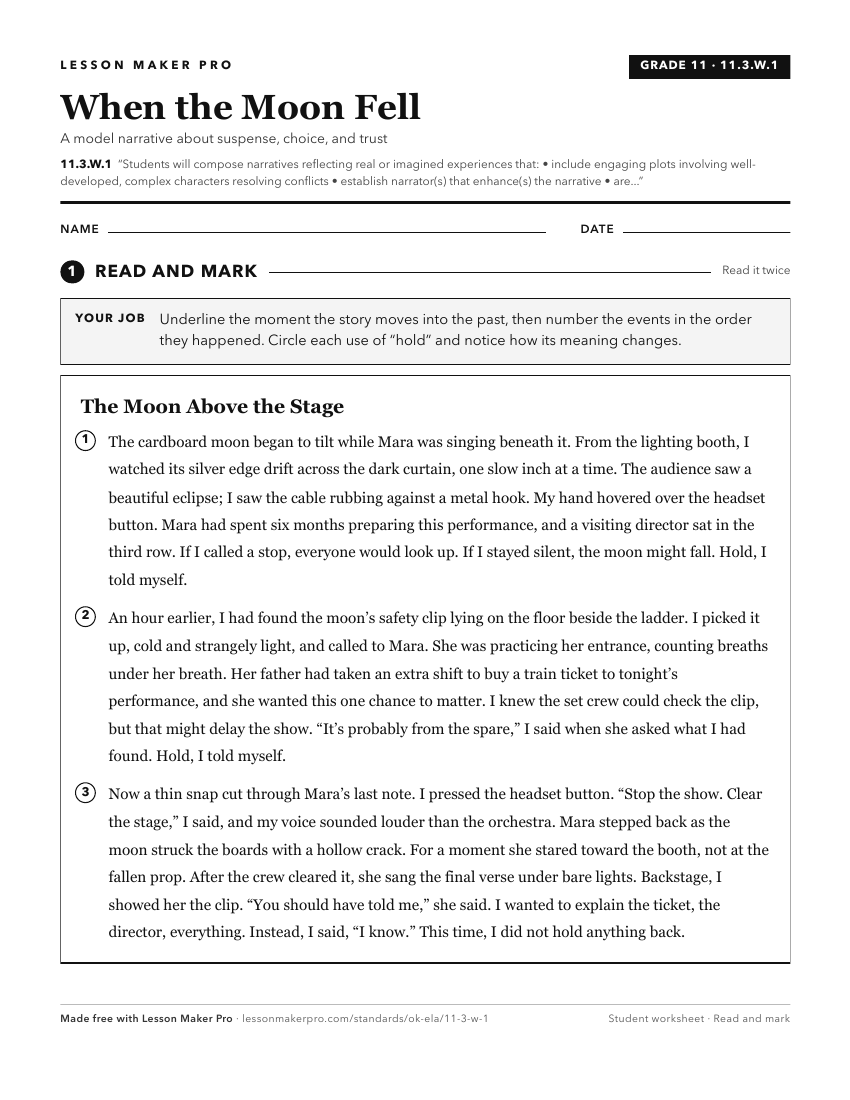
A ready-to-print activity worksheet aligned to 11.3.W.1, with an answer key for the teacher on its own page. No account needed.
PDF, US Letter, prints cleanly in black and white.
Download the worksheetKeep exploring
Related Standards
- 12.3.W.1
The 12th Grade version of this standard.
- 9.3.W.1
The 9th Grade version of this standard.
- 10.3.W.1
Compose narratives reflecting real or imagined experiences that:- include engaging plots involving well-developed, complex characters resolving conflicts- estab...
- 7.3.W.1
Compose narratives reflecting real or imagined experiences that:- include plots involving complex characters resolving conflicts- unfold in chronological or sur...
Turn this exact standard into a lesson
Grade, subject, topic, and the complete standard are prefilled. Create one free, no account needed.
Also for this standard:Make a WorksheetMake a QuizMake a Sub Lesson