Oklahoma ELA 6.3.W.1
The Standard
Students will compose narratives reflecting real or imagined experiences that: • include plots involving characters resolving conflicts • unfold in chronological sequence • include a narrator, precise language, sensory details, and dialogue to enhance the narrative • use sentence variety to create clarity • emulate literary elements and/or literary devices from mentor texts
Oklahoma Academic Standards for English Language Arts (2021)
Teacher's field guide
What This Standard Means
What Students Need to Do
- Students write a true or made-up story with a problem, events in order, and a solution. They use a narrator, dialogue, and specific details to make scenes clear. They vary sentence lengths and try a writing move they noticed in a story they read.
What Mastery Looks Like
- A reader can tell who is speaking, what goes wrong, what happens next, and how the problem is solved. Dialogue affects the action, and details help the reader picture the scene. The student can point to a move from a model story that they used in their own writing.
Common Misconceptions
- Students may list events without giving the character a problem to solve. They may add dialogue that repeats the narration or use many adjectives instead of a few telling details. Some think borrowing a writing move means copying the model's words.
How to Assess It
- Give students this starter: “The gym door clicked shut, and my backpack was inside.” Ask for six more sentences that show an attempt, a solution, one spoken line, and a repeated phrase modeled on “I knocked. I waited. I knocked again.”
Lesson moves
Ways to Teach It
Give pairs three index cards labeled problem, attempt, and solution; have them arrange the cards and write a scene with a narrator and dialogue.
Display “I knocked. I waited. I knocked again.” Ask how repetition builds tension, then have students use that pattern in a new scene.
Play sentence swap: partners replace two flat sentences in a draft with one short sentence and one longer sentence that adds a sensory detail.
Have students imagine missing the bus and write what they did, what someone said to them, and how they got home.
Free download
Printable 6.3.W.1 Worksheet
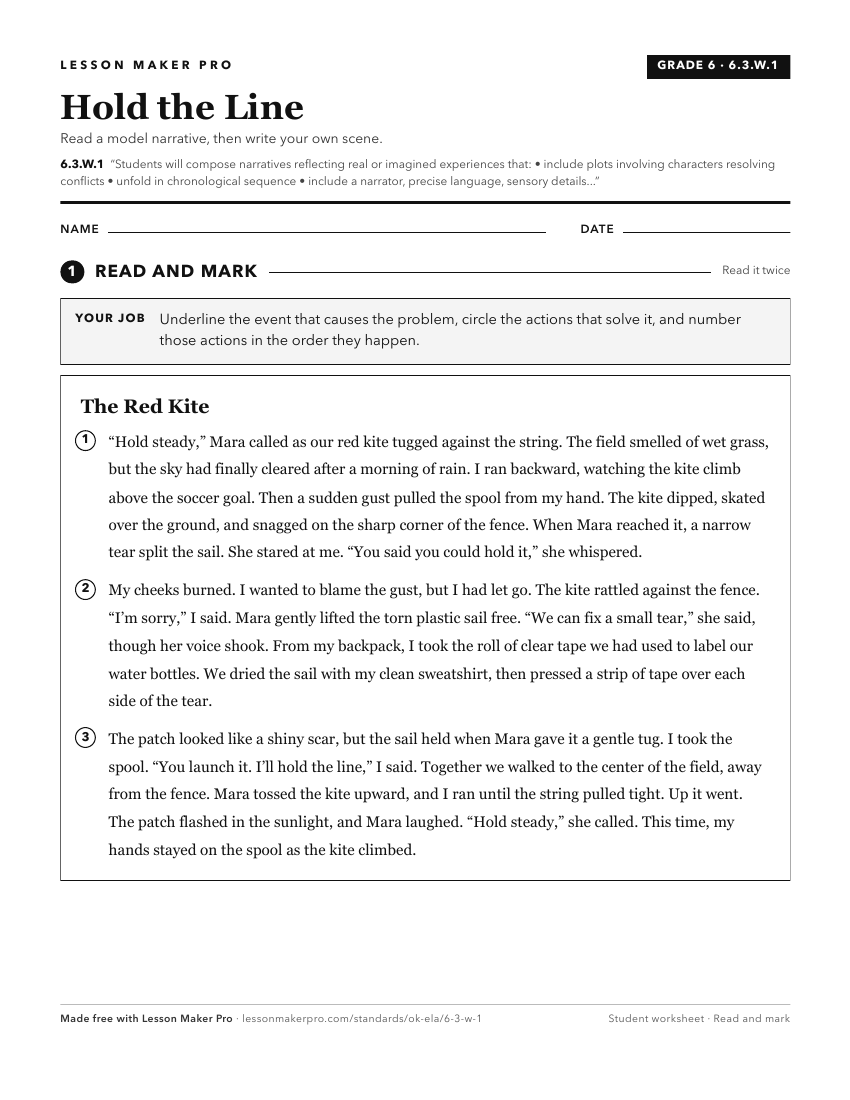
A ready-to-print activity worksheet aligned to 6.3.W.1, with an answer key for the teacher on its own page. No account needed.
PDF, US Letter, prints cleanly in black and white.
Download the worksheetKeep exploring
Related Standards
- 7.3.W.1
Compose narratives reflecting real or imagined experiences that:- include plots involving complex characters resolving conflicts- unfold in chronological or sur...
- 8.3.W.1
Compose narratives reflecting real or imagined experiences that:- include plots involving complex characters resolving conflicts- unfold in chronological or sur...
- 4.3.W.1
Compose narratives reflecting real or imagined experiences that:- include plots with a climax and resolution- include developed characters who overcome conflict...
- 5.3.W.1
Compose narratives reflecting real or imagined experiences that:- include plots with a climax and resolution- include developed characters who overcome conflict...
Turn this exact standard into a lesson
Grade, subject, topic, and the complete standard are prefilled. Create one free, no account needed.
Also for this standard:Make a WorksheetMake a QuizMake a Sub Lesson